Stats
Actions
Available In
Tags

Write, run, and refine promptfoo eval suites for LLM testing, including adversarial red team scans with configurable providers, plugins, and strategies. Automate CI gates and export reports.
Write, refine, run, and QA non-redteam promptfoo eval suites after the target or provider already works: prompts, vars, test cases, assertions, model-graded rubrics, transforms, datasets, output exports, filters, and CI gates. Use for regression tests and eval-suite authoring. Do not use for connecting a new target/provider, mapping HTTP requests or auth, smoke-testing an endpoint, or redteam plugin/strategy setup; use `promptfoo-provider-setup` for connection work instead.
Configure promptfoo providers or redteam targets for hosted models, live HTTP APIs, Python/JavaScript local scripts, agent SDKs, or multi-input systems. Use when connecting promptfoo to the system under test, mapping vars, auth env vars, request bodies, response transforms, or static-code-derived provider wrappers. Do not use for choosing eval assertions or red team plugins unless a smoke test is needed to verify the connection.
Run, rerun, inspect, and QA promptfoo redteam scans from generated redteam YAML or an existing redteam setup config. Use when executing `promptfoo redteam eval` or `promptfoo redteam run`, exporting results, triaging attack success rate, grader failures, target errors, filter/rerun commands, reports, or CI gates. Do not use for initial provider wiring or for choosing plugins and strategies before generation.
Create or refine promptfoo redteam setup configs: purpose, targets, plugins, strategies, frameworks, multi-input target inputs, policy text, grader guidance, contexts, and static-code-derived target/threat mapping. Use when preparing a red team scan plan from live probes, code evidence, or provider configs, or when generating adversarial test cases for QA. Do not use for basic provider wiring alone or for running/evaluating an already-generated redteam scan.
Based on adoption, maintenance, documentation, and repository signals. Not a security audit or endorsement.





promptfoo is a CLI and library for evaluating and red-teaming LLM apps. Stop the trial-and-error approach - start shipping secure, reliable AI apps.
Website · Getting Started · Red Teaming · Documentation · Discord
Promptfoo is now part of OpenAI. Promptfoo remains open source and MIT licensed. Read the company update.
Requires Node.js ^20.20.0 or >=22.22.0 for npm and npx usage.
Node.js 20 support ends July 30, 2026 at 00:00 UTC; upgrade to Node.js 24 LTS before updating promptfoo at or after the cutoff.
npm install -g promptfoo
promptfoo init --example getting-started
Also available via brew install promptfoo and pip install promptfoo. You can also use npx promptfoo@latest to run any command without installing.
Most LLM providers require an API key. Set yours as an environment variable:
export OPENAI_API_KEY=sk-abc123
Once you're in the example directory, run an eval and view results:
cd getting-started
promptfoo eval
promptfoo view
See Getting Started (evals) or Red Teaming (vulnerability scanning) for more.
Here's what it looks like in action:
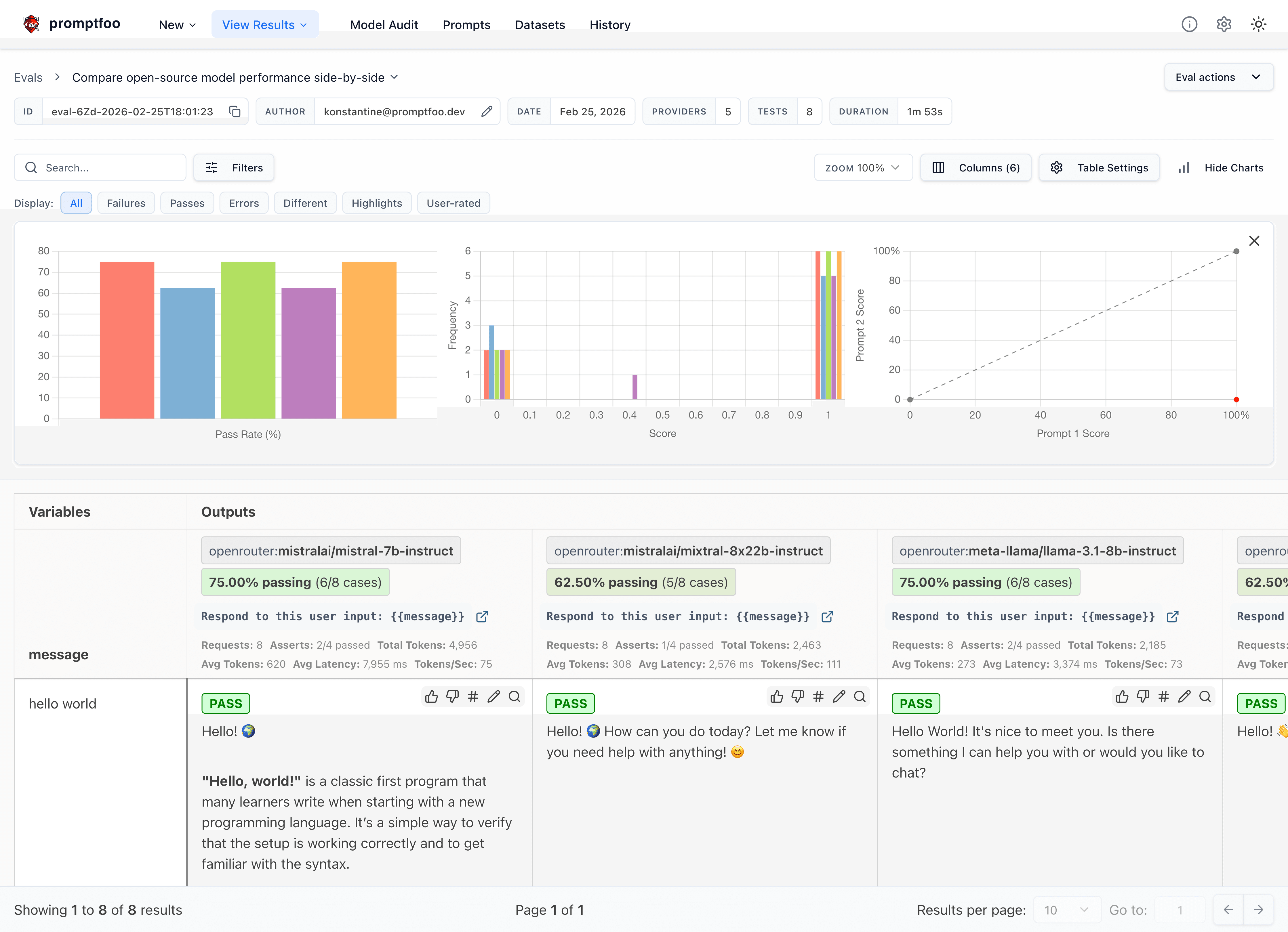
It works on the command line too:

It also can generate security vulnerability reports:
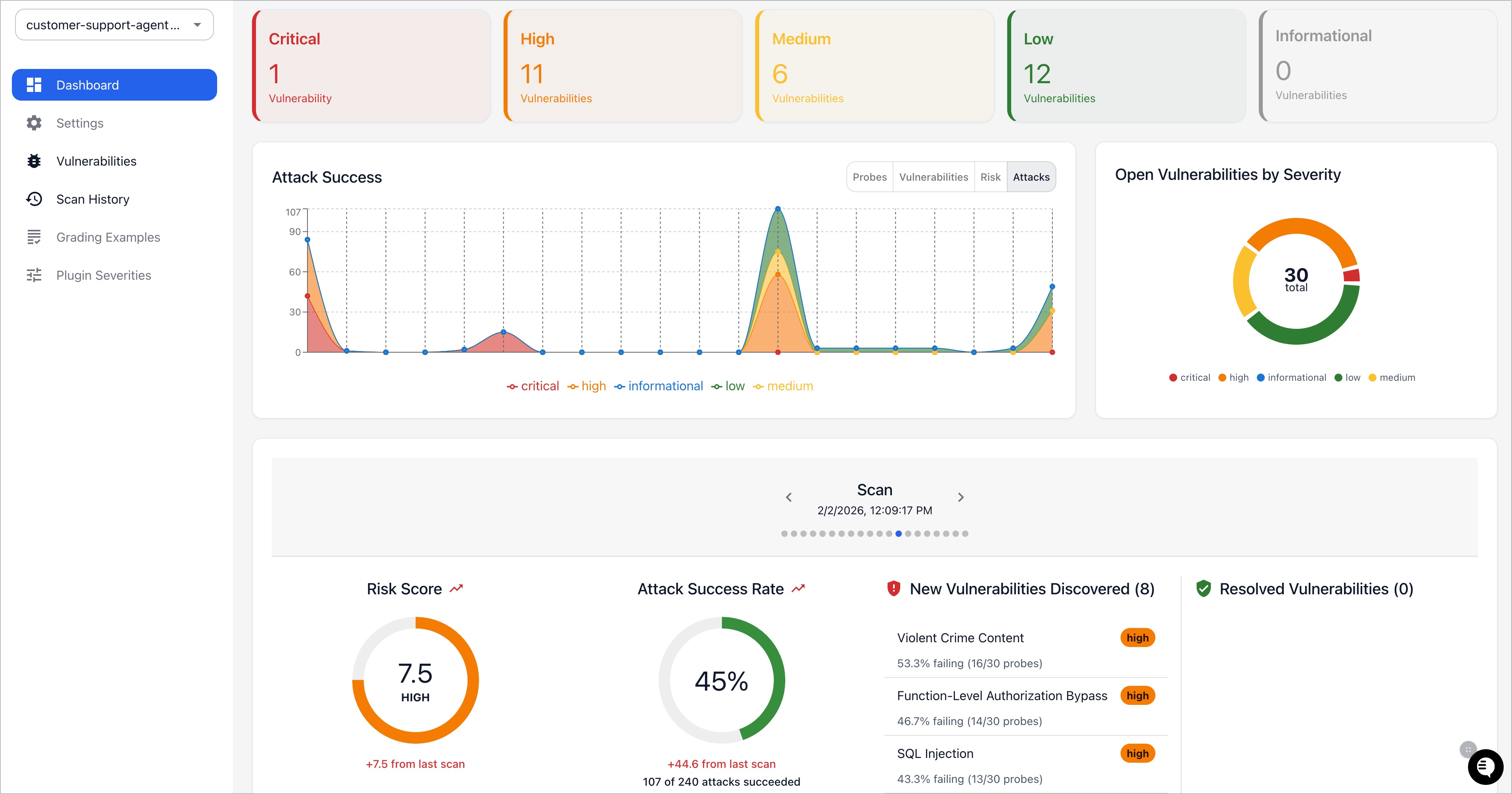
We welcome contributions! Check out our contributing guide to get started.
Join our Discord community for help and discussion.
npx claudepluginhub p/promptfoo-promptfoo-plugins-promptfooTeaches AI coding agents to create promptfoo eval suites with deterministic assertions, provider configs, and best practices
 promptfoo
Teaches AI coding agents to create promptfoo eval suites with deterministic assertions, provider configs, and best practices
promptfooConfigures and runs LLM evaluation using Promptfoo framework. Use when setting up prompt testing, creating evaluation configs (promptfooconfig.yaml), writing Python custom assertions, implementing llm-rubric for LLM-as-judge, or managing few-shot examples in prompts. Triggers on keywords like promptfoo, eval, LLM evaluation, prompt testing, or model comparison
 daymade
Implement comprehensive evaluation strategies for LLM applications using automated metrics, human feedback, and benchmarking. Use when testing LLM performance, measuring AI application quality, or establishing evaluation frameworks.
 wshobson
26 Agent Skills (several with runnable, unit-tested scripts) for building, evaluating, securing, and monitoring reliable LLM & AI-agent apps.
 ContextJet-ai
Skills for adding DeepEval evaluations, tracing, datasets, Confident AI reports, and iterative improvement loops to AI applications.
 confident-ai
Set up evaluation of AI agents with tool call validation, correctness checks, task completion, and tool reliability using Dokimos. Framework-agnostic — works with any agent framework.
 dokimos-dev
'%20stop-opacity%3D'0.16'%2F%3E%3Cstop%20offset%3D'1'%20stop-color%3D'rgb(200%2C90%2C60)'%20stop-opacity%3D'0.03'%2F%3E%3C%2FlinearGradient%3E%3C%2Fdefs%3E%3Crect%20width%3D'320'%20height%3D'200'%20fill%3D'url(%23g)'%2F%3E%3Ccircle%20cx%3D'250'%20cy%3D'56'%20r%3D'92'%20fill%3D'rgb(200%2C90%2C60)'%20fill-opacity%3D'0.06'%2F%3E%3Ccircle%20cx%3D'64'%20cy%3D'172'%20r%3D'58'%20fill%3D'rgb(200%2C90%2C60)'%20fill-opacity%3D'0.05'%2F%3E%3C%2Fsvg%3E)