Stats
Actions
Available In
Tags

Conduct full product discovery cycles in your IDE: brainstorm ideas and experiments for new/existing products from PM/designer/engineer views, identify/prioritize assumptions and features, triage requests, generate interview scripts, summarize transcripts, and design metrics dashboards.
Brainstorm product ideas or experiments from PM, Designer, and Engineer perspectives — for existing or new products
Run a full product discovery cycle — from ideation through assumption mapping to experiment design
Prepare a customer interview script or summarize an interview transcript into structured insights
Design a product metrics dashboard with North Star metric, input metrics, health metrics, and alert thresholds
Analyze, categorize, and prioritize a batch of feature requests from customers or stakeholders
Analyze and prioritize a list of feature requests by theme, strategic alignment, impact, effort, and risk. Use when reviewing customer feature requests, triaging a backlog, or making prioritization decisions.
Design experiments to test assumptions for an existing product — prototypes, A/B tests, spikes, and other low-effort validation methods. Use when validating assumptions, testing feature ideas cheaply, or planning product experiments.
Design lean startup experiments (pretotypes) for a new product. Creates XYZ hypotheses and suggests low-effort validation methods like landing pages, explainer videos, and pre-orders. Use when validating a new product idea, creating pretotypes, or testing market demand.
Brainstorm product ideas for an existing product using multi-perspective ideation from PM, Designer, and Engineer viewpoints. Use when generating new feature ideas, brainstorming solutions for an identified opportunity, or ideating with a product trio.
Brainstorm feature ideas for a new product in initial discovery from PM, Designer, and Engineer perspectives. Use when starting product discovery for a new product, exploring features for a startup idea, or doing initial ideation.
Own this plugin?
Verify ownership to unlock analytics, metadata editing, and a verified badge. GitHub access is read-only (username + org membership).
Sign in to claimOwn this plugin?
Verify ownership to unlock analytics, metadata editing, and a verified badge. GitHub access is read-only (username + org membership).
Sign in to claimBased on adoption, maintenance, documentation, and repository signals. Not a security audit or endorsement.


65 PM skills and 36 chained workflows across 8 plugins. Claude Code, Cowork, and more. From discovery to strategy, execution, launch, and growth.
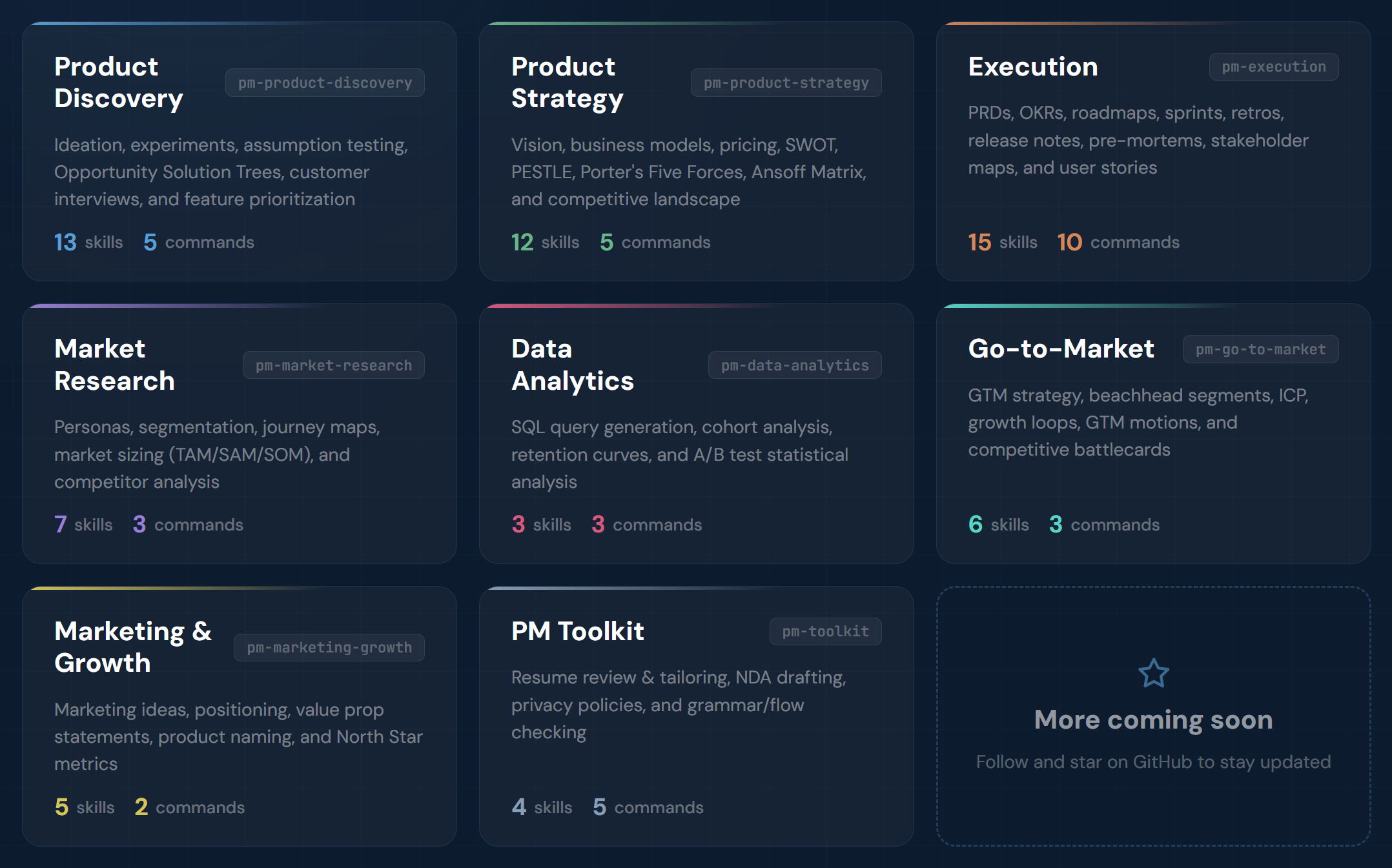
Designed for Claude Code and Cowork. Skills compatible with other AI assistants.
New idea? → /discover
Need strategic clarity? → /strategy
Writing a PRD? → /write-prd
Planning a launch? → /plan-launch
Defining metrics? → /north-star
If this project helps you, ⭐ the repo.
Generic AI gives you text. PM Skills Marketplace gives you structure.
Each skill encodes a proven PM framework — discovery, assumption mapping, prioritization, strategy — and walks you through it step by step. You get the rigor of Teresa Torres, Marty Cagan, and Alberto Savoia built into your daily workflow, not sitting on a bookshelf.
The result: better product decisions, not just faster documents.
Skills are the building blocks of the marketplace. Each skill gives Claude domain knowledge, analytical frameworks, or a guided workflow for a specific PM task. Some skills also work as reusable foundations that multiple commands share.
Skills are loaded automatically when relevant to the conversation — no explicit invocation needed. If needed (e.g., prioritizing skills over general knowledge), you can force loading skills with /plugin-name:skill-name or /skill-name (Claude will add the prefix).
Commands are user-triggered workflows invoked with /command-name. They chain one or more skills into an end-to-end process. For example, /discover chains four skills together: brainstorm-ideas → identify-assumptions → prioritize-assumptions → brainstorm-experiments.
Plugins group related skills and commands into installable packages. Each plugin covers a PM domain — discovery, strategy, execution, and so on. Installing the marketplace gives you all 8 plugins at once.

Commands use skills. Some skills serve multiple commands. Some skills (like prioritization-frameworks or opportunity-solution-tree) are standalone references that Claude draws on whenever relevant — no command needed.
Commands are designed to flow into each other, matching the PM workflow. After any command completes, it suggests relevant next commands — just follow the prompts.
phuryn/pm-skillsAll 8 plugins install automatically. You get both commands (/discover, /strategy, etc.) and skills.
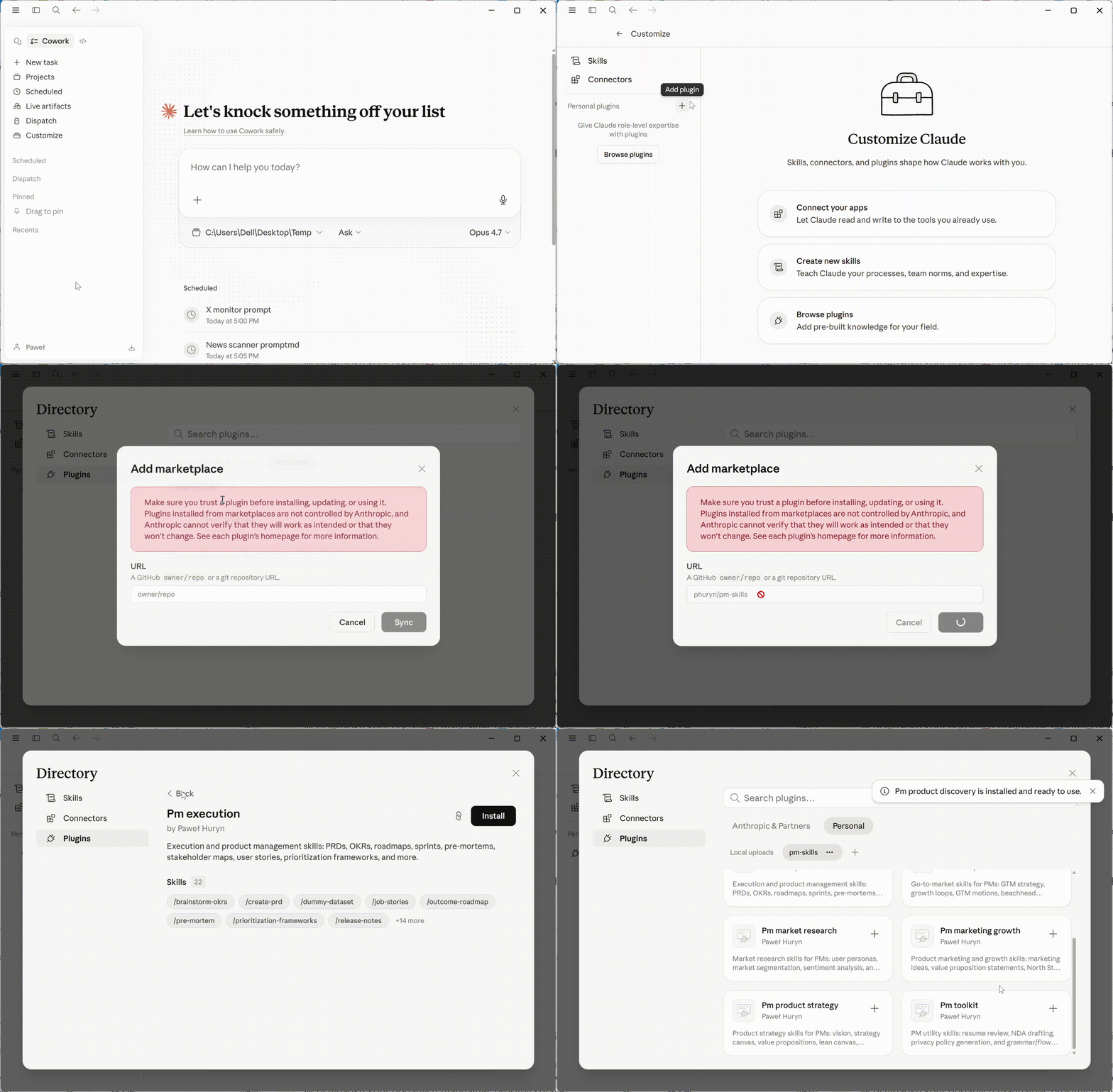
# Step 1: Add the marketplace
claude plugin marketplace add phuryn/pm-skills

# Step 2: Install individual plugins
claude plugin install pm-toolkit@pm-skills
claude plugin install pm-product-strategy@pm-skills
claude plugin install pm-product-discovery@pm-skills
claude plugin install pm-market-research@pm-skills
claude plugin install pm-data-analytics@pm-skills
claude plugin install pm-marketing-growth@pm-skills
claude plugin install pm-go-to-market@pm-skills
claude plugin install pm-execution@pm-skills
The skills/*/SKILL.md files follow the universal skill format and work with any tool that reads it. Commands (/slash-commands) are Claude-specific.
| Tool | How to use | What works |
|---|---|---|
| Gemini CLI | Copy skill folders to .gemini/skills/ | Skills only |
| OpenCode | Copy skill folders to .opencode/skills/ | Skills only |
| Cursor | Copy skill folders to .cursor/skills/ | Skills only |
| Codex CLI | Copy skill folders to .codex/skills/ | Skills only |
| Kiro | Copy skill folders to .kiro/skills/ | Skills only |
# Example: copy all skills for OpenCode (project-level)
for plugin in pm-*/; do
  mkdir -p .opencode/skills/
  cp -r "$plugin/skills/"* .opencode/skills/ 2>/dev/null
done

# Example: copy all skills for Gemini CLI (global)
for plugin in pm-*/; do
  cp -r "$plugin/skills/"* ~/.gemini/skills/ 2>/dev/null
done
Skills (13):
Product strategy skills for PMs: vision, strategy canvas, value propositions, lean canvas, business model canvas, SWOT, PESTLE, Ansoff Matrix, Porter's Five Forces, and monetization.
 phuryn
PM utility skills: resume review, NDA drafting, privacy policy generation, and grammar/flow checking. Essential tools for product managers beyond core product work.
phurynMarket research skills for PMs: user personas, market segmentation, sentiment analysis, and competitive analysis.
phurynData analytics skills for PMs: SQL query generation and cohort analysis. Analyze user data, generate queries, and identify retention patterns.
phurynGo-to-market skills for PMs: GTM strategy, growth loops, GTM motions, beachhead segments, and ideal customer profiles.
phurynnpx claudepluginhub phuryn/pm-skills --plugin pm-product-discoveryPM을 위한 프로덕트 디스커버리 스킬: 아이디에이션, 실험 설계, 가정 검증, 기능 우선순위 결정, 고객 인터뷰 종합.
 lucas-flatwhite
Discovery & research skills: Discovery Interview Guide, Job Story Mapper, User Interview Synthesis, Assumption Mapper. Structure user research from screener to synthesis.
 mohitagw15856
Product management skills — turn messy ideas into specs, design experiments, synthesize research, and draft readouts.
 amplitude
Agent-first PM toolkit with 9 specialist agents and 18 skills for solo developers and small teams
 slgoodrich
Execution and product management skills: PRDs, OKRs, roadmaps, sprints, pre-mortems, stakeholder maps, user stories, prioritization frameworks, and more.
phurynWrite feature specs, plan roadmaps, and synthesize user research faster. Keep stakeholders updated and stay ahead of the competitive landscape.
 anthropics
'%20stop-opacity%3D'0.16'%2F%3E%3Cstop%20offset%3D'1'%20stop-color%3D'rgb(200%2C90%2C60)'%20stop-opacity%3D'0.03'%2F%3E%3C%2FlinearGradient%3E%3C%2Fdefs%3E%3Crect%20width%3D'320'%20height%3D'200'%20fill%3D'url(%23g)'%2F%3E%3Ccircle%20cx%3D'250'%20cy%3D'56'%20r%3D'92'%20fill%3D'rgb(200%2C90%2C60)'%20fill-opacity%3D'0.06'%2F%3E%3Ccircle%20cx%3D'64'%20cy%3D'172'%20r%3D'58'%20fill%3D'rgb(200%2C90%2C60)'%20fill-opacity%3D'0.05'%2F%3E%3C%2Fsvg%3E)
