Stats
Actions
Available In
Tags

Generate PRDs, OKRs, outcome roadmaps, user stories, job stories, sprint plans, release notes, and stakeholder maps. Run pre-mortems for risk analysis, retrospectives for team feedback, prioritization frameworks, meeting summaries, and test scenarios with dummy data to manage agile product execution workflows.
Generate realistic dummy datasets for testing — CSV, JSON, SQL inserts, or Python scripts
Summarize a meeting transcript into structured notes with decisions, action items, and follow-ups
Brainstorm team-level OKRs aligned with company objectives — qualitative objectives with measurable key results
Run a pre-mortem risk analysis on a PRD, launch plan, or feature — identify what could go wrong before it does
Map stakeholders on a Power × Interest grid and create a tailored communication plan
Brainstorm team-level OKRs aligned with company objectives — qualitative objectives with measurable key results. Use when setting quarterly OKRs, aligning team goals with company strategy, drafting objectives, or learning how to write effective OKRs.
Create a Product Requirements Document using a comprehensive 8-section template covering problem, objectives, segments, value propositions, solution, and release planning. Use when writing a PRD, documenting product requirements, preparing a feature spec, or reviewing an existing PRD.
Generate realistic dummy datasets for testing with customizable columns, constraints, and output formats (CSV, JSON, SQL, Python script). Use when creating test data, building mock datasets, or generating sample data for development and demos.
Create job stories using the 'When [situation], I want to [motivation], so I can [outcome]' format with detailed acceptance criteria. Use when writing job stories, creating JTBD-style backlog items, or expressing user situations and motivations.
Transform an output-focused roadmap into an outcome-focused one that communicates strategic intent. Rewrites initiatives as outcome statements reflecting user and business impacts. Use when shifting to outcome roadmaps, making a roadmap more strategic, or rewriting feature lists as outcomes.
Own this plugin?
Verify ownership to unlock analytics, metadata editing, and a verified badge. GitHub access is read-only (username + org membership).
Sign in to claimOwn this plugin?
Verify ownership to unlock analytics, metadata editing, and a verified badge. GitHub access is read-only (username + org membership).
Sign in to claimBased on adoption, maintenance, documentation, and repository signals. Not a security audit or endorsement.


65 PM skills and 36 chained workflows across 8 plugins. Claude Code, Cowork, and more. From discovery to strategy, execution, launch, and growth.
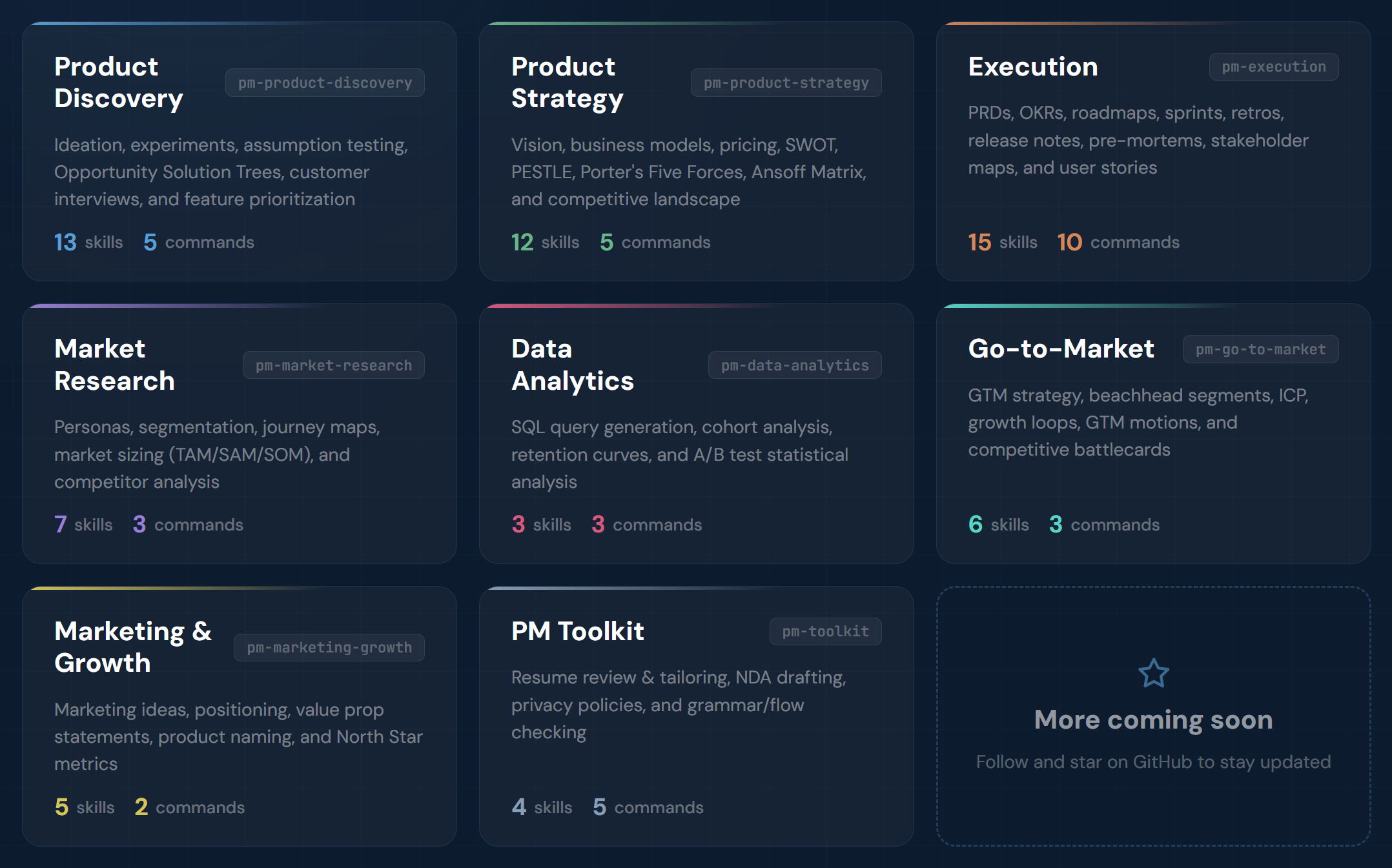
Designed for Claude Code and Cowork. Skills compatible with other AI assistants.
New idea? → /discover
Need strategic clarity? → /strategy
Writing a PRD? → /write-prd
Planning a launch? → /plan-launch
Defining metrics? → /north-star
If this project helps you, ⭐ the repo.
Generic AI gives you text. PM Skills Marketplace gives you structure.
Each skill encodes a proven PM framework — discovery, assumption mapping, prioritization, strategy — and walks you through it step by step. You get the rigor of Teresa Torres, Marty Cagan, and Alberto Savoia built into your daily workflow, not sitting on a bookshelf.
The result: better product decisions, not just faster documents.
Skills are the building blocks of the marketplace. Each skill gives Claude domain knowledge, analytical frameworks, or a guided workflow for a specific PM task. Some skills also work as reusable foundations that multiple commands share.
Skills are loaded automatically when relevant to the conversation — no explicit invocation needed. If needed (e.g., prioritizing skills over general knowledge), you can force loading skills with /plugin-name:skill-name or /skill-name (Claude will add the prefix).
Commands are user-triggered workflows invoked with /command-name. They chain one or more skills into an end-to-end process. For example, /discover chains four skills together: brainstorm-ideas → identify-assumptions → prioritize-assumptions → brainstorm-experiments.
Plugins group related skills and commands into installable packages. Each plugin covers a PM domain — discovery, strategy, execution, and so on. Installing the marketplace gives you all 8 plugins at once.

Commands use skills. Some skills serve multiple commands. Some skills (like prioritization-frameworks or opportunity-solution-tree) are standalone references that Claude draws on whenever relevant — no command needed.
Commands are designed to flow into each other, matching the PM workflow. After any command completes, it suggests relevant next commands — just follow the prompts.
phuryn/pm-skillsAll 8 plugins install automatically. You get both commands (/discover, /strategy, etc.) and skills.
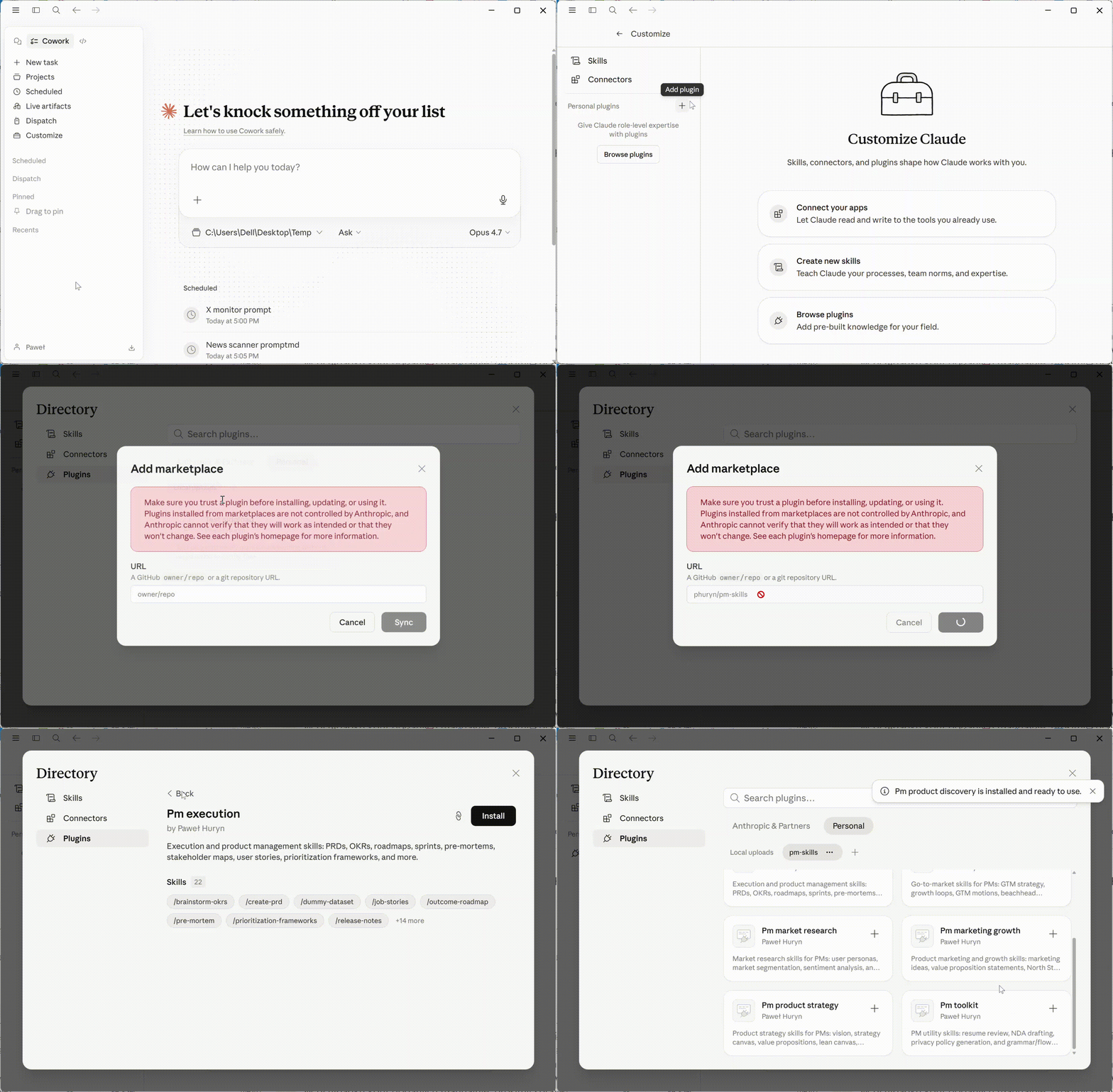
# Step 1: Add the marketplace
claude plugin marketplace add phuryn/pm-skills

# Step 2: Install individual plugins
claude plugin install pm-toolkit@pm-skills
claude plugin install pm-product-strategy@pm-skills
claude plugin install pm-product-discovery@pm-skills
claude plugin install pm-market-research@pm-skills
claude plugin install pm-data-analytics@pm-skills
claude plugin install pm-marketing-growth@pm-skills
claude plugin install pm-go-to-market@pm-skills
claude plugin install pm-execution@pm-skills
The skills/*/SKILL.md files follow the universal skill format and work with any tool that reads it. Commands (/slash-commands) are Claude-specific.
| Tool | How to use | What works |
|---|---|---|
| Gemini CLI | Copy skill folders to .gemini/skills/ | Skills only |
| OpenCode | Copy skill folders to .opencode/skills/ | Skills only |
| Cursor | Copy skill folders to .cursor/skills/ | Skills only |
| Codex CLI | Copy skill folders to .codex/skills/ | Skills only |
| Kiro | Copy skill folders to .kiro/skills/ | Skills only |
# Example: copy all skills for OpenCode (project-level)
for plugin in pm-*/; do
  mkdir -p .opencode/skills/
  cp -r "$plugin/skills/"* .opencode/skills/ 2>/dev/null
done

# Example: copy all skills for Gemini CLI (global)
for plugin in pm-*/; do
  cp -r "$plugin/skills/"* ~/.gemini/skills/ 2>/dev/null
done
Skills (13):
npx claudepluginhub phuryn/pm-skills --plugin pm-executionProduct strategy skills for PMs: vision, strategy canvas, value propositions, lean canvas, business model canvas, SWOT, PESTLE, Ansoff Matrix, Porter's Five Forces, and monetization.
 phuryn
PM utility skills: resume review, NDA drafting, privacy policy generation, and grammar/flow checking. Essential tools for product managers beyond core product work.
phurynMarket research skills for PMs: user personas, market segmentation, sentiment analysis, and competitive analysis.
phurynData analytics skills for PMs: SQL query generation and cohort analysis. Analyze user data, generate queries, and identify retention patterns.
phurynGo-to-market skills for PMs: GTM strategy, growth loops, GTM motions, beachhead segments, and ideal customer profiles.
phuryn실행 및 제품 관리 스킬: PRD, OKR, 로드맵, 스프린트, 프리모템, 이해관계자 맵, 사용자 스토리, 우선순위 프레임워크 등.
 lucas-flatwhite
Planning & strategy skills: OKR Builder, Feature Prioritisation (RICE/MoSCoW/Kano/ICE), Roadmap Presentation, Pricing Strategy, RICE + Impact Matrix, Roadmap Narrative.
 mohitagw15856
Business and product skills for PRDs, user stories, client proposals, competitor analysis, feature prioritization, and stakeholder updates.
 heaptracetechnology
Write feature specs, plan roadmaps, and synthesize user research faster. Keep stakeholders updated and stay ahead of the competitive landscape.
 anthropics
The Product Manager's Operating System. AI-powered skills for every PM workflow: PRDs, prioritization, competitive intel, stakeholder updates, launch planning, and more.
 shaan-ad
Product discovery skills for PMs: ideation, experiments, assumption testing, feature prioritization, and customer interview synthesis.
phuryn'%20stop-opacity%3D'0.16'%2F%3E%3Cstop%20offset%3D'1'%20stop-color%3D'rgb(200%2C90%2C60)'%20stop-opacity%3D'0.03'%2F%3E%3C%2FlinearGradient%3E%3C%2Fdefs%3E%3Crect%20width%3D'320'%20height%3D'200'%20fill%3D'url(%23g)'%2F%3E%3Ccircle%20cx%3D'250'%20cy%3D'56'%20r%3D'92'%20fill%3D'rgb(200%2C90%2C60)'%20fill-opacity%3D'0.06'%2F%3E%3Ccircle%20cx%3D'64'%20cy%3D'172'%20r%3D'58'%20fill%3D'rgb(200%2C90%2C60)'%20fill-opacity%3D'0.05'%2F%3E%3C%2Fsvg%3E)
