Stats
Actions
Available In
Tags

Turns Claude Code conversation JSONL transcripts into polished, first-person blog posts via a 5-stage interactive pipeline: parse, triage, outline, draft, polish — with human editorial gates at each step.
Use this agent to create a structured blog post outline from a chosen story angle. This agent reads the full event stream (including relevant subagent content), the author's chosen angle, and any editorial notes, then produces a section-by-section outline with beat treatments, key quotes, and word count estimates. <example> Context: The triage stage is complete, the author has chosen an angle and provided notes user: "Go with the process angle. The brainstorming skill was built in a prior session." assistant: "I'll create a structured outline for the process angle, incorporating your context." <commentary> Stage 3 of the retell pipeline. The outline architect receives the chosen angle, author context, and the full event stream (with relevant subagent content loaded). It structures the post without writing prose. </commentary> </example> <example> Context: Author wants a different structure after seeing the first outline user: "Move section 3 before section 2 and make the rejection a flashback" assistant: "I'll restructure the outline with your changes." <commentary> The outline architect can revise outlines based on author feedback before handing off to the draft stage. </commentary> </example>
Use this agent to assess whether a parsed conversation is blog-worthy and to generate story angle recommendations. This agent reads events.json (the extracted signal from a Claude Code conversation) and outputs a structured triage report with angles, a recommendation, a timeline, and context questions for the author. <example> Context: The retell command has run the parser and produced events.json and manifest.json user: "Turn conversation 8c439a20 into a blog post" assistant: "The parser extracted 82 events. Let me analyze the conversation for story angles." <commentary> Stage 2 of the retell pipeline. The triage agent reads the main conversation signal (no subagent content) and assesses blog-worthiness before committing to the expensive outline and draft stages. </commentary> </example> <example> Context: User wants to know if a conversation has a good story in it user: "Is this conversation worth writing about?" assistant: "I'll use the triage analyst to assess the narrative potential." <commentary> The triage agent can be used standalone to quickly check if a conversation has blog potential before running the full pipeline. </commentary> </example>
This skill should be used when parsing Claude Code conversation files, reading conversation history, working with ".jsonl" conversation transcripts, extracting signal from conversation data, filtering noise entries, linking subagent files, detecting session boundaries, or understanding the Claude Code conversation storage format. Provides the JSONL schema, entry types, content block extraction rules, user message filtering logic, and subagent linking patterns needed by the retell pipeline.
This skill should be used when writing a blog post from conversation data, identifying story arcs in human-AI collaboration, structuring narrative beats, choosing story angles, handling user quotes, or applying editorial principles to conversation-derived content. Covers first-person voice constraints, five-act structure mapping, beat-to-treatment classification, and blog-worthiness heuristics specific to the retell pipeline.
Uses power tools
Uses Bash, Write, or Edit tools
Own this plugin?
Verify ownership to unlock analytics, metadata editing, and a verified badge. GitHub access is read-only (username + org membership).
Sign in to claimOwn this plugin?
Verify ownership to unlock analytics, metadata editing, and a verified badge. GitHub access is read-only (username + org membership).
Sign in to claimBased on adoption, maintenance, documentation, and repository signals. Not a security audit or endorsement.


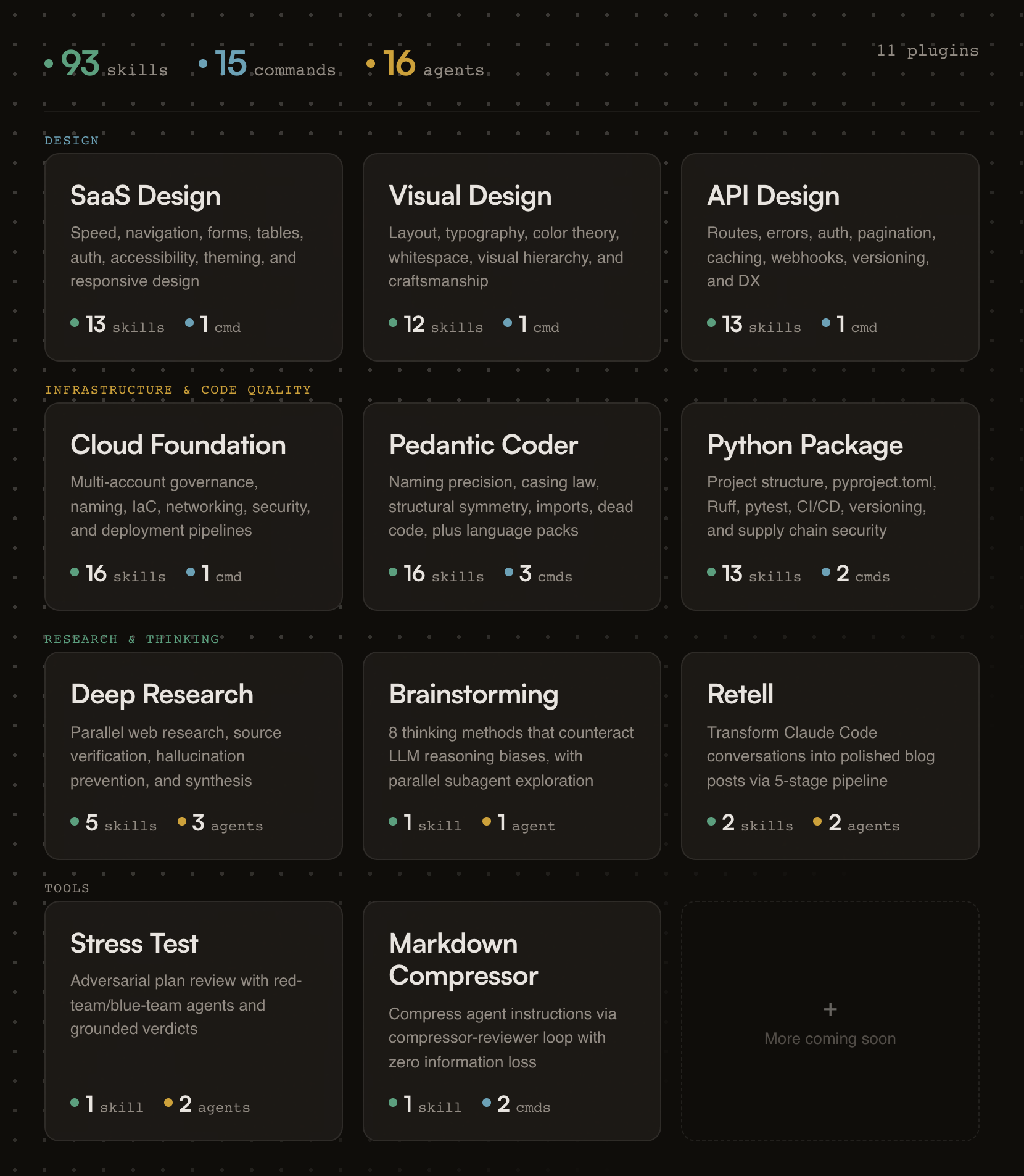
93 skills, 15 commands, and 16 agents across 11 plugins. Opinionated, research-backed Claude Code plugins for building SaaS products that ship.
Designed for Claude Code and Cowork. Skills compatible with other AI assistants.
Building a form? Skills activate automatically.
Need an API review? /api-review
Auditing code quality? /pedantic-review
Researching a topic? /research "your question"
Stress-testing a plan? /stress-test path/to/plan.md
Compressing your CLAUDE.md? /compress path/to/file.md
If this project helps you, star the repo.
Generic AI gives you suggestions. fractional-cto gives you standards.
Each skill encodes a proven engineering principle (naming precision, API design patterns, cloud governance) and enforces it the moment Claude detects relevant work. You get the rigor of Stripe's API design, Nielsen Norman's usability research, and production cloud architecture baked into every session. No bookshelf required.
The skills are deliberately opinionated. They don't present five options and ask you to choose. They tell you what to do, cite why, and show you the code. If you disagree, edit the skill. It's just markdown.
Every plugin activates the moment your Claude session starts. A session hook fires, reads the plugin's skill index, and injects it into context. From that point on, Claude knows what principles exist and when to apply them.
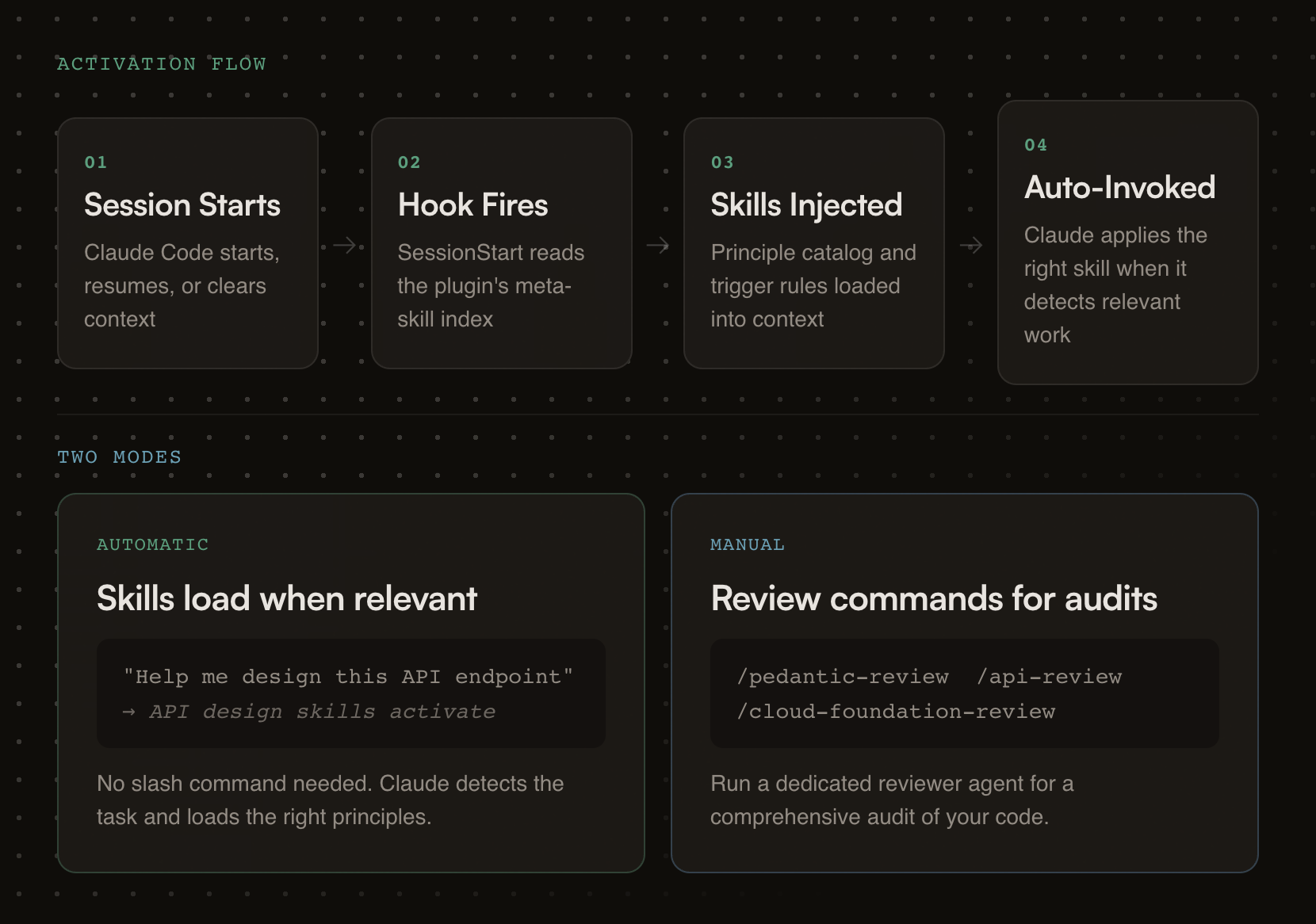
Each plugin carries review checklists, good/bad pattern comparisons, working code examples, and a dedicated reviewer agent for deeper audits.
# Step 1: Add the marketplace
/plugin marketplace add oborchers/fractional-cto

# Step 2: Install individual plugins
/plugin install saas-design-principles@fractional-cto
/plugin install visual-design-principles@fractional-cto
/plugin install api-design-principles@fractional-cto
/plugin install cloud-foundation-principles@fractional-cto
/plugin install pedantic-coder@fractional-cto
/plugin install python-package@fractional-cto
/plugin install deep-research@fractional-cto
/plugin install structured-brainstorming@fractional-cto
/plugin install retell@fractional-cto
/plugin install stress-test@fractional-cto
/plugin install markdown-compressor@fractional-cto
The skills/*/SKILL.md files follow the universal skill format and work with any tool that reads it. Commands and agents are Claude-specific.
| Tool | How to use | What works |
|---|---|---|
| Gemini CLI | Copy skill folders to .gemini/skills/ | Skills only |
| OpenCode | Copy skill folders to .opencode/skills/ | Skills only |
| Cursor | Copy skill folders to .cursor/skills/ | Skills only |
| Codex CLI | Copy skill folders to .codex/skills/ | Skills only |
| Kiro | Copy skill folders to .kiro/skills/ | Skills only |
# Example: copy all skills for Gemini CLI (project-level)
for plugin in */; do
  [ -d "$plugin/skills" ] && cp -r "$plugin/skills/"* .gemini/skills/ 2>/dev/null
done
claude --plugin-dir /path/to/fractional-cto/<plugin-name>
Research-backed SaaS design principles drawn from Linear, Stripe, Shopify Polaris, and Nielsen Norman Group research.
Skills (13):
npx claudepluginhub oborchers/fractional-cto --plugin retellManage Claude Code's plan-mode artifacts, author multi-phase master planning documents, walk through Open Questions interactively, and synthesize dense progress entries to markdown / Linear / GitHub. Provides /plan-context (pre-load with optional ticket fetch), /plan-master (draft with optional ticket fetch), /plan-open-questions (interactive Open-Questions walkthrough with batch apply), /plan-verify (audit), /plan-tick (auto-tick provenly-achieved phases), /plan-progress (per-branch progress entry with SHA-based idempotency), and /plan-delete (per-session cleanup). Integer-only phases, no sizing, project-agnostic.
 oborchers
Chain work across two independent agent processes that share no parent session. One agent passes a baton (a completion signal file) when done, optionally carrying a free-form payload; another waits for it, with a deadline, then starts its dependent task. Harness-agnostic protocol — each agent picks its own waiting mechanism. The baton tells you when, never what: the payload is content, not instructions. Provides /baton-pass and /baton-wait.
oborchersThe holy principles of SaaS design: research-backed, opinionated guidance for building fast, predictable, and progressively powerful SaaS products
oborchersResearch-backed, opinionated guidance for designing world-class RESTful APIs — routes, naming, errors, auth, caching, webhooks, and more, distilled from Stripe, GitHub, Twilio, Shopify, Google, and Microsoft
oborchersAdversarial plan review using red-team/blue-team agents -- generates what-if questions and grounds answers in plan artifacts with configurable tool scope
oborchersPersonal AI agent skills — technical Slidev presentations, courses, marketing content (brief, blog, social, newsletter), changelogs, architecture impact docs, and rendered promo videos. Built for Claude Code, Copilot, Codex, Gemini & Cursor.
 AlemTuzlak
Write technical blog posts, tutorials, and documentation with Flatiron School's engaging teaching style. Turn complex topics into clear narratives.
 aviflombaum
Process skill for turning raw project data (research notes, session logs, drafts, code) into structured technical blog posts. Covers gathering, extraction, structure, and Astro frontmatter.
 sam-dumont
Technical content generation for blog posts and social media
 rohitg00
Create publication-ready technical articles and social media posts (LinkedIn, Instagram, X/Twitter) with author voice profiles, web research, runnable code examples, and multi-language output. Supports interactive single-article creation, social media post generation, or autonomous batch processing from a task queue.
 mwguerra
Research-backed writing toolkit: anti-AI prose principles, iterative review loop, author voice capture, and voice-matched content generation
 doodledood
'%20stop-opacity%3D'0.16'%2F%3E%3Cstop%20offset%3D'1'%20stop-color%3D'rgb(200%2C90%2C60)'%20stop-opacity%3D'0.03'%2F%3E%3C%2FlinearGradient%3E%3C%2Fdefs%3E%3Crect%20width%3D'320'%20height%3D'200'%20fill%3D'url(%23g)'%2F%3E%3Ccircle%20cx%3D'250'%20cy%3D'56'%20r%3D'92'%20fill%3D'rgb(200%2C90%2C60)'%20fill-opacity%3D'0.06'%2F%3E%3Ccircle%20cx%3D'64'%20cy%3D'172'%20r%3D'58'%20fill%3D'rgb(200%2C90%2C60)'%20fill-opacity%3D'0.05'%2F%3E%3C%2Fsvg%3E)
