Stats
Actions
Available In
Tags
Signal Intelligence - Comprehensive market research toolkit with report generation, GitHub issue creation, and trend-based analysis using three-valued logic
Deep-dive into a specific area of current research
Adversarially falsify research findings via web-only disconfirming search; quarantine, downgrade, or annotate findings based on verdicts
Manually initialize the research context for sigint.
Load and execute the `sigint:issues` skill with these arguments: $ARGUMENTS
Generate comprehensive research report in multiple formats
Use this agent for focused research on a single market dimension (competitive, sizing, trends, customer, tech, financial, regulatory). Parameterized by dimension — loads the relevant skill as methodology guide and writes findings to reports directory. Examples: <example> Context: Orchestrator spawning parallel analysts user: "Analyze the competitive landscape for AI code review tools" assistant: "I'll launch a dimension-analyst focused on competitive analysis, using the competitive-analysis skill methodology." <commentary> Single-dimension research with skill-guided methodology. </commentary> </example> <example> Context: User augmenting research with a deep dive user: "/sigint:augment competitive" assistant: "I'll spawn a dimension-analyst for competitive analysis to deep-dive into this area." <commentary> The augment command delegates to a single dimension-analyst. </commentary> </example>
Use this agent to perform adversarial falsification of sigint research findings. The agent treats each finding as a hypothesis under test, generates targeted disconfirming queries, executes web-only adversarial search, assigns a verdict (falsified | weakened | survived | inconclusive), and writes per-claim falsification attempts plus a session-level falsification report. The skill orchestrating this agent (`sigint:falsify`) handles remediation actions (quarantine, confidence downgrade, follow-up queue). <example> Context: An active research session has produced findings and the user wants adversarial review before report generation. user: "Falsify the findings before we generate the report" assistant: "I'll spawn the falsification-analyst to attempt to disconfirm each finding via web-only adversarial search and produce a per-claim verdict with cited disconfirming evidence." <commentary> Adversarial assessment of findings is this agent's purpose. </commentary> </example> <example> Context: A specific finding looks overconfident. user: "Try to break finding f_competitive_3" assistant: "I'll launch the falsification-analyst scoped to that single claim — generate negation queries, fetch sources, and assign a verdict." </example>
Use this agent when converting research findings, recommendations, or analysis into actionable GitHub issues. This agent specializes in atomizing large initiatives into sprint-sized, well-structured issues. Examples: <example> Context: Research has been completed and user wants action items user: "Convert these market research findings into GitHub issues" assistant: "I'll use the issue-architect agent to analyze the findings and create sprint-sized issues with proper categorization, acceptance criteria, and context." <commentary> User explicitly wants to convert findings to issues, triggering the issue architect. </commentary> </example> <example> Context: User has a report with recommendations user: "Create issues from the recommendations in this report" assistant: "I'll launch the issue-architect agent to extract recommendations and structure them as actionable GitHub issues." <commentary> Converting recommendations to issues is core functionality of this agent. </commentary> </example> <example> Context: After completing research, proactively suggest issue creation user: "That analysis was great, what should we do next?" assistant: "Now that the research is complete, I can use the issue-architect agent to convert the key findings and recommendations into sprint-sized GitHub issues for your team to act on." <commentary> Proactively suggesting issue creation after research completion. </commentary> </example> <example> Context: User wants to track competitive gaps user: "Track these competitive feature gaps as issues" assistant: "I'll use the issue-architect agent to create feature request issues for each competitive gap, with market context and acceptance criteria." <commentary> Converting competitive gaps into trackable feature requests. </commentary> </example>
Use this agent when generating formal research reports from collected findings. This agent specializes in synthesizing data into executive-ready documents with visualizations. Examples: <example> Context: Research is complete and user wants a report user: "Generate a report from my market research" assistant: "I'll use the report-synthesizer agent to create a comprehensive report with executive summary, visualizations, and all standard sections." <commentary> User wants a formal report from research findings. </commentary> </example> <example> Context: User needs presentation materials user: "Create an executive summary of the competitive analysis" assistant: "I'll launch the report-synthesizer agent to create an executive-focused summary with key insights and strategic recommendations." <commentary> Executive summary is a key report component this agent produces. </commentary> </example> <example> Context: User wants specific report format user: "Generate the research report in both markdown and HTML" assistant: "I'll use the report-synthesizer agent to generate the report in multiple formats with proper styling and embedded visualizations." <commentary> Multi-format report generation is a specialty of this agent. </commentary> </example> <example> Context: After research completion user: "I think we have enough data now" assistant: "With the research data collected, I can use the report-synthesizer agent to compile everything into a formal report. Would you like the full comprehensive report or a targeted summary?" <commentary> Proactively suggesting report generation when research appears complete. </commentary> </example>
Orchestrator agent for sigint research sessions. Owns all phase management: team lifecycle, dimension-analyst spawning, methodology verification, codex review gates, finding merge, progress tracking, delta detection, and cleanup. Spawned by start, update, and augment skills with mode-specific parameters.
Deep-dive into a specific area of current research. Orchestrates a single dimension-analyst using full swarm pattern (TeamCreate, TaskCreate, SendMessage). Use when the user wants to augment current research with deeper analysis of a specific area.
This skill should be used when the user asks to "analyze competitors", "map competitive landscape", "Porter's 5 Forces analysis", "competitor comparison", "competitive positioning", "identify competitors", "competitive intelligence", or needs guidance on competitor research methodology, market positioning analysis, or competitive strategy frameworks.
This skill should be used when the user asks to "understand customers", "customer research", "user personas", "customer needs analysis", "buyer journey mapping", "voice of customer", "customer segmentation", "user research", or needs guidance on customer discovery methodologies, persona development, or understanding buyer behavior.
Adversarial falsification of sigint research findings. Generates disconfirming queries, executes web-only adversarial search, assigns ordinal verdicts (falsified | weakened | survived | inconclusive), and applies remediation (quarantine, confidence downgrade, follow-up queue). Invocable standalone via `/sigint:falsify` or as Phase 3.6 gate inside the research-orchestrator before report finalization. Use when the user invokes /sigint:falsify.
This skill should be used when the user asks to "analyze financials", "revenue model", "unit economics", "pricing analysis", "cost structure", "profitability analysis", "financial projections", "business model economics", or needs guidance on financial metrics, revenue analysis, or economic viability assessment.
Uses power tools
Uses Bash, Write, or Edit tools
Own this plugin?
Verify ownership to unlock analytics, metadata editing, and a verified badge. GitHub access is read-only (username + org membership).
Sign in to claimOwn this plugin?
Verify ownership to unlock analytics, metadata editing, and a verified badge. GitHub access is read-only (username + org membership).
Sign in to claimBased on adoption, maintenance, documentation, and repository signals. Not a security audit or endorsement.


Comprehensive market research toolkit for Claude Code with report generation, GitHub issue creation, and trend-based analysis.
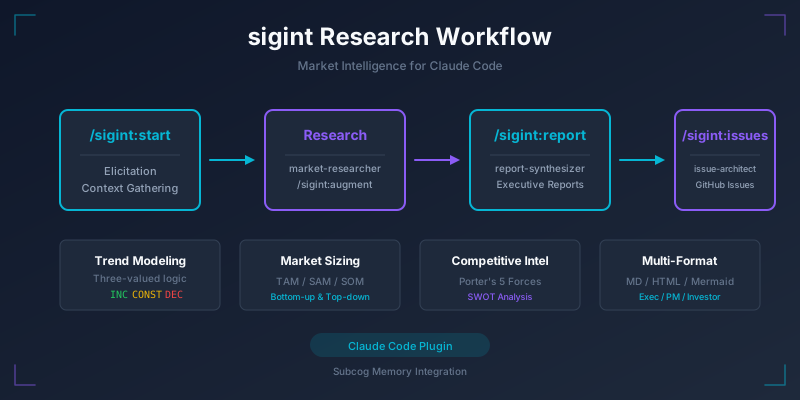
# 1. Start research with a topic
/sigint:start AI-powered code review tools

# 2. Answer elicitation questions (decision context, audience, priorities)

# 3. Check progress
/sigint:status

# 4. Generate report
/sigint:report

# 5. Create GitHub issues (optional)
/sigint:issues
See the Getting Started Tutorial for a detailed walkthrough.
# Option 1: Plugin Marketplace (recommended)
/plugins add sigint

# Option 2: Local development
claude --plugin-dir /path/to/sigint

# Option 3: Manual install to plugins directory
cp -r sigint ~/.claude/plugins/
For organization-wide deployment and detailed setup, see the Cowork deployment guide.
| Command | Description |
|---|---|
/sigint:start <topic> | Begin new research session |
/sigint:augment <area> | Deep-dive into specific area |
/sigint:update | Refresh existing research data |
/sigint:report | Generate comprehensive report |
/sigint:falsify | Adversarially falsify findings (web-only disconfirming search) and remediate (quarantine, downgrade, queue followups) |
/sigint:issues | Create GitHub issues from findings |
/sigint:resume | Resume previous research session |
/sigint:status | Show current research state |
/sigint:init | Initialize plugin configuration |
falsified/weakened/survived/inconclusive)Each skill teaches AND executes the methodology:
Reports include:
./reports/
├── README.md                   # Master index of all research
└── topic-name/
    ├── README.md               # Topic research index
    ├── state.json
    ├── YYYY-MM-DD-research.md
    ├── YYYY-MM-DD-report.md
    ├── YYYY-MM-DD-report.html
    ├── YYYY-MM-DD-falsification-report.md
    ├── YYYY-MM-DD-falsification-report.json
    ├── YYYY-MM-DD-falsification-followups.json
    └── YYYY-MM-DD-issues.json
npx claudepluginhub zircote-plugins/sigintMulti-agent orchestration for Claude Code. Coordinate teams of agents with shared tasks, messaging, and 7 proven patterns including RLM for large-file analysis beyond context limits.
 zircote-plugins
Software Development Lifecycle standards and requirements for project quality, security, and compliance
zircote-pluginsComplete lifecycle management for Architectural Decision Records (ADRs): create, update, supersede, search, audit compliance, and export
zircote-pluginsVerify and enforce use of latest stable library and package versions using live documentation lookups. Prevents outdated version recommendations, security vulnerabilities from stale dependencies, and deprecated API usage across 13+ package ecosystems.
zircote-pluginsComprehensive documentation management: review, create, update, and maintain high-quality documentation with Diataxis framework support
zircote-pluginsResearch, search, and analysis specialists - market research, competitive analysis, trend forecasting, and idea validation
 VoltAgent
Generate format-controlled research reports with evidence tracking, source governance, and multi-pass synthesis. V6.1 adds: source accessibility (circular verification forbidden, exclusive advantage encouraged). Enterprise Research Mode: six-dimension data collection, SWOT/barrier/risk frameworks, and three-level quality control for company research
 daymade
8つの専門エージェント(市場規模分析・トレンド調査・競合インテリジェンス・投資シグナル・日本市場・ユーザー需要分析・規制調査・データ検証)が ディスカッション型でアプリ/デジタルプロダクトの市場調査を実施するスキル。 エージェント同士が対話・批判し合い、data-critic がライブモデレーターとして矛盾を検出・収束を判定する。 トライアンギュレーション(データ・方法論・調査者・理論の4種類)をディスカッションに組み込み、 確証バイアスを排除した信頼度付きレポートを出力する。 Gate 1(全員参加の合意形成)→ Gate 2(最終検証 + Devil's Advocate)の2段階ゲートで品質を担保。 コンテキストファイルで過去のセッションを引き継げる。 Use when: 市場調査をしたい、TAM/SAM/SOMを算出したい、市場の成長性を調べたい、 参入タイミングを判断したい、競合市場を分析したい、規制リスクを調べたい。 Triggers: "市場調査", "market research", "TAM", "SAM", "SOM", "市場規模", "市場分析", "market analysis", "参入", "market entry", "市場性", "market viability", "市場トレンド", "market trend" (addBlockedBy は設定しない。Phase 1 エージェントと同時起動し、ライブモデレートする)
 sean-sunagaku
Claude Skills collection for market research, equity research, and investment analysis. Includes: verifying, topic-brief, analyst-research (3 modes: light/medium/heavy), local-vault (local Markdown knowledge base — file conversion + disciplined retrieval). | 市场研究 / 投研 / 行业分析 Claude Skills 合集。当前包含:verifying(信息核实)、topic-brief(主题观察简报生成器)、analyst-research(三档研究工作流:light/medium/heavy)、local-vault(本地 Markdown 知识库:文件转换 + 检索)
 genli-ai
Ultra-compressed communication mode. Cuts 65% of output tokens (measured) while keeping full technical accuracy by speaking like a caveman.
 JuliusBrussee
Multi-model consensus engine integrating OpenAI Codex CLI, Gemini CLI, and Claude CLI for collaborative code review and problem-solving.
 xrf9268-hue
'%20stop-opacity%3D'0.16'%2F%3E%3Cstop%20offset%3D'1'%20stop-color%3D'rgb(200%2C90%2C60)'%20stop-opacity%3D'0.03'%2F%3E%3C%2FlinearGradient%3E%3C%2Fdefs%3E%3Crect%20width%3D'320'%20height%3D'200'%20fill%3D'url(%23g)'%2F%3E%3Ccircle%20cx%3D'250'%20cy%3D'56'%20r%3D'92'%20fill%3D'rgb(200%2C90%2C60)'%20fill-opacity%3D'0.06'%2F%3E%3Ccircle%20cx%3D'64'%20cy%3D'172'%20r%3D'58'%20fill%3D'rgb(200%2C90%2C60)'%20fill-opacity%3D'0.05'%2F%3E%3C%2Fsvg%3E)
