Stats
Actions
Available In
Tags

Guides startup founders through the entire validation lifecycle — from idea assessment and competitor research to hypothesis testing, customer interviews, MVP design, and survey analysis — using structured skills and bias-isolated agents.
Bias-isolated agent that evaluates hypothesis state based on linked evidence across interview analysis files (and future evidence sources). Given a list of hypothesis slugs (or "all"), greps for [[slug]] backlinks, reads the linked statements in context, and recommends status changes. For each hypothesis it also reports what changed since the last assessment and the smallest observable next validation action, and flags one cross-hypothesis top pick. Also synthesizes candidate new hypotheses from cross-interview patterns in unlinked statements. Dispatched by the main agent from the interviews or hypotheses skills. Does not write files or interact with the founder.
Bias-isolated agent that reads a customer discovery interview transcript (or recollection) and produces a structured interview analysis file — extracted statements with hypothesis backlinks, plus technique feedback. Dispatched by the interviews skill. Does not evaluate hypothesis state or write to hypothesis files.
Bias-isolated assessment agent that evaluates a startup project's current state against lean startup methodology and recommends plan updates. Dispatched by the whats-next skill — not invoked directly by the founder. Returns structured recommendations as text; does not write files or interact with the user.
General-purpose web research agent. Dispatched by the main agent to research a specific topic — competitor discovery, market analysis, source validation, or any information-gathering task. Returns a structured, source-cited summary. Use when the main agent needs to delegate a focused research task to avoid context bloat.
Manages the founder's competitive landscape — discovering competitors, updating existing competitor files, adding new ones, and dispatching ad-hoc research. Use when the founder wants to explore competitors, do competitive research, update a competitor profile, or understand who else is solving their problem.
Manages the project's testable hypotheses — surfacing new ones, refining existing ones, updating status, reviewing the full set, and assessing hypothesis state based on evidence gathered so far. Use when the conversation touches assumptions, risks, what to validate, hypotheses, interview prep, assessing which hypotheses are confirmed or invalidated, reviewing overall hypothesis health, or when the user questions whether something about their idea is true.
Manages the founder's customer discovery interview lifecycle — drafting scripts tailored to a target segment, refining existing ones, managing script status, and analyzing interview transcripts to extract insights, review technique, and update hypothesis state. Use when the founder wants to prep for interviews, draft a discovery script, refine questions, change a script's status, analyze a completed interview (transcript, paste, or recollection), extract insights, or review how an interview went.
Manages the founder's market understanding — running initial market research, updating findings, and answering questions about market size, customer segments, buying behavior, pricing benchmarks, and industry trends. Use when the conversation touches market size (TAM/SAM/SOM), who the buyers are and how they make decisions, what people typically pay, industry tailwinds or headwinds, or when the founder wants to understand the broader landscape their idea sits in.
Guides the founder through designing and optionally building the simplest MVP or prototype that validates their current hypotheses. Use when the founder wants to build something to test assumptions, discusses what to build next, wants to interpret results from a live MVP, or is deciding whether the current approach is still right. Also use when a founder proposes something to build — the skill will check whether the proposed form is the simplest thing that generates honest signal. Also use when the founder wants cheap behavioral demand signal — a fake door (a not-yet-built feature or tier that logs real intent) or a small paid-traffic experiment to reach people they cannot reach by hand.
Modifies files
Hook triggers on file write and edit operations
Uses power tools
Uses Bash, Write, or Edit tools
Verified owner:
Based on adoption, maintenance, documentation, and repository signals. Not a security audit or endorsement.
Validate before you build. Local-first, file-based, founder-friendly.



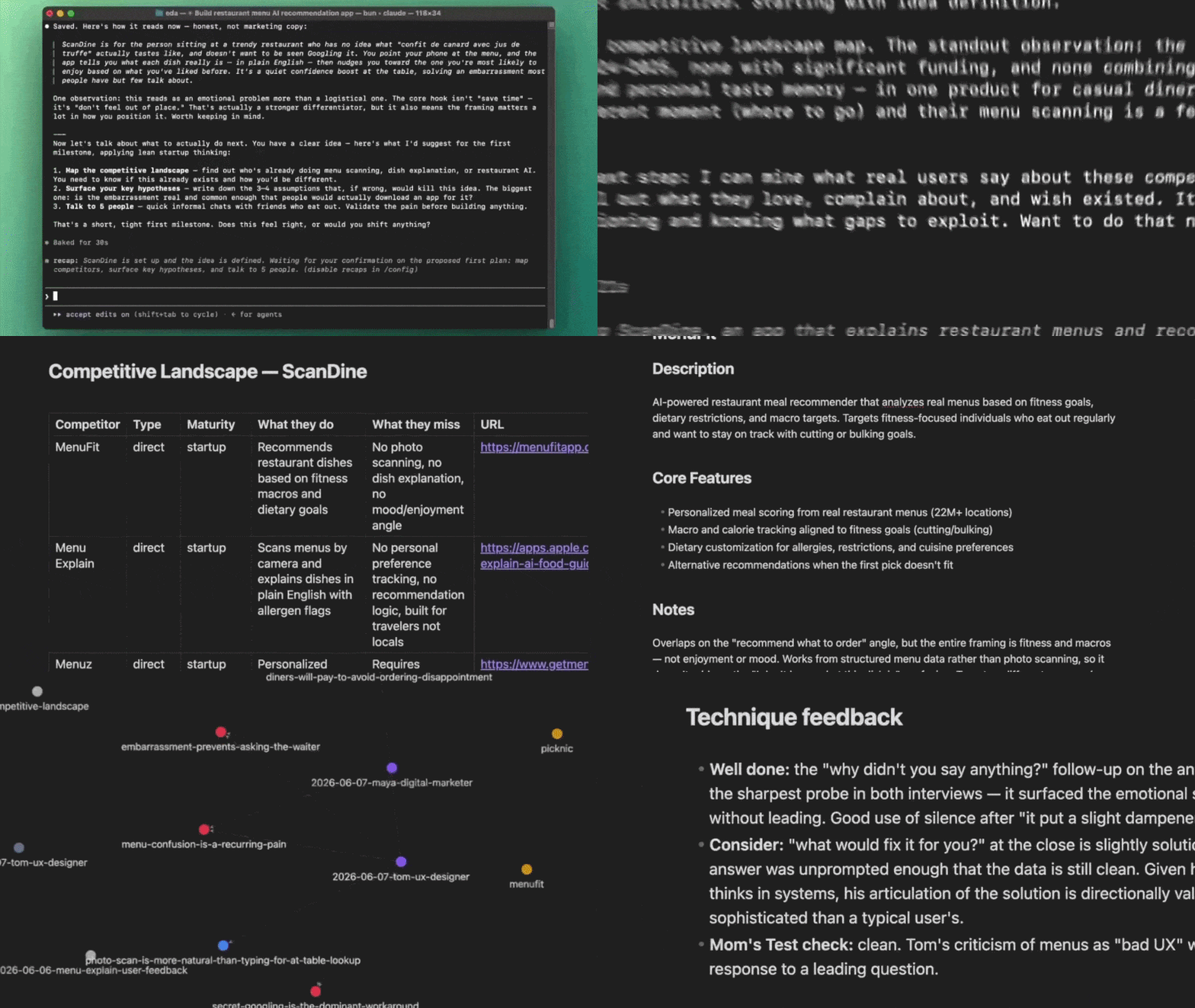
A local-first idea-validation co-pilot for Claude Code. It guides founders through the messy early work of figuring out whether an idea has legs — competitors, market, hypotheses, interviews, surveys, and an MVP — and keeps every artifact as plain markdown in your project, yours to read, edit, commit, and share.
📖 Read the full documentation →
A Claude Code plugin that turns idea-validation work into a conversation with a thoughtful co-founder — one that takes notes, runs research in the background, and never loses track of what you decided three weeks ago.
It is opinionated about evidence before commitment: discover competitors before sizing the market, write down hypotheses before doing interviews, run interviews before designing surveys, learn from real conversations before building an MVP.
Key features:
/whats-next, /competitors, /market-research, /hypotheses, /interviews, /surveys, /mvp. Use them through a guided plan or à la carte.startup/ in your project. No accounts, no database, no SaaS lock-in.[[slug]] backlinks (e.g. hypotheses to supporting interview statements). Browse the evidence trail in any markdown editor.It is recommended to have a new repository/folder per idea you want to explore — the idea can grow into an MVP, and the prototype's code will live naturally in that workspace. The plugin keeps its artifacts in the startup/ subdirectory once initialised.
Pick the instructions for your client:
/plugin marketplace add SergeiGorbatiuk/startup-superpowers
! mkdir my-new-idea && cd my-new-idea
/plugin install startup-superpowers@startup-superpowers
/reload-plugins
/whats-next
On first run the agent will ask about your idea and set everything up. After that, /whats-next is your home base — run it any time you want to know where your project stands and what to focus on next.
Only work in the Code tab of the app.
1. Add the marketplace (one-time):
Code tab.SergeiGorbatiuk/startup-superpowers, then click "Sync".On certain app versions the interface does not clearly indicate success or failure of this step. To verify: click "+" under "Personal Plugins" again, then "Browse plugins". You should see startup-superpowers in the "Code" tab of the Directory window.
2. Create a workspace folder for your idea (in your shell, file manager, or however you usually do it):
mkdir my-new-idea
cd my-new-idea
Then open this folder in the Desktop app.
3. Install the plugin for this project:
Code tab, click the "+" icon by the chat input → "Plugins" → "Add plugin".4. Kick things off: run /whats-next in the chat.
npx claudepluginhub sergeigorbatiuk/startup-superpowers --plugin startup-superpowersYour virtual AI team. Treats your solopreneur workflow as a virtual company with specialized AI employees, SOPs, team meetings, and performance reviews.
 pcatattacks
Product discovery skills for PMs: ideation, experiments, assumption testing, feature prioritization, and customer interview synthesis.
 phuryn
Agent-first PM toolkit with 9 specialist agents and 18 skills for solo developers and small teams
 slgoodrich
Business analysis toolkit: competitive analysis, UX strategy artifacts, market sizing, canvas, PRD, personas
 digital-stoic-org
Theory-grounded product-thinking discipline for AI agents. 58 skills, 13 theory gates, six diamond scales (Purpose to Market). Discovery to delivery with evidence gates that block on insufficient evidence.
 haabe
haabeOpportunity Solution Tree framework for pre-PMF startups to guide product discovery, problem validation, and solution prioritization
 kasperjunge
'%20stop-opacity%3D'0.16'%2F%3E%3Cstop%20offset%3D'1'%20stop-color%3D'rgb(200%2C90%2C60)'%20stop-opacity%3D'0.03'%2F%3E%3C%2FlinearGradient%3E%3C%2Fdefs%3E%3Crect%20width%3D'320'%20height%3D'200'%20fill%3D'url(%23g)'%2F%3E%3Ccircle%20cx%3D'250'%20cy%3D'56'%20r%3D'92'%20fill%3D'rgb(200%2C90%2C60)'%20fill-opacity%3D'0.06'%2F%3E%3Ccircle%20cx%3D'64'%20cy%3D'172'%20r%3D'58'%20fill%3D'rgb(200%2C90%2C60)'%20fill-opacity%3D'0.05'%2F%3E%3C%2Fsvg%3E)
