Stats
Actions
Available In
Tags
Manage LimaCharlie security operations at scale: multi-tenant IaC, adapter lifecycle, threat hunting, sensor coverage analysis, false positive tuning, interactive dashboards, and automated reporting for MSSP workflows.
Create a new skill for the lc-essentials plugin following best practices and framework conventions. Use when adding LimaCharlie API operations, orchestration workflows, or specialized capabilities to the plugin.
Pre-defined report templates combining data collection and visualization. Usage: /lc-essentials:reporting-templates
Research adapter documentation from multiple sources in parallel. Gathers configuration parameters, examples, and credential requirements from local docs, GitHub usp-adapters repo, and external API documentation.
Collect comprehensive asset profile for a SINGLE sensor. Designed to be spawned in parallel (batched) by the sensor-coverage skill. Gathers OS version, packages, users, services, autoruns, and network connections. Returns structured JSON profile.
Search for malicious behaviors within a SINGLE LimaCharlie organization using LCQL queries. Designed to be spawned in parallel (one instance per org) by the threat-report-evaluation skill. Returns summarized findings with sample events.
Survey a single cloud platform (GCP, AWS, Azure, DigitalOcean) to discover projects, VMs, and security-relevant log sources. Designed to be spawned in parallel (one instance per platform) by the onboard-new-org skill. Returns structured JSON with discovered resources.
Generate and validate D&R rules for a specific detection layer within a SINGLE LimaCharlie organization. Designed to be spawned in parallel (one per layer) by the threat-report-evaluation skill. Returns validated rules ready for deployment.
Complete adapter lifecycle assistant for LimaCharlie. Supports External Adapters (cloud-managed), Cloud Sensors (SaaS/cloud integrations), and On-prem USP adapters. Dynamically researches adapter types from local docs and GitHub usp-adapters repo. Creates, validates, deploys, and troubleshoots adapter configurations. Handles parsing rules (Grok, regex), field mappings, credential setup, and multi-adapter configs. Use when setting up new data sources (Okta, S3, Azure Event Hub, syslog, webhook, etc.), troubleshooting ingestion issues, or managing adapter deployments.
Automatically detect false positive patterns in detections using deterministic analysis. Fetches historic detections for a time window, runs pattern detection script to identify noisy patterns (single-host concentration, identical command-lines, service accounts, same hash, temporal periodicity, etc.), generates narrow FP rules for each pattern, and presents for user approval before deployment. Use for bulk FP tuning, detection noise analysis, or automated alert fatigue reduction.
Generate interactive HTML dashboards and visualizations from LimaCharlie data using Jinja2 templates and D3.js charts. Creates professional, self-contained HTML reports with pie charts, bar charts, line graphs, gauges, sortable tables, and responsive layouts. Supports MSSP multi-tenant dashboards, single-org details, sensor health reports, detection analytics, and billing summaries. Integrates with reporting, sensor-health, and detection-engineering skills. Built with strict data accuracy guardrails - NEVER fabricates, estimates, or infers data. Use for "visual report", "dashboard", "HTML output", "interactive charts", "export HTML", "generate visualization", "graphical report".
Set up automated Slack notifications for LimaCharlie case events. Creates a Python playbook, D&R rules, API key, and secrets so that case creations, resolutions, severity upgrades, and closures post rich messages to a Slack channel. Usage - /init-cases-to-slack <org_name>
REQUIRED for ANY operation involving ai-team or ai-agent definitions: deploy, install, update, upgrade, remove, push, sync, or modify AI agents and Agentic SOC configurations in a LimaCharlie organization. This includes modifying agent prompts, updating hive configs (ai_agent, dr-general), managing API keys and secrets, subscribing to extensions, and pushing changes after editing source YAML files in ai-teams/ or ai-agents/ directories. Trigger words: ai-team, ai-agent, ai_agent hive, deploy SOC, install agent, push agent, update agent, sync agent, baselining-soc, tiered-soc, lean-soc, exposure-team, intel-team, l1-bot, general-analyst, bulk-triage, l2-analyst, malware-analyst, containment, threat-hunter, soc-manager, shift-reporter. Examples: "deploy tiered-soc to my org", "install lean-soc", "update the l1-bot agent", "push agent changes to the org", "remove the tiered SOC", "modify the bulk-triage prompt".
Uses power tools
Uses Bash, Write, or Edit tools
Own this plugin?
Verify ownership to unlock analytics, metadata editing, and a verified badge. GitHub access is read-only (username + org membership).
Sign in to claimOwn this plugin?
Verify ownership to unlock analytics, metadata editing, and a verified badge. GitHub access is read-only (username + org membership).
Sign in to claimBased on adoption, maintenance, documentation, and repository signals. Not a security audit or endorsement.

This repository contains AI integrations for LimaCharlie, including Claude Code plugins, agents, and skills for security operations.
The plugins/ directory contains Claude Code plugins that can be installed to enhance Claude Code with LimaCharlie capabilities.
The lc-essentials plugin provides comprehensive LimaCharlie integration for Claude Code, including:
Before using the lc-essentials plugin, you need access to Claude Code through one of these options:
Install Claude Code on your local machine:
curl -fsSL https://claude.ai/install.sh | bash
For detailed setup instructions, see the Claude Code Quickstart Guide.
Then continue to the Plugin Installation section below.
Use Claude Code directly through the LimaCharlie web interface at app.limacharlie.io. The lc-essentials plugin is already pre-configured - you're ready to go with no additional setup required.
Only required for Option A (local installation)
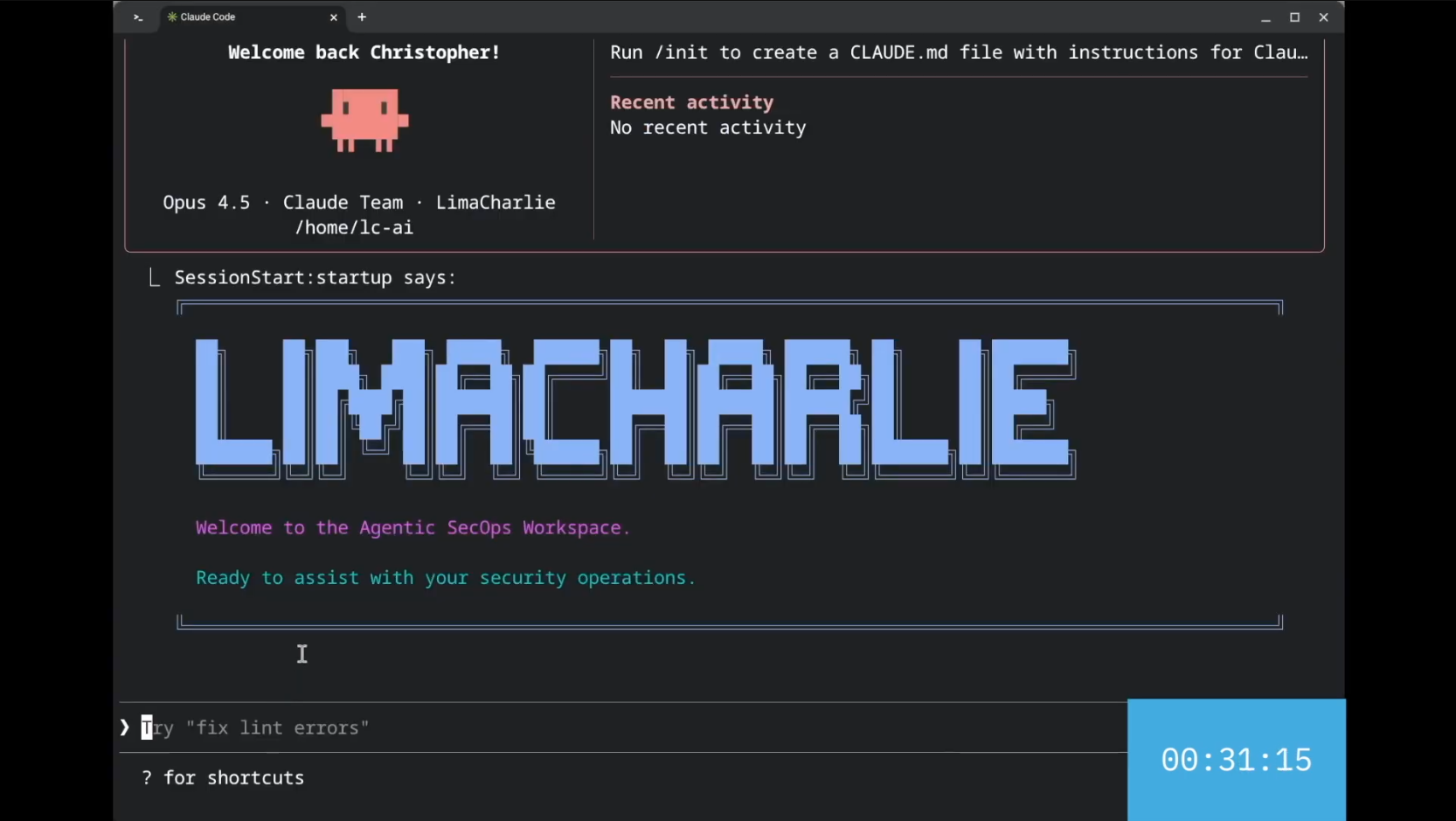
Installing the AgenticSecOps Workspace
From within a project directory:
# Add the marketplace
/plugin marketplace add https://github.com/refractionPOINT/lc-ai

# Install the plugin
/plugin install lc-essentials@lc-marketplace
Clone this repository and add it as a local marketplace:
git clone https://github.com/refractionPOINT/lc-ai.git
cd your-project
/plugin marketplace add /path/to/lc-ai
/plugin install lc-essentials@lc-marketplace
Use the pre-configured Docker container with everything ready to go:
cd docker && docker compose run --rm lc-claude
See the Docker section below for more details.
After installing the plugin:
claude tool/mcp and select the LimaCharlie MCP serverFor advanced configuration options, see the LimaCharlie MCP documentation.
Once installed, initialize any project with LimaCharlie guidelines:
/init-lc
Then use natural language to interact with LimaCharlie:
See marketplace/plugins/lc-essentials/SKILLS_SUMMARY.md for a complete list of available skills.
The ai-agents/ directory contains autonomous AI agents that run inside LimaCharlie organizations. These are not Claude Code sub-agents — they are standalone AI agents deployed as LimaCharlie IaC.
| Agent | Description |
|---|---|
| l1-bot | Automated L1 SOC analyst that investigates new cases and documents findings for L2 review |
With the lc-essentials plugin (recommended): Ask Claude Code to "install the l1-bot agent in my org" — the lc-deployer skill handles everything automatically.
Manually: See each agent's README for step-by-step instructions.
npx claudepluginhub refractionpoint/lc-ai --plugin lc-advanced-skillsCore LimaCharlie skills for CLI-based API access, detection engineering, sensor tasking, case investigation, and fleet health monitoring.
 refractionPOINT
Core LimaCharlie skills for CLI-based API access, detection engineering, sensor tasking, case investigation, and fleet health monitoring.
refractionPOINTClaude plugins for Blumira - SIEM findings management, device inventory, MSP multi-tenant operations, and security posture analysis
 wyre-technology
Agent-delegated SOC workflow for CrowdStrike NGSIEM — distributes triage, investigation, and evidence collection across specialized sub-agents (Haiku for mechanical, Sonnet for substantive, Opus for judgment).
 willwebster5
SentinelOne SecOps skills for Claude: PowerQuery threat hunting and STAR/Custom Detection rules; Management Console API; Singularity Data Lake API; SDL dashboards; log parsing (OCSF); Hyperautomation SOAR; z-score anomaly baselining; autonomous DFIR alert investigation (soc-investigator); and one-prompt SDL solutions: source onboarding, asset enrichment, UEBA, ingest health, detection exclusions, Risk-Based Alerting, alert noise reduction, and Detection as Code.
 pmoses-s1
Agentic SOC Platform integration for Claude Code
 FunnyWolf
SentinelOne SecOps skills for Claude: PowerQuery threat hunting, Management Console API, Singularity Data Lake API, SDL dashboard authoring, SDL log parsing, Hyperautomation workflow generation, source-agnostic behavioral baselining with z-score anomaly detection, and packaged SDL solution deployment (data source onboarding to OCSF with device/user enrichment, dashboard, MITRE-mapped detections and a threat-response flow; plus asset enrichment of raw logs).
 Sentinel-One
'%20stop-opacity%3D'0.16'%2F%3E%3Cstop%20offset%3D'1'%20stop-color%3D'rgb(200%2C90%2C60)'%20stop-opacity%3D'0.03'%2F%3E%3C%2FlinearGradient%3E%3C%2Fdefs%3E%3Crect%20width%3D'320'%20height%3D'200'%20fill%3D'url(%23g)'%2F%3E%3Ccircle%20cx%3D'250'%20cy%3D'56'%20r%3D'92'%20fill%3D'rgb(200%2C90%2C60)'%20fill-opacity%3D'0.06'%2F%3E%3Ccircle%20cx%3D'64'%20cy%3D'172'%20r%3D'58'%20fill%3D'rgb(200%2C90%2C60)'%20fill-opacity%3D'0.05'%2F%3E%3C%2Fsvg%3E)