Stats
Actions
Available In
Tags

Maintain an agent-owned second brain in an Obsidian-compatible Markdown vault, with semantic search, schema management, and session-aware preference logging for persistent knowledge and context.
Record taste signals and apply-evidence events into the Brain observing-memory layer of Open Second Brain. INVOKE this skill (and call `brain_feedback`) the moment the user expresses a preference, dislike, correction, or rule in dialogue — "don't do X", "use A instead of B", "I prefer Y", "X is wrong here", or any explicit imperative that should outlive the current turn. SEPARATELY invoke (and call `brain_apply_evidence`) right after you produce a durable artifact (code shipped, file written, content drafted, config change) and at least one preference in `Brain/preferences/` has a `scope` that plausibly applies — record whether you `applied` or `violated` it. SKIP only for casual chat, exploration without a stated rule, read-only inspection, and trivial edits. When a preference plausibly applies but you are unsure, RECORD with `note: "speculative; <reason>"` rather than skipping — the dream pass discards single-event speculative entries that do not recur, so coverage costs less than missing the signal. WRITE the `principle` and `note` fields in the same natural language the user has been speaking in this session; technical identifiers (`topic` slug, `pref_id`, `scope`) stay English.
Use when the user explicitly mentions codegraph, asks structural code questions such as callers/callees/impact, asks where a symbol is defined, asks what breaks if a symbol changes, or asks for an architectural overview of a code repository. Skip for prose-only or vault-only questions.
Bring Open Second Brain semantic search online — embedding API key, sqlite-vec extension, first reindex, optional periodic refresh. INVOKE when the user mentions "embeddings", "semantic search", "vector index", or after `o2b search check` reports `vec_extension: unavailable`, `embedding_key: missing`, or any line in its `recommendations:` block. SKIP when the user is asking conceptual questions about embeddings or comparing providers without intent to set up — answer those directly.
Use Open Second Brain to read, write, and maintain an agent-owned second brain in an Obsidian-compatible Markdown vault. The agent owns one top-level directory (`Brain/`). User-authored notes live wherever the operator names them and are read-only inputs when listed in `notes.read_paths`.
Use when adding, renaming, reviewing, or explaining Brain schema tokens, aliases, prefixes, link types, extractability, or expert routing in Open Second Brain vaults.
Matches all tools
Hooks run on every tool call, not just specific ones
Admin access level
Server config contains admin-level keywords
Own this plugin?
Verify ownership to unlock analytics, metadata editing, and a verified badge. GitHub access is read-only (username + org membership).
Sign in to claimOwn this plugin?
Verify ownership to unlock analytics, metadata editing, and a verified badge. GitHub access is read-only (username + org membership).
Sign in to claimBased on adoption, maintenance, documentation, and repository signals. Not a security audit or endorsement.
Executables (bin/) — files in this plugin's bin/directory are added to the Bash tool's PATH while the plugin is enabled.
Modifies files
Hook triggers on file write and edit operations
Modifies files
Hook triggers on file write and edit operations
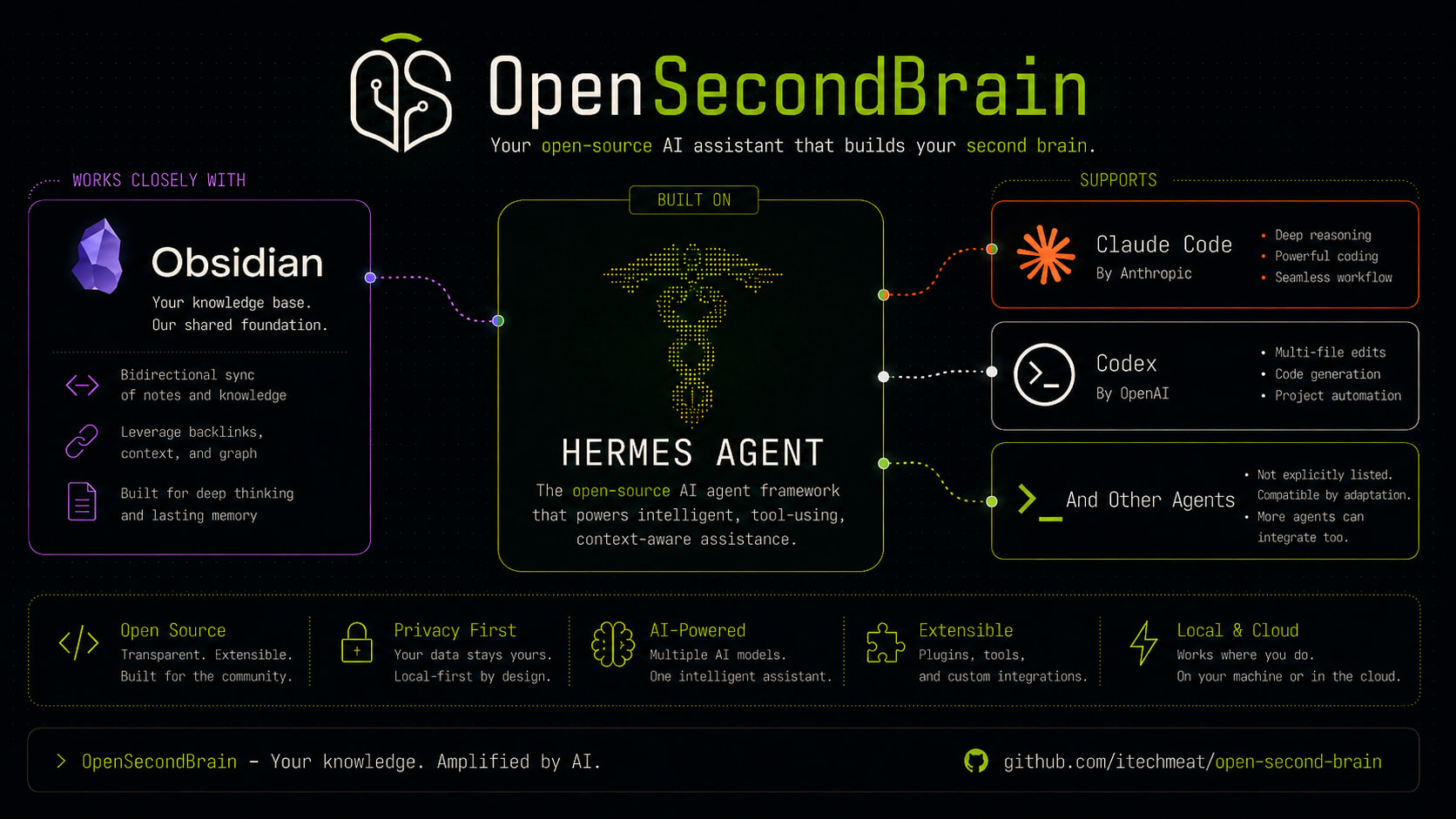
An Obsidian-native memory layer for your AI agent. Plain Markdown you own, in the same vault you already use.
Open Second Brain plugs into Hermes Agent and turns your Obsidian vault into a memory layer the agent reads and writes through deterministic CLI / MCP tools. Preferences, signals, evidence, and audit trails are real .md files under Brain/ in the vault you already open in Obsidian every day. You can grep them, version them with git, search them in Obsidian, edit them by hand. No daemon, no vector black box, no hidden state outside the vault.
Open Second Brain 1.38.0 adds baselining for semantic-health advisories. When a vault is bulk-seeded with many preferences at once, the concept-gap and batch-concept-inflation advisories fire permanently and pin the health verdict at watch, with no way to acknowledge the burst short of deleting real memory. Now an optional health.silence_before watermark in _brain.yaml (managed by o2b brain health-baseline set <date>|now, get, clear) declares the state accepted up to that date: findings whose underlying entries are entirely older than the watermark are filtered from the surfaced report, the verdict reflects only what is shown, and the report always says exactly how many findings the baseline hid. Detection and storage are untouched, an entry without a parseable timestamp is never suppressed, and with no watermark set every output is byte-identical to 1.37.0.
Previous release, 1.37.0, was a retrieval quality and context delivery wave: a typed-edge relational retrieval arm, composite owner/session/project scope keys, an overwrite-only o2b brain state lane with a retrieval-time staleness barrier, a deterministic summary-search router, o2b search rerank-fit, the read-only brain_retrieval_plan MCP tool, a cadence-controlled navigation tier, an opt-in strict orientation hook, and workspace-wide codegraph partnering. Details live in the CHANGELOG.
Brain/preferences/pref-no-internal-abbrev.md in Obsidian and you literally see what your agent learned about you - title, status, evidence count, confidence band, body text. Wikilinks, backlinks, graph view all work.dream pass turns repeat signals into rules and retires the ones nothing applies any more. Counters and atomic file moves - no LLM inside the algorithm, no surprise hallucinations in your memory.flowchart LR
Vault[("Your vault<br/>Brain/ - plain Markdown")]
Hermes["**Hermes Agent**<br/>(primary)"]
CC[Claude Code]
Codex[OpenAI Codex]
Others["Cursor · Aider · OpenClaw<br/>opencode · Grok Build · kiro · Copilot CLI<br/>Gemini CLI · Pi · any MCP host"]
Hermes <==> Vault
CC <--> Vault
Codex <--> Vault
Others <--> Vault
style Hermes fill:#1e3a5f,stroke:#90caf9,color:#fff
style Vault fill:#5d3a9b,stroke:#ce93d8,color:#fff
Hermes Agent owns the schedule (dream cron, daily digests, Telegram delivery). Other runtimes participate as readers and writers of the same Brain through MCP - no per-runtime fork of the memory.
The simplest path - let your agent set it up. Paste this into Hermes (or whichever AI agent already has shell access on the target machine):
Install Open Second Brain for me by following the steps at https://github.com/itechmeat/open-second-brain/blob/main/install/hermes.md. My vault is at
/path/to/your-vault.
The agent reads the install doc, runs every command, and verifies the result. That's it.
If you prefer running the steps yourself:
# 1. Install the plugin
hermes plugins install itechmeat/open-second-brain --enable
hermes gateway restart

# 2. Put `o2b` on PATH
~/.hermes/plugins/open-second-brain/scripts/o2b install-cli

# 3. Bootstrap the vault
o2b init       --vault /path/to/your-vault --name "My Second Brain"
o2b brain init --vault /path/to/your-vault --primary-agent <agent-name>

# 4. Verify
o2b doctor --vault /path/to/your-vault
npx claudepluginhub itechmeat/open-second-brain --plugin open-second-brainOperate any Obsidian vault as a living, AI-first second brain: 45 slash commands across vault management, thinking tools, a research toolkit, and scheduled agents.
 eugeniughelbur
Automatic Claude Code -> Obsidian second brain: zero-config session capture, hybrid search, autonomous recall, daily/lessons/preferences.
 m3talux
Set up or upgrade an AI-powered Obsidian vault with journaling, knowledge graphs, pattern recognition, and meeting workflows. Includes skills for daily journaling, weekly insights, graphify knowledge graphs, humanizer, and more.
 mycelium-hq
Bidirectional knowledge flow between Claude Code and Obsidian — 20 MCP tools, skills, and hooks for PKM
 AdrianV101
Persistent Obsidian-based memory for coding agents. Automatically orients from a knowledge vault at session start, navigates project architecture via graph traversal, and writes discoveries back to the vault.
 AdamTylerLynch
Sync AI conversations to an Obsidian knowledge base with Memory Mason knowledge base skills.
 s-gryt
'%20stop-opacity%3D'0.16'%2F%3E%3Cstop%20offset%3D'1'%20stop-color%3D'rgb(200%2C90%2C60)'%20stop-opacity%3D'0.03'%2F%3E%3C%2FlinearGradient%3E%3C%2Fdefs%3E%3Crect%20width%3D'320'%20height%3D'200'%20fill%3D'url(%23g)'%2F%3E%3Ccircle%20cx%3D'250'%20cy%3D'56'%20r%3D'92'%20fill%3D'rgb(200%2C90%2C60)'%20fill-opacity%3D'0.06'%2F%3E%3Ccircle%20cx%3D'64'%20cy%3D'172'%20r%3D'58'%20fill%3D'rgb(200%2C90%2C60)'%20fill-opacity%3D'0.05'%2F%3E%3C%2Fsvg%3E)