Stats
Actions
Available In
Tags

Run a full marketing and growth workflow from a coding agent: research markets and ICP, diagnose problems, plan campaigns, write copy and ads, produce briefs for video/design/landing pages, publish to social/paid channels, and measure results with critic-gated evaluation loops that compound context across sessions.
Based on adoption, maintenance, documentation, and repository signals. Not a security audit or endorsement.
You are driving **forsvn-preview**, the local review surface. Artifacts are plain
This is the **iterative** review surface — distinct from `/forsvn:review`
Diagnose the FORSVN install — report which of the three layers (review surface, MCP contract, Proof collab) are live and what's missing, each with a one-line fix. Use when /forsvn:review or :collab isn't working, or to confirm a fresh install is usable, not just installed.
Produces production-ready briefs for app onboarding, App Store preview, and feature-demo videos from supplied UI screenshots. Defines the feature promise, cropped UI beats, interaction choreography, captions, motion rules, platform specs, and asset manifest. Use when screenshots exist and the goal is to show a product feature in action. Not for generic short-form social videos (use brief-shortform) or rendering the video (use produce-video).
Produce a graphic-design brief for a single visual asset — social posts, thumbnails, banners, OOH, OG cards, hero illustrations. Pulls brand tokens, generates concepts, writes platform-aware specs + image-gen prompt or designer-handoff spec. Does NOT render — rendering is downstream. Not for brand identity (use create-brand), whole-page redesigns (use brief-landing-page), or the copy that goes IN the asset (use write-copy).
Generates a campaign-grade brief for a conversion landing page or redesign — hypothesis, surface rhythm, section-by-section spec, asset slots, copy candidates, hand-off prompts, conversion + brand-voice critics. Output ready for Claude Design, Figma, a human designer, or a coding agent. Not for post-launch CRO from analytics (use evaluate-landing-page inside an eval-loop), non-conversion pages (blogs, docs), or a single visual asset (use brief-graphic).
Production-ready brief for short-form video — hook, shot list, on-screen text, audio plan, caption, CTA, aspect, length. Covers live-action + motion-graphic. 1 hero + 2 variants per run. Reads the per-platform research-shortform catalog. Not for static visual assets (use brief-graphic), organic social copy (use write-social), paid ad creative (use write-ad), or rendering (use produce-video).
Builds a brand identity system as up to five artifacts — BRAND.md (story, voice, archetype), DESIGN.md (design tokens), CREATIVE-DIRECTION.md (art direction), FRAME.md (frame direction for the camera), ASSETS.md (per-platform inventory). Runs Quick Brand (Route A) or full brand-system (Route B). Use to define or rebrand a product's identity. Not for marketing copy (use write-copy), user flows (use map-user-flow), campaign planning (use plan-campaign), or audience research (use research-icp).
Admin access level
Server config contains admin-level keywords
Modifies files
Hook triggers on file write and edit operations

A marketing/growth co-working stack for your coding agent — composable skills across research, strategy, content & ads, and measurement, from one install. (Engineering/build skills are the separate forsvn-dev package — see below.)
Call any skill by verb (/research-icp, /write-copy, /plan-campaign, /review-work) or let the front door route for you (/forsvn). Skills chain — each one reads what earlier skills left behind, so output compounds the more you use the stack.
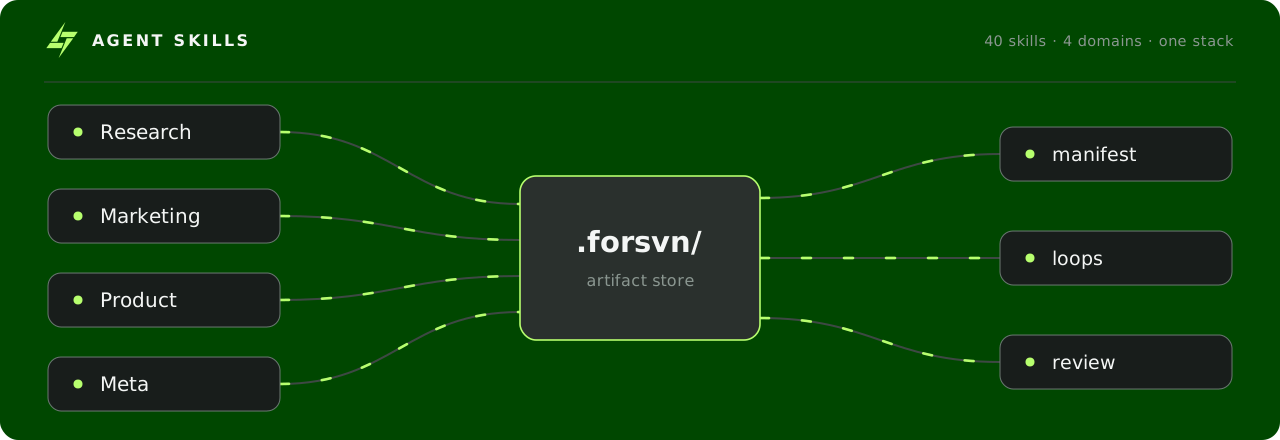
Pick the path that matches what you want.
One install. forsvn carries the skills (the /forsvn front door) and the bundled review surface — preview any draft as a themed, on-brand page and approve / deny / request changes via /forsvn:review (the agent drafts, you decide).
/plugin marketplace add hungv47/meta-skills
/plugin install forsvn            # the growth stack + /forsvn front door + /forsvn:review|collab|doctor
/plugin install forsvn-dev        # OPTIONAL: engineering/build skills (architecture, refactoring, docs, task breakdown, iOS) — not the growth product
The review surface needs Bun (curl -fsSL https://bun.sh/install | bash) — it's a small localhost CLI driven by /forsvn:review. The skills themselves need nothing beyond your agent.
The review surface is one-shot approve/deny/request-changes. The richer turn-by-turn human↔agent collaborative editing (Proof-backed) is a separate opt-in tier that additionally needs the forsvn-mcp server and the Proof SDK; it is documented in the app repo's collaborative-docs runbook.
Just the skills, plain Markdown output, no review surface.
npx skills add hungv47/meta-skills
Useful flags:
npx skills add hungv47/meta-skills -g                   # install globally
npx skills add hungv47/meta-skills --skill write-copy   # cherry-pick one
npx skills add hungv47/meta-skills --list               # see what's available
npx plugins/npx skillsare a third-party CLI (theclaude-pluginsregistry); they resolve through their own index, not this repo'smarketplace.json. For Claude Code prefer the built-in/plugin marketplace addabove. Runnpx skills --helpfor the full surface (list,update,remove,find). Requires Node 18+.
Renamed from
forsvn-skills→forsvn(v1.2.0). If you installed the old name, remove and reinstall:npx skills remove forsvn-skills(or/plugin marketplace removein Claude Code), then installforsvnabove. The repository URL staysgithub.com/hungv47/meta-skills, so existing links keep working.
forsvn-previewis now a module insideforsvn, not a separate plugin. Its commands re-namespace under the single plugin:/forsvn-preview:review→/forsvn:review,/forsvn-preview:collab→/forsvn:collab,/forsvn-preview:doctor→/forsvn:doctor. There is no/forsvn-preview:*alias — the command prefix is the plugin name. If you previously installedforsvn-previewseparately, remove it (/plugin marketplace remove) and use the bundled commands; one/plugin install forsvnnow carries both the skills and the review surface.
/forsvn and describe what you're trying to do — vague is fine./research-icp "B2B PM SaaS for agencies").You don't have to memorize skill names. Plain English ("help me figure out who we're building for", "this codebase has accumulated cruft") routes to the right skill via your editor's slash-command picker.
A few of the things /forsvn routes to — type any of these in plain English:
Own this plugin?
Verify ownership to unlock analytics, metadata editing, and a verified badge. GitHub access is read-only (username + org membership).
Sign in to claimOwn this plugin?
Verify ownership to unlock analytics, metadata editing, and a verified badge. GitHub access is read-only (username + org membership).
Sign in to claimnpx claudepluginhub hungv47/meta-skills --plugin forsvnSoftware-engineering skills extracted from the FORSVN growth stack — architecture, refactoring, dead-code cleanup, service extraction, in-product UX flow + UI specs, code/operator docs, engineering task breakdown, and native app builds. A separate companion to forsvn (the marketing/growth product): install this only when you also want the build-side skills. Distributed from github.com/hungv47/meta-skills.
 hungv47
A collection of 61 agent skills for founders who hate marketing
 Varnan-Tech
Content marketing with content strategy and search specialist agents
 EricGrill
Go-to-market skills for Claude Code — SEO, content, outbound, sales, growth, analytics, strategy, ads, social, and CRM
 manojbajaj95
Agents for content marketing, customer support, and sales automation
 davepoon
Editorial "Marketing & Growth" bundle for Claude Code from Antigravity Awesome Skills.
 sickn33
50 specialist skills + 43 slash commands for coding agents — orchestrator, backend, frontend, QA, security, deploy, detective-spec, static-analysis, skill-author, program-router, parallel-dispatcher, blog-publisher, blog-screenshot, canary-deployment, zoom-out, handoff-context, post-deploy-canary-monitor, pattern-conformity, research-prep, context-budget, direct-response-copy, ux-research + spec-driven development, anti-AI writing, memory consolidation, executable YAML pipelines + insights dashboard (v2.18.0, 6 tabs). v2.37.0: absorcao de 7 ebooks Casa do Codigo — skill 50 ux-research (gap real: discovery qualitativo — entrevista, persona baseada em pesquisa, journey map, teste de usabilidade, arquitetura de informacao; antecede PO 01 e UI/UX 02) + 3 policies de XP (pair-programming, continuous-integration, sustainable-pace, ligadas a skill 37) + incrementos cirurgicos: skill 01 ganha Fundamento de Negocio (validacao de hipotese, MVP, monetizacao, AARRR, product-market fit — do Guia da Startup); skill 14 ganha Keyword Research (KEI, intent, cauda longa) + Off-Page/Link Building (do SEO Pratico); skill 07 ganha Infrastructure as Code (provisionamento declarativo, idempotencia, drift — principios do DevOps na pratica traduzidos pra Terraform/Ansible); skill 38 ganha lentes de coesao/acoplamento, seam distribuido (REST/async/RPC, HATEOAS) e camadas (da Introducao a Arquitetura). Livros de Jogos HTML5 Canvas (nicho <2%) descartados por frequencia. v2.36.0: skill 50 direct-response-copy — copy de direct response destilada de 3 ebooks classicos PT-BR: biblioteca de formulas de headline em 20 categorias de gatilho (357 modelos destilados em formulas parametrizadas), 8 gatilhos mentais + storytelling de venda, copy de Instagram (legenda/engajamento). Gate de integridade obrigatorio: sem claim nao-verificavel, sem depoimento fabricado, escassez so real. Complementa a skill 13 (copy de produto): 13 cobre landing/microcopy/brand voice, 50 cobre ads/pagina de vendas/email/social. v2.35.0: auto-skillify (absorcao parcial do activeloopai/hivemind) — hook UserPromptSubmit que a cada N turnos (default 20) injeta checkpoint perguntando se a atividade recente vale virar learned-skill (3 criterios: nao-googleavel, especifico do codebase, custou debugging). Adapta o skillify-via-Haiku do hivemind ao runtime: delega a decisao ao agente da sessao (ja pago) em vez de forkar LLM. Le a contagem do context-turn-counter. O resto do hivemind ja tinhamos: codebase graph=Graphify, semantic search=.index/vault.db, memory compound=memory-curator. v2.34.0: vault de memoria UNIFICADO ao kit — instalar o kit agora CRIA o vault automaticamente (scripts/init-vault.mjs roda no install.sh: cria estrutura logs/architecture/secrets, CLAUDE.md com as regras de escrita, .gitignore protegendo secrets/, git init). Path PORTAVEL via scripts/vault-resolver.mjs: $CLAUDE_MEMORY_VAULT → ~/.claude-memory (novo padrao, vale Windows/Mac/Linux) → D:/claude-memory (legado). Antes o vault era montado a mao e o path hardcoded; agora kit+memoria sao uma coisa so. Idempotente (nao sobrescreve vault existente). v2.33.0: absorcao obsidian-second-brain (memoria AI-first) — policy memory-write-rules.md aplica anti-fabricacao ao VAULT (false-absence: busque exaustivamente antes de afirmar que nao existe nota/decisao — o failure mode mais comum; no-fabrication: TBD para desconhecido; recency markers '(as of YYYY-MM, fonte)' em claims externos; niveis de confianca) + convencao 'For future Claude' (preambulo de 2-3 linhas que o futuro-Claude le em 10s pra decidir relevancia, no skill 31 session-summary) + comando /reconcile-memory (detecta contradicoes no vault — decisoes revertidas/superadas nunca atualizadas — e resolve: mais novo+autoritativo vence com secao ## History, ambiguo vira flag, evolucao marca superseded). v2.32.0: pre-build-gate (UserPromptSubmit hook) leva o 'pare e decida antes de codar' de cada disciplina (que o /auto tem nas fases) para o MODO PASSIVO — detecta intencao de criacao no prompt e injeta o checklist da disciplina certa: acceptance-criteria (defina done antes de implementar), api-contract (formato de erro + status codes antes da 1a rota), schema-integrity (constraints/FK/indices antes do 1o INSERT), ui-design (ancora estetica antes de estilizar), deploy-readiness (healthcheck/env/graceful-shutdown). 4 novas rules path-scoped por disciplina (rules/backend/, rules/database/, rules/frontend/, rules/common/acceptance-criteria.md). v2.31.0: design-aware /auto — fase UI-DESIGN como gate (PLAN→[UI-DESIGN]→BUILD) que invoca skill 02-ui-ux-design e bloqueia build de arquivo visual ate a ancora estetica estar escolhida; rules/frontend/ui-design.md (path-scoped em .css/.tsx/public) proibe o default generico (#4f46e5 indigo + system-ui), forca escolher 1 ancora; coverage config virou gate HARD no /auto; scope inference (app→fullstack) movido pra rules/common para o modo passivo herdar. Validado por bench A/B real (bench/ab/, 3 rounds) que expos UI generica nos 3 bracos. v2.29.0: claim-verifier (PostToolUse — detecta afirmacoes sem evidencia: 'email enviado', 'deploy OK', 'teste passou'; passa livre se ha exit code 0/HTTP 200/query result) + context-turn-counter (UserPromptSubmit — compact a cada 25 turnos, handoff inteligente a cada 50 usando vault de memoria). v2.28.0: /spec-kit (SDD pipeline unificado specify→plan→tasks→implement + Adversarial Verifier inline), /insights (recomendacoes baseadas em telemetria dos hooks), /swarm com Phase 3 Adversarial Verify (Implementor vs Verifier com goals opostos, spec atualizada em real-time). v2.27.0: investigate-first guard (hook PreToolUse que impede a IA de perguntar o auto-descobrivel — gh user, branch, package manager, porta, versao de runtime — manda investigar primeiro) + policy investigate-first. v2.26.0: silent-failure-hunter (16o subagent, review-only: caca catch{} vazio, swallowed errors, fallbacks perigosos, stack traces perdidos, rollback faltando) + skill 49 context-budget (audita peso de contexto carregado por componente) + /context-budget. v2.25.0: rules system path-scoped (`.claude/rules/` com `paths:` glob, inspirado no ECC), bug-fix da allowlist de subagents, 5 skills stub reescritos com profundidade. v2.24.0: curador AUTONOMO de memoria (inspirado no Hermes Agent) — roda async no SessionStart, faz decay/archive/dedup em JS puro sem gastar LLM e delega so a parte semantica ao agente presente. v2.23.0: absorcao addozhang (skill 48 research-prep, Spring Boot playbook, mem9 patterns). v2.22.0: memory curator nudge. v2.21.0: context-cost guards. v2.20.0: skill 47 pattern-conformity. 16 dispatchable subagents.
 felvieira
'%20stop-opacity%3D'0.16'%2F%3E%3Cstop%20offset%3D'1'%20stop-color%3D'rgb(200%2C90%2C60)'%20stop-opacity%3D'0.03'%2F%3E%3C%2FlinearGradient%3E%3C%2Fdefs%3E%3Crect%20width%3D'320'%20height%3D'200'%20fill%3D'url(%23g)'%2F%3E%3Ccircle%20cx%3D'250'%20cy%3D'56'%20r%3D'92'%20fill%3D'rgb(200%2C90%2C60)'%20fill-opacity%3D'0.06'%2F%3E%3Ccircle%20cx%3D'64'%20cy%3D'172'%20r%3D'58'%20fill%3D'rgb(200%2C90%2C60)'%20fill-opacity%3D'0.05'%2F%3E%3C%2Fsvg%3E)