Stats
Actions
Available In
Tags

Wiki-first research that compounds. Binds each run to a wiki knowledge base; future runs read what prior runs filed before hitting the web. v0.1.0 inverted pipeline (plan → curate → fetch → ingest → distill → compose → verify → finalize) with zero-network, citation-consistent claim verification — opt-in live-source resweep via `knowledge-refresh --resweep`. The shallow `knowledge-query` rung is read-only by default and can optionally file its answer back as an un-verified synthesis page via `--file-back`.
Based on adoption, maintenance, documentation, and repository signals. Not a security audit or endorsement.
Phase-4.5 answer-claim distiller for the inverted pipeline. Reads a per-question claim bundle — each existing type:question node grouped with the pre-extracted claims of the sources that answer it — and selects, per question, the claims that actually ANSWER it, writing a raw-text answer-records file the knowledge-distill orchestrator feeds to question-store.py answer-merge. Pure proposal — never writes wiki pages, never builds JSON/YAML, never computes slugs or decides claim-dedup. The constrained per-question sibling of concept-distiller.
Phase-4 claim extractor for the inverted pipeline. Reads one cached source body plus the calling sub-question refs, identifies 5-20 verifiable factual claims grounded in the body, and returns a JSON array of {id, text, excerpt_quote, excerpt_position, sub_question_refs, extracted_at} entries the calling source-ingester writes into the wiki page's pre_extracted_claims frontmatter. Pure extraction — never writes files.
Phase-4.5 distiller for the inverted pipeline. Reads the run's source-claim bundle plus an index of the distilled pages already on the wiki, clusters recurring facts into a small set of concept / entity / person proposals, and writes a raw-text concept-records file the knowledge-distill orchestrator feeds to concept-store.py. Pure proposal — never writes wiki pages, never builds JSON/YAML, never computes slugs or decides claim-dedup.
Phase-4.5 summary re-narrator for the inverted pipeline. For each distilled page (concept / entity / person) that gained claims this run, rewrites the
Phase-7 concepts-outline lead-in narrator for the inverted pipeline (concept-map auto-refresh). For each theme group in wiki/concepts/index.md, (re)writes the per-theme lead-in paragraph the ENGINE owns — framing prose (why the theme matters + what to read first), never a bullet dump. Reads a bundle (per theme: heading + current machine lead-in + that theme's concept titles and one-line summaries), writes a raw-text records file the knowledge-finalize concepts auto-refresh sub-step stages or applies. Pure proposal — never writes wiki pages, never builds JSON/YAML, never touches a human (non-sentineled) lead-in, and never lists, reorders, or invents concept bullets (the deterministic renderer owns those).
Phase 5 of the inverted pipeline. Reads <project>/.metadata/plan.json + <project>/.metadata/ingest-manifest.json + the populated cogni-wiki, dispatches a wiki-composer pass (plus ONE bounded fail-soft zero-network coverage-gated re-dispatch when a sub-question has ingested evidence the draft left uncited), and lands <project>/output/draft-vN.md + <project>/.metadata/citation-manifest.json. Supports --source wiki to compose a report grounded only in the bound wiki + fetch-cache with no web crawl (default web unchanged; local/hybrid staged). Use this skill whenever the user says 'compose the draft', 'write the report from the wiki', 'wiki-only report', 'compose from the wiki only', 'no web crawl report', 'phase 5 of the knowledge pipeline', 'knowledge compose', 'draft v1', or 'run the writer'. After compose, knowledge-verify will run the zero-network claim alignment.
Phase 2 of the inverted pipeline. Reads plan.json, dispatches one source-curator agent per sub-question to WebSearch + score candidate sources AND fetch each survivor's body via WebFetch into the shared fetch-cache, then merges the per-sub-question batches into candidates.json via candidate-store.py. Each candidate carries a fetch sub-object. Use this skill whenever the user says 'curate sources for the eu-ai-act plan', 'discover candidates for project X', 'run the curators on plan.json', 'knowledge curate', 'phase 2 of the knowledge pipeline'. After curate, run knowledge-fetch (cobrowse reconcile; a near no-op unless --cobrowse).
Render an HTML dashboard for a bound cogni-knowledge base — runs the vendored wiki-dashboard scripts (render_dashboard.py + build_graph.py) natively against the bound wiki and writes a knowledge-overlay.md sidecar that lists deposited research projects and the latest lint-audit claim_drift count. Use this skill whenever the user says 'show the dashboard for my <slug> base', 'knowledge dashboard', 'visualize my eu-ai-act knowledge base', 'render the knowledge base as HTML', 'knowledge-dashboard <slug>'. The sidecar makes the binding's contribution visible alongside the wiki's own dashboard.
Phase 4.5 of the inverted pipeline (between ingest and compose). Distills the run's source claims into recurring type:concept / type:entity / type:person pages, creating-or-merging them under a lock with claim-level dedup so the bound wiki compounds across runs (distilled pages get enriched, not duplicated). Also synthesizes a citable answer_claims: surface onto each type:question node from its findings' claims (Step 6.1). An optional cross-lingual pass merges DE↔EN twin claims on mixed-language bases (auto-skips otherwise). Fail-soft and optional: a distill failure never blocks compose. Use this skill whenever the user says 'distill the concepts', 'build the concept web', 'phase 4.5', 'knowledge distill', 'extract entities and concepts', 'answer the question nodes', or 'dedupe claims'. After distill, knowledge-compose reads the distilled pages as framing context.
Phase 3 of the inverted pipeline. Builds fetch-manifest.json from the fetch results the curators already produced in Phase 2 (bodies are already fetched during curate). Cobrowse is OPT-IN (--cobrowse): the skill walks the user through enabling the Claude-in-Chrome extension, then dispatches source-fetcher sequentially to recover WebFetch misses AND to additively top up thin primary-tier sources (reading the fuller browser body beyond WebFetch's cap, superseding only if strictly longer). Use this skill whenever the user says 'fetch candidates for project X', 'build the fetch manifest', 'phase 3 of the knowledge pipeline', 'recover the failed sources', 'deepen the primary sources', 'knowledge fetch'. After fetch, run knowledge-ingest to deposit per-URL wiki pages.
Uses power tools
Uses Bash, Write, or Edit tools
Open-source plugins for consulting, sales, and marketing on Claude Code. 13 Apache-2.0 plugins that automate the research-heavy, methodology-driven work behind B2B deliverables — trend scouting, portfolio positioning, sales pitches, content creation, visual production, website generation, knowledge management, and source verification.
Each plugin implements an established framework (Corporate Visions, Double Diamond, TIPS, IS/DOES/MEANS) rather than general-purpose text generation. Outputs include inline citations, structured data models, and quality gates. Every deliverable follows a reproducible methodology you can inspect and override.
European-first, multi-market & multilingual. insight-wave is built for European B2B, not DACH alone. Research, trend scouting, and portfolio positioning run bilingually (local language + English) against curated regional authority sources across a built-out European set — DACH/DE, FR, IT, ES, NL, PL — plus UK and US, with 16+ output languages in native UTF-8. A broader set of registered regions (single-country, composite EU/Nordics, and global) is taxonomy-ready for expansion. See Supported markets & languages for the full registry and the built-out-vs-registered distinction.
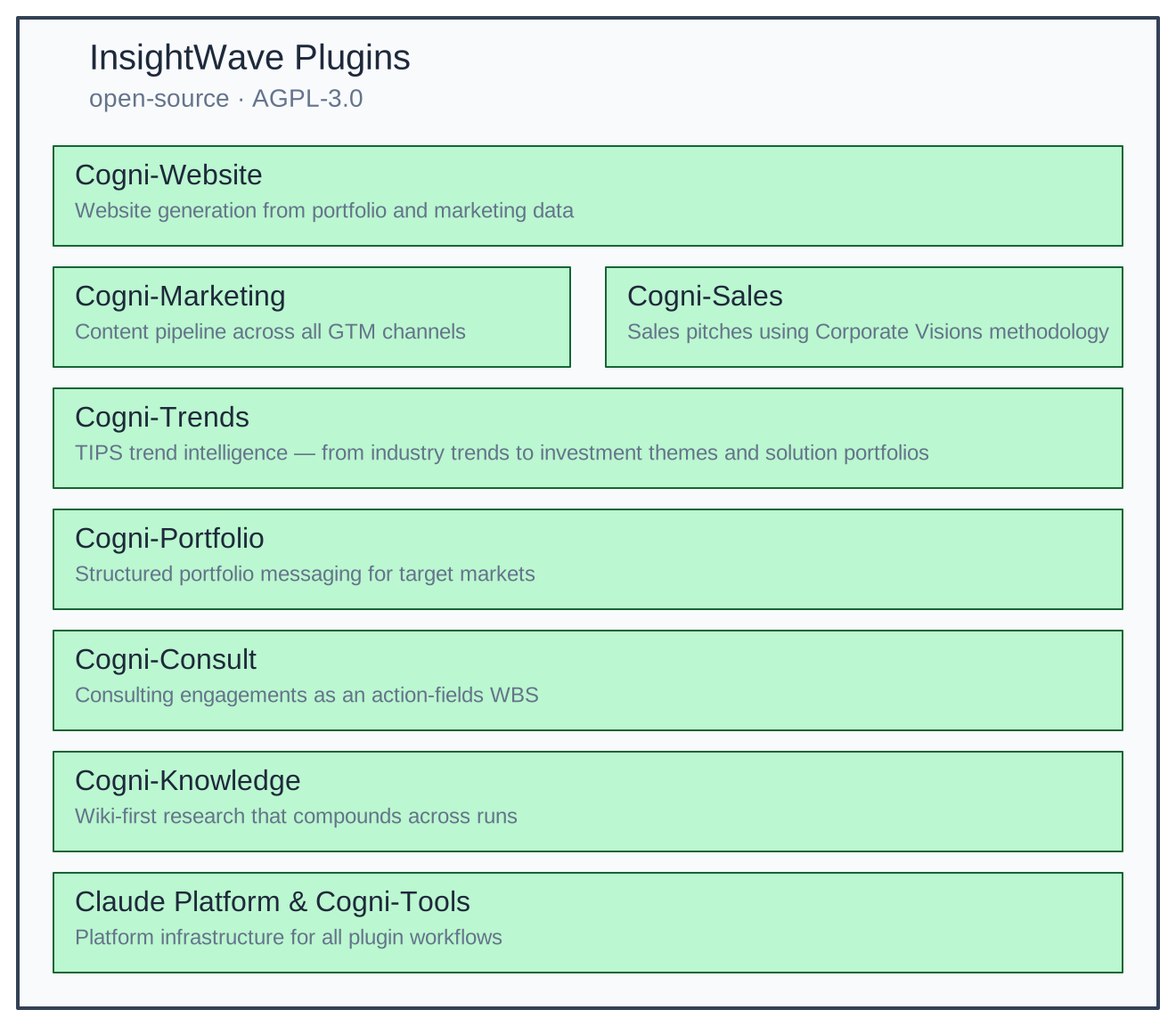 Plugin ecosystem architecture — edit source:
 assets/architecture.excalidraw
13 plugins organized around nine capability areas. Each area handles a distinct part of the consulting-to-delivery workflow; plugins within an area share data formats and can be used independently or together.
cogni-knowledge is the wiki-first research orchestrator — it binds its own vendored wiki knowledge base to any number of research projects so findings compound across runs instead of dying in chat history. Its zero-network inverted pipeline (plan → curate → fetch → ingest → compose → verify → finalize) deposits verified syntheses straight into the wiki, where future questions read them as prior framing. 12 skills.
"Set up a knowledge base on the EU AI Act and deposit my first research synthesis"
cogni-consult manages consulting engagements where action fields are the work-breakdown-structure containers for every deliverable. Scoping derives 3-6 action fields from one SMART key question; each deliverable runs its own design-thinking loop (empathize→define→ideate→prototype→test), acting stakeholder personas challenge the work in their own voice, and one cogni-knowledge base per engagement compounds research across all deliverables. 6 skills.
"I need to evaluate strategic options for expanding our cloud services portfolio in the DACH mid-market"
→ Plugin guide · Consulting Engagement workflow
cogni-trends scouts industry trends across four TIPS dimensions with bilingual DE/EN web research, producing 60 scored trend candidates per run using multi-framework analysis (TIPS, Ansoff, Rogers, CRAAP). The value-modeler consolidates candidates into 3-7 investment themes with solution blueprints. Reusable industry catalogs accumulate knowledge across engagements. European-first with curated institutional sources per market — German-rooted (VDMA, BITKOM, Fraunhofer) and extending across FR/IT/ES/NL/PL plus UK/US. 6 skills and 9 agents.
"Scout trends for the automotive industry, then model investment themes from the results"
→ Plugin guide · Trends to Solutions workflow
cogni-portfolio structures products, features, and target markets into market-specific value propositions using IS/DOES/MEANS messaging. 19 skills handle the full positioning lifecycle — from TAM/SAM/SOM market sizing and competitive analysis through three-layer quality assessment to export-ready proposals and workbooks. Eight industry taxonomies (ICT, SaaS, FinTech, HealthTech, MarTech, Industrial Tech, Professional Services, Open Source) classify your portfolio automatically. 19 skills and 20 agents.
"Set up a portfolio for our cloud monitoring product targeting mid-market SaaS companies in DACH"
→ Plugin guide · Portfolio to Pitch workflow
Own this plugin?
Verify ownership to unlock analytics, metadata editing, and a verified badge. GitHub access is read-only (username + org membership).
Sign in to claimOwn this plugin?
Verify ownership to unlock analytics, metadata editing, and a verified badge. GitHub access is read-only (username + org membership).
Sign in to claimnpx claudepluginhub cogni-work/insight-wave --plugin cogni-knowledgeB2B marketing content engine bridging cogni-trends strategic themes (GTM paths) and cogni-portfolio propositions into channel-ready content. Supports thought leadership, demand generation, lead generation, sales enablement, and ABM across markets with configurable brand voice. Bilingual DE/EN.
 cogni-work
Document polishing with messaging frameworks (BLUF, Pyramid, SCQA, STAR, PSB, FAB, Inverted Pyramid), parallel-persona stakeholder review, readability optimization, sales Power Positions, JSON field polishing (copy-json), arc audit against cogni-narrative, and translate-then-polish across DE/EN/FR/IT/PL/NL/ES via an EN/DE pivot. Arc-mode translation across all seven languages.
cogni-workFoundation-layer plugin for insight-wave marketplace plugins. Manages shared infrastructure (env vars, settings), MCP server installation and Desktop config patching, theme management, theme picker, plugin discovery, workspace health, an interactive workspace-configuration dashboard, Obsidian vault integration, and a bundled vendor-curated insight-wave reference wiki queryable via the ask skill.
cogni-workPortfolio messaging and proposition planning for SMEs using the IS/DOES/MEANS (FAB) framework — market-specific value propositions with competitive analysis, customer profiling, and export-ready deliverables across eight pluggable industry taxonomies and first-class market coverage spanning DACH/EU, UK/US, LATAM (MX/BR), and China (CN).
cogni-workConsulting engagement orchestrator where action fields are the work-breakdown-structure containers for every deliverable: each deliverable runs its own design-thinking loop (empathize→define→ideate→prototype→test), acting stakeholder personas challenge the work in their own voice, and one cogni-knowledge base per engagement is the central research tool that compounds across all deliverables.
cogni-workFoundation-layer plugin for insight-wave marketplace plugins. Manages shared infrastructure (env vars, settings), MCP server installation and Desktop config patching, theme management, theme picker, plugin discovery, workspace health, an interactive workspace-configuration dashboard, Obsidian vault integration, and a bundled vendor-curated insight-wave reference wiki queryable via the ask skill.
cogni-workResearch, search, and analysis specialists - market research, competitive analysis, trend forecasting, and idea validation
 VoltAgent
Structured deep research methodology for Claude Code — query decomposition, parallel web research with source verification, hallucination prevention, and synthesis into well-sourced documents
 oborchers
Upstash Context7 MCP server for up-to-date documentation lookup. Pull version-specific documentation and code examples directly from source repositories into your LLM context.
 upstash
v9.54.1 — Reliability wave: tangle contextual review correction loop with hard round ceiling, progress-supervised review rounds (per-agent stall watch, descendant-tree kills), council diversity and agy pin fixes, marketplace generator source-of-truth fix, provider troubleshooting runbook and cost-expectations docs. Run /octo:setup.
 nyldn
nyldnConsult multiple AI coding agents (Gemini, OpenAI, Grok, Perplexity, plus codex, antigravity, and grok CLIs when installed) to get diverse perspectives on coding problems
 hex
hex'%20stop-opacity%3D'0.16'%2F%3E%3Cstop%20offset%3D'1'%20stop-color%3D'rgb(200%2C90%2C60)'%20stop-opacity%3D'0.03'%2F%3E%3C%2FlinearGradient%3E%3C%2Fdefs%3E%3Crect%20width%3D'320'%20height%3D'200'%20fill%3D'url(%23g)'%2F%3E%3Ccircle%20cx%3D'250'%20cy%3D'56'%20r%3D'92'%20fill%3D'rgb(200%2C90%2C60)'%20fill-opacity%3D'0.06'%2F%3E%3Ccircle%20cx%3D'64'%20cy%3D'172'%20r%3D'58'%20fill%3D'rgb(200%2C90%2C60)'%20fill-opacity%3D'0.05'%2F%3E%3C%2Fsvg%3E)