Stats
Actions
Available In
Tags

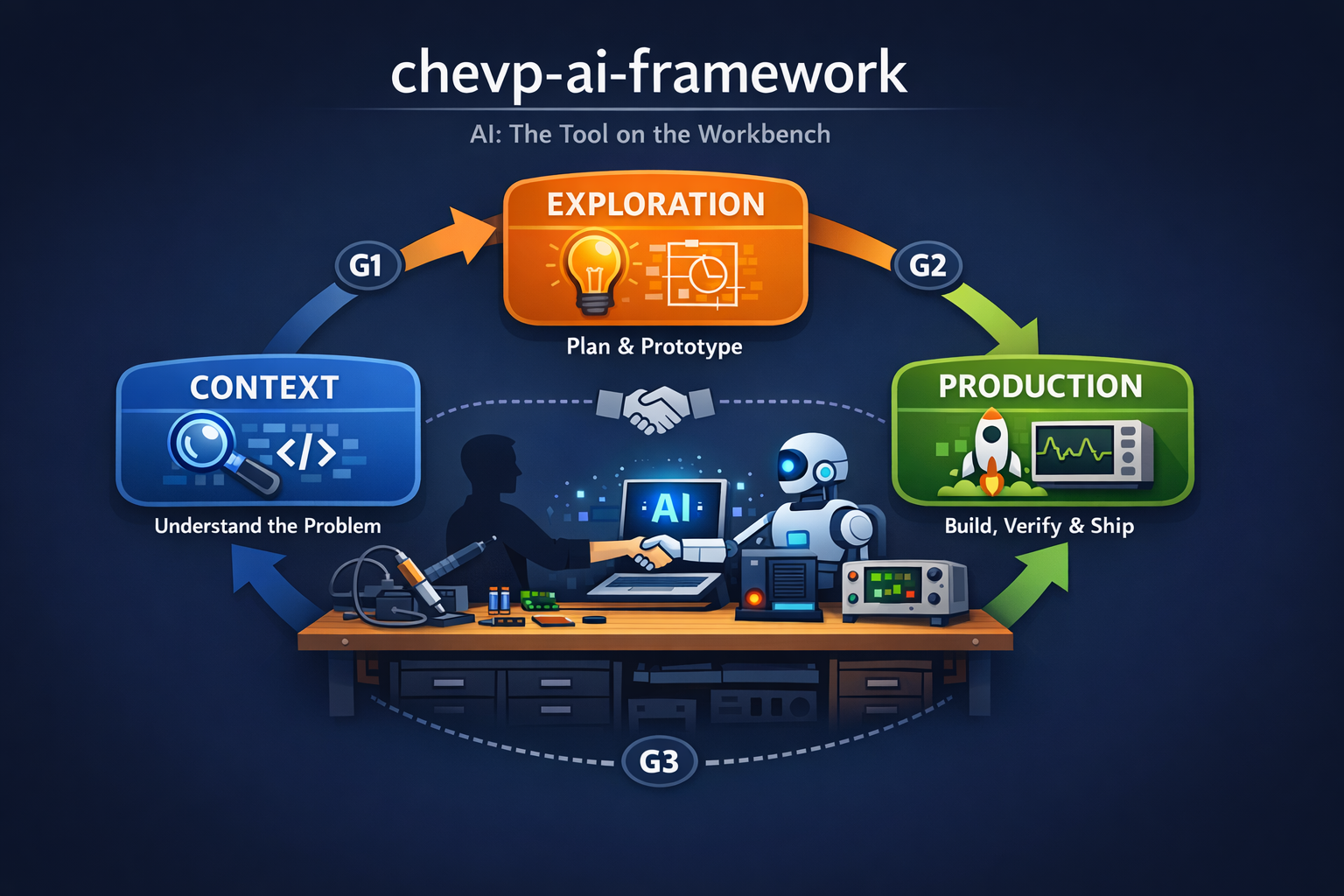
Process-driven AI collaboration lifecycle: Context -> Exploration -> Production with enforced quality gates (G1/G2/G3).
Record a human approval/acceptance for an artifact (ADR, CTX, EXP, PRD) in its provenance frontmatter.
Enter Context mode — read, verify, ask. No code changes allowed.
Promote a Plan Proposal (PROP-NNN) to a real CTX/EXP/PRD plan in its suggested chapter.
Enter Exploration mode — plan, design, prototype. No production code.
Validate a quality gate (G1, G2, or G3) against required deliverables.
> Many small reviewers. One orchestrator. Friction lives in the AI, not in the human.
Reviews plans, code changes, and ADRs against the project's architecture invariants. Use when a plan proposes a new pattern/layer, when changes cross architectural boundaries, or when a new ADR is drafted. Flags invariant violations.
Dispatcher kept for backward compatibility. Routes /gate-check requests to gatekeeper-g1 / gatekeeper-g2 / gatekeeper-g3. New code should invoke the specialised gatekeepers directly.
Validates the Context → Exploration transition (G1) of chevp-ai-framework. Use PROACTIVELY before any move from Context to Exploration and whenever /gate-check G1 is invoked. Returns a verdict (pass | block | conditional-pass), findings, and proposes Plan Proposals for out-of-scope items found in the CTX plan.
Validates the Exploration → Production transition (G2) of chevp-ai-framework. Use PROACTIVELY before any move from Exploration to Production and whenever /gate-check G2 is invoked. Returns a verdict (pass | block | conditional-pass), findings, and proposes Plan Proposals for out-of-scope items found in the EXP plan.
Use when the user wants to record an architecture decision, says "write an ADR", "new ADR", "document this decision", or when a non-trivial architectural choice is made during Context or Exploration that future contributors need to understand.
Use when the user starts a new task and a Context-Plan (CTX) is needed, or when they say "context plan", "CTX", "start context step", or a new request arrives with no active plan. Produces a CTX plan per the chevp-ai-framework template.
Use when a feature needs to be planned/designed in the Exploration step, or when the user says "EXP plan", "feature plan", "exploration plan", "design the feature". Produces an EXP plan/spec per chevp-ai-framework templates.
Use when an approved EXP plan is ready to be implemented and a Production-Plan (PRD) is needed, or when the user says "PRD plan", "production plan", "produce", "implement EXP-NNN", "draft PRD". Produces a PRD per the chevp-ai-framework template.
Use when an out-of-scope item, Challenger-identified failure mode, or NOT-in-Scope row warrants its own future plan (Rule 12). Trigger phrases: "create proposal", "PROP for this", "open a proposal", "log this for later", "this is out of scope but worth tracking". Produces a `PROP-NNN` file per the plan-proposal template.
Modifies files
Hook triggers on file write and edit operations
Uses power tools
Uses Bash, Write, or Edit tools
Own this plugin?
Verify ownership to unlock analytics, metadata editing, and a verified badge. GitHub access is read-only (username + org membership).
Sign in to claimOwn this plugin?
Verify ownership to unlock analytics, metadata editing, and a verified badge. GitHub access is read-only (username + org membership).
Sign in to claimBased on adoption, maintenance, documentation, and repository signals. Not a security audit or endorsement.
AI writes the code. You stay in control.
Three steps. Three checkpoints. No surprise commits.
A simple workflow that lets AI do the heavy lifting — and lets you stop it before it ships something you didn't agree to. Works with Claude Code, Cursor, or any AI assistant that can read Markdown.
A real exchange. The AI announces what it's about to do, then waits for you.
You: Add Google OAuth login to the app.

AI:  [Step 1: Understand]
     Before I write any code, here's what this will touch:
       • New files: auth/google.ts, routes/oauth.ts
       • Schema change: add oauth_provider column to users
       • New dependency: passport-google-oauth20
       • 3 existing tests need updating

     Does this scope look right?
     → [Yes, proceed] [Adjust scope] [Cancel]
The AI cannot move forward until you click. The same checkpoint repeats before planning, and again before any code reaches your repo.
Three steps, each ending with a checkpoint you control.
| Step | What happens | What you see |
|---|---|---|
| 1. Understand (01-context/) | The AI reads your code and confirms what the task actually is — in your terms, not its assumptions. | A short problem description, affected files, agreed scope. |
| 2. Plan (02-exploration/) | The AI proposes how to solve it — sometimes with a clickable prototype — before writing real code. | A written plan, an optional prototype, a record of any architectural decisions. |
| 3. Build (03-production/) | Only now does the AI write production code — following the plan you approved, nothing more. | Working code, passing tests, a clean commit. |
| Question | When | |
|---|---|---|
| Checkpoint 1 | Did we understand the task? | Before any planning starts. |
| Checkpoint 2 | Is the plan good? | Before any production code is written. |
| Checkpoint 3 | Does it actually work? | Before the change is considered done. |
Each checkpoint is enforced by a dedicated gatekeeper subagent (gatekeeper-g1/g2/g3) that returns pass | conditional-pass | block along with findings. Anything found out of scope becomes a PROP-NNN proposal in the backlog — out-of-scope items never disappear.
For the full matrix (roles, deliverables, evidence requirements, kill criteria), see LIFECYCLE.md. For the operating principle, see guidelines/uncertainty-reduction.md.
Everything else follows from these.
| Rule | Why |
|---|---|
| Context before code | AI without context invents things. The first step is always understanding. |
| A prototype is not the product | Quickly generated code must be reviewed and understood before it ships. |
| Small steps, with stops | Validate after each step. No silent leaps from idea to merged code. |
| The human decides | The AI suggests. You approve. The responsibility never moves. |
Pick the path that matches you.
Open your project's CLAUDE.md (or create one) and paste in this single line:
@url https://chevp.github.io/chevp-ai-framework/chevp-ai-framework.md
That's it. Ask the AI to do something. It will announce its step and wait for your approval. No fork, no submodule, no install.
For a project where you'll keep plans, specs, and decisions versioned in git:
@url reference above to CLAUDE.md.mkdir -p context/{architecture,adr,guidelines,plans/finished,specs}
See integration/ for project-specific patterns.
The Markdown files in this repo are the source of truth. On top of them, a thin Claude Code plugin layer turns the framework into callable surface area.
npx claudepluginhub chevp/chevp-ai-frameworkComplete collection of battle-tested Claude Code configs from an Anthropic hackathon winner - agents, skills, hooks, and rules evolved over 10+ months of intensive daily use
 xu-xiang
Complete creative writing suite with 10 specialized agents covering the full writing process: research gathering, character development, story architecture, world-building, dialogue coaching, editing/review, outlining, content strategy, believability auditing, and prose style/voice analysis. Includes genre-specific guides, templates, and quality checklists.
 greyhaven-ai
Unity Development Toolkit - Expert agents for scripting/refactoring/optimization, script templates, and Agent Skills for Unity C# development
 Dev-GOM
Comprehensive .NET development skills for modern C#, ASP.NET, MAUI, Blazor, Aspire, EF Core, Native AOT, testing, security, performance optimization, CI/CD, and cloud-native applications
 wshaddix
20 SEO/GEO skills and 5 commands on one shared contract for keyword research, content creation, technical audits, schema markup, monitoring, quality gates, entity truth, and campaign memory.
 aaron-he-zhu
Comprehensive SEO analysis plugin for Claude Code. 25 sub-skills (21 core + 1 orchestrator + 1 framework + 2 extension mirrors) and 18 sub-agents cover technical SEO, content quality, schema, sitemaps, Core Web Vitals, local SEO, backlinks, AI/GEO, ecommerce, hreflang, SXO, clustering, drift monitoring, and Google APIs. Includes optional MCP extensions, SPA-aware rendering, portability, and hardened SSRF/DNS-rebinding safe fetchers.
 AgriciDaniel
'%20stop-opacity%3D'0.16'%2F%3E%3Cstop%20offset%3D'1'%20stop-color%3D'rgb(200%2C90%2C60)'%20stop-opacity%3D'0.03'%2F%3E%3C%2FlinearGradient%3E%3C%2Fdefs%3E%3Crect%20width%3D'320'%20height%3D'200'%20fill%3D'url(%23g)'%2F%3E%3Ccircle%20cx%3D'250'%20cy%3D'56'%20r%3D'92'%20fill%3D'rgb(200%2C90%2C60)'%20fill-opacity%3D'0.06'%2F%3E%3Ccircle%20cx%3D'64'%20cy%3D'172'%20r%3D'58'%20fill%3D'rgb(200%2C90%2C60)'%20fill-opacity%3D'0.05'%2F%3E%3C%2Fsvg%3E)