Stats
Actions
Available In
Tags
Persistent filesystem-based memory for Claude Code that captures decisions, learnings, and context across sessions, supports custom ontologies, semantic search, health auditing, and integration with existing plugins.
Haiku-based agent for compressing verbose memories into concise summaries
Autonomous memory maintenance and curation agent for conflict detection, deduplication, and decay management
Efficient memory search agent for iterative query refinement. Executes targeted ripgrep searches and returns structured findings.
Discovers entities in codebase based on ontology patterns
Cross-session handoff, persistent context via blackboard, and agent coordination patterns
This skill should be used when the user says "capture memory", "save to memory", "remember this", or trigger phrases like: "I've decided", "let's use", "we're going with", "I learned", "turns out", "TIL", "discovered", "I'm stuck", "blocked by", "always use", "never do", "convention is". Also triggers on recall phrases: "what did we decide", "how do we handle", "remind me", "search memories".
Memory system custodian for health checks, validation, and maintenance. Trigger phrases: "check memory health", "validate memories", "fix broken links", "update decay", "relocate memories", "audit memories", "memory maintenance", "custodian", "memory health"
MIF Level 3 specification, memory templates, and formatting guidelines
This skill should be used when the user asks to "integrate mnemonic", "wire plugin", "add memory to plugin", "enable memory capture in plugin", "integrate memory operations", "add mnemonic protocol", "remove mnemonic integration", "rollback plugin integration", or "migrate legacy memory sections". It wires mnemonic memory capture and recall workflows into other Claude Code plugins using sentinel markers.
Executes bash commands
Hook triggers when Bash tool is used
Modifies files
Hook triggers on file write and edit operations
Own this plugin?
Verify ownership to unlock analytics, metadata editing, and a verified badge. GitHub access is read-only (username + org membership).
Sign in to claimOwn this plugin?
Verify ownership to unlock analytics, metadata editing, and a verified badge. GitHub access is read-only (username + org membership).
Sign in to claimBased on adoption, maintenance, documentation, and repository signals. Not a security audit or endorsement.
Uses power tools
Uses Bash, Write, or Edit tools
Uses power tools
Uses Bash, Write, or Edit tools



A pure filesystem-based memory system for Claude Code. No external dependencies - all operations use standard Unix tools and Claude's native capabilities.
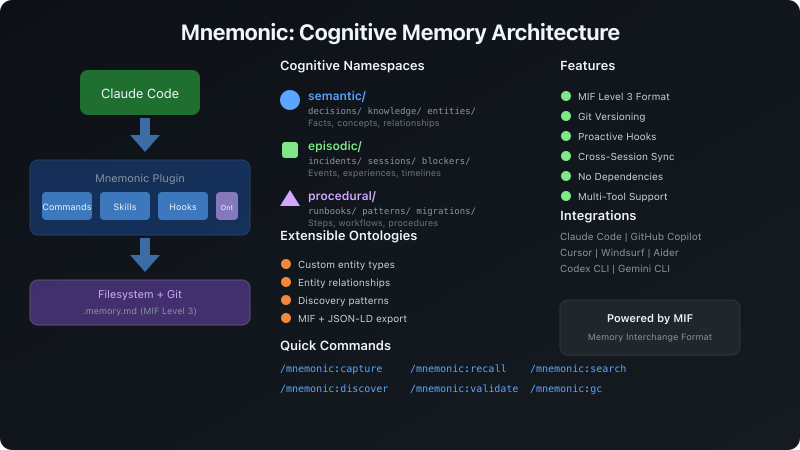
Note: This plugin implements the Memory Interchange Format (MIF) specification for standardized AI memory storage. MIF defines a portable, human-readable format for persistent AI memories.
Research validates the filesystem approach for AI memory. In Letta's LoCoMo benchmark, filesystem-based memory achieved 74.0% accuracy compared to Mem0's graph-based approach at 68.5%. This counterintuitive result has a simple explanation: LLMs are extensively pretrained on filesystem operations, making simple tools more reliable than specialized knowledge graphs or vector databases.
This approach is grounded in Unix philosophy, as articulated in "From Everything is a File to Files Are All You Need". Just as Unix collapsed diverse device interfaces into uniform file operations, AI agents benefit from the same abstraction—complexity is encapsulated, not eliminated.
Key advantages of the filesystem approach:
grep, find, and file operations from training data# Load the plugin
claude --plugin-dir /path/to/mnemonic
# Or add to settings for permanent installation
claude settings plugins add /path/to/mnemonic
# Initialize mnemonic for your project
/mnemonic:setup

# Capture a memory
/mnemonic:capture decisions "Use PostgreSQL for storage" --tags database,architecture

# Recall memories
/mnemonic:recall --namespace decisions

# Search memories
/mnemonic:search "authentication"

# Check status
/mnemonic:status
All memories are stored under ${MNEMONIC_ROOT}/ with a unified path structure:
${MNEMONIC_ROOT}/
├── default/                           # Fallback when org detection fails
│   └── {namespace}/                   # Cognitive triad namespaces
├── {org}/                             # Organization-level
│   ├── semantic/                      # Org-wide facts/knowledge
│   │   ├── decisions/
│   │   ├── knowledge/
│   │   └── entities/
│   ├── episodic/                      # Org-wide events
│   │   ├── incidents/
│   │   ├── sessions/
│   │   └── blockers/
│   ├── procedural/                    # Org-wide procedures
│   │   ├── runbooks/
│   │   ├── patterns/
│   │   └── migrations/
│   └── {project}/                     # Project-specific memories
│       ├── semantic/
│       │   ├── decisions/
│       │   ├── knowledge/
│       │   └── entities/
│       ├── episodic/
│       │   ├── incidents/
│       │   ├── sessions/
│       │   └── blockers/
│       ├── procedural/
│       │   ├── runbooks/
│       │   ├── patterns/
│       │   └── migrations/
│       └── .blackboard/               # Project session coordination
└── .git/                              # Version control
Memory scope hierarchy:
{org}/{project}/ - Project-specific memories (default){org}/ - Organization-wide memories (shared across projects)default/ - Fallback when org cannot be detectedEach memory is a .memory.md file with YAML frontmatter:
MIF compliance for structured-MADR ADRs: a per-level projector and validator, an ADR-typing ontology, an authoring skill/agent/commands, and an authoring-time enforcement hook. The conformance level is selected in .github/config.yml.
 modeled-information-format
Git-versioned, taxonomy-structured memory for Claude Code — recall by path, branch to isolate, time-travel to audit.
 zhangfengcdt
Persistent semantic memory for Claude Code — auto-injects relevant context at session start, captures git commits, test results, and research via hooks, and provides 30+ MCP tools for memory management.
 agentic-box
Curated persistent memory for Claude Code. Write gate prevents bloat — only behavior-changing facts get saved. Tiered architecture: daily logs, structured registers, and auto-loaded working memory.
 davegoldblatt
Persistent memory across Claude Code sessions using Cognis
 Lyzr-Cognis
Extended Second Brain that learns as you work in Claude Code
 remember-md
Persistent memory system for Claude Code with enforced context
npx claudepluginhub modeled-information-format/mnemonic
'%20stop-opacity%3D'0.16'%2F%3E%3Cstop%20offset%3D'1'%20stop-color%3D'rgb(200%2C90%2C60)'%20stop-opacity%3D'0.03'%2F%3E%3C%2FlinearGradient%3E%3C%2Fdefs%3E%3Crect%20width%3D'320'%20height%3D'200'%20fill%3D'url(%23g)'%2F%3E%3Ccircle%20cx%3D'250'%20cy%3D'56'%20r%3D'92'%20fill%3D'rgb(200%2C90%2C60)'%20fill-opacity%3D'0.06'%2F%3E%3Ccircle%20cx%3D'64'%20cy%3D'172'%20r%3D'58'%20fill%3D'rgb(200%2C90%2C60)'%20fill-opacity%3D'0.05'%2F%3E%3C%2Fsvg%3E)
