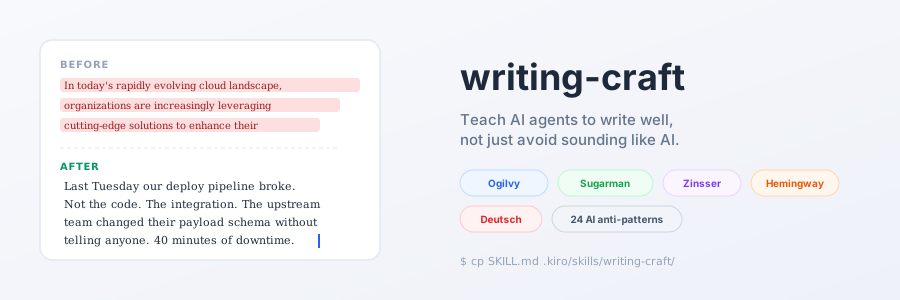
One file that teaches your AI agent how sentences work. Word choice, rhythm, loss framing, the slippery slide, and 24 patterns to catch when the output drifts back toward safe and smooth.
I built this because I kept pasting the same editing instructions into every session. Fix the hedge words. Cut the throat-clearing. Make it concrete. One file that carries those rules everywhere was overdue.
Models are trained to produce text that's pleasant to skim and hard to disagree with. RLHF rewards smooth, safe, hedged prose. This skill produces the opposite: writing that takes a position, names a specific failure, and rewards readers who pay attention.
See it work
Same idea, run through edit mode. The input passes most AI detectors. It still reads like nobody wrote it.
Before (the AI first draft):
In today's rapidly evolving development landscape, leveraging AI coding assistants has become increasingly crucial. These powerful tools can significantly enhance developer productivity and streamline workflows, empowering teams to focus on what truly matters.
After (edit mode output):
AI coding assistants handle the boring parts: boilerplate, test scaffolds, the third CRUD endpoint that looks like the first two. They will not decide what to build for you. That part is still yours.
The skill flagged six tells in the first version (in today's, landscape, leveraging, crucial, enhance, empowering), then rewrote for a concrete claim instead of swapping synonyms.
Quick start
Copy one file. That's the install.
# Claude Code / Kiro CLI (project-level, shared via git)
mkdir -p .kiro/skills/writing-craft
cp SKILL.md .kiro/skills/writing-craft/SKILL.md
# User-level (applies to all your projects)
mkdir -p ~/.kiro/skills/writing-craft
cp SKILL.md ~/.kiro/skills/writing-craft/SKILL.md
Works with any agent that reads markdown instructions: Claude Code, Kiro CLI, Cursor, VS Code Copilot, OpenHands.
What's inside
The skill has two modes.
Write mode drafts content from scratch using craft principles. Opens concrete, grounds every claim, closes with action.
Edit mode reviews existing text, flags problems, rewrites flagged passages. Triggered by "edit this," "review this," or =C= (grammar and clarity only).
Craft principles (the generative half)
Classic copywriting applied to technical writing:
- 🔤 Word choice (Ogilvy/Halbert): "use" not "utilize," concrete nouns, active verbs, cut adverbs
- 📐 Sentence craft (Sugarman): the slippery slide, short first sentences, one idea per sentence
- 📄 Paragraph craft (Zinsser): lead with the point, one thought per paragraph, kill throat-clearing
- 🎵 Rhythm (Deutsch): copy works like music, vary length, reprise themes
- 🎯 Loss framing: frame what the reader loses by not acting, not what they gain
- 🔍 Knowledge advantage: specific frustration beats general benefit
- ✂️ The editing principle: "I'm not a great writer, but I'm a hell of an editor" (Ogilvy)
Anti-pattern checklist (the defensive half)
24 categories of AI writing tells, organized by type:
| Category | Examples |
|---|
| Vocabulary (3 tiers) | delve, tapestry, leverage, robust, seamless, harness, foster, resonate |
| Structure | Significance inflation, empty -ing phrases, "Despite" formula, copula avoidance |
| Formatting | Em dash overuse, bold-as-study-guide, inline-header lists |
| Content | Vague attribution, chatbot artifacts, "Let's explore," rhetorical questions |
| Rhythm | Sentence uniformity, paragraph uniformity, missing first-person, over-polishing |
How it's different

 vidanov
 JuliusBrussee
 anthropics
 thedotmack
 coreyhaines31
 wshobson
 Lucklyric



'%20stop-opacity%3D'0.16'%2F%3E%3Cstop%20offset%3D'1'%20stop-color%3D'rgb(200%2C90%2C60)'%20stop-opacity%3D'0.03'%2F%3E%3C%2FlinearGradient%3E%3C%2Fdefs%3E%3Crect%20width%3D'320'%20height%3D'200'%20fill%3D'url(%23g)'%2F%3E%3Ccircle%20cx%3D'250'%20cy%3D'56'%20r%3D'92'%20fill%3D'rgb(200%2C90%2C60)'%20fill-opacity%3D'0.06'%2F%3E%3Ccircle%20cx%3D'64'%20cy%3D'172'%20r%3D'58'%20fill%3D'rgb(200%2C90%2C60)'%20fill-opacity%3D'0.05'%2F%3E%3C%2Fsvg%3E)