Stats
Actions
Available In
Tags
Skills for adding DeepEval evaluations, tracing, datasets, Confident AI reports, and iterative improvement loops to AI applications.
DeepEval evaluation workflow for AI agents and LLM applications. TRIGGER when the user wants to evaluate or improve an AI agent, tool-using workflow, multi-turn chatbot, RAG pipeline, or LLM app; add evals; generate datasets or goldens; use deepeval generate; use deepeval test run; send results to Confident AI; monitor production; run online evals; inspect traces; or iterate on prompts, tools, retrieval, or agent behavior from eval failures. AI agents are the primary use case. Covers Python SDK, pytest eval suites, CLI generation, traced evals, Confident AI reporting, and agent-driven improvement loops. DO NOT TRIGGER for unrelated generic pytest, non-AI test setup, or non-DeepEval observability work unless the user asks to compare or migrate to DeepEval; for instrumenting an app with DeepEval tracing, @observe, or framework integrations (use the `deepeval-tracing` skill); or for raw OpenTelemetry / OTLP export without the deepeval package (use the `deepeval-otel` skill).
Export raw OpenTelemetry traces from an AI application to Confident AI's Observatory. TRIGGER when the user wants to send OpenTelemetry or OTLP traces/spans from an LLM app, agent, RAG pipeline, or chatbot to Confident AI; configure the Confident AI OTLP endpoint; set confident.span.* or confident.trace.* attributes; export AI-app traces to Confident AI without the deepeval Python package; wire an OTLPSpanExporter, OpenTelemetry Collector, or vendor-neutral OTel SDK to Confident AI; or pick the US vs EU Confident AI OTLP endpoint. Language-agnostic — the mechanism is OTLP attribute keys plus an exporter endpoint. DO NOT TRIGGER for building DeepEval pytest eval suites, datasets, goldens, metrics, or deepeval test run (use the `deepeval` skill); for instrumenting with the DeepEval SDK's @observe decorator or framework integrations (use the `deepeval-tracing` skill); or for instrumenting non-AI software such as web servers, CRUD backends, or infrastructure — the confident.* attributes describe AI components (agents, LLM calls, retrievers, tools) and apply to AI applications only.
Instrument an AI application with DeepEval's native tracing so its behavior is visible in Confident AI. TRIGGER when the user wants to add DeepEval tracing or @observe to an LLM app, agent, RAG pipeline, or chatbot; wire a framework, model-provider, or vector-database integration (LangGraph, LangChain, OpenAI Agents, LlamaIndex, Pydantic AI, CrewAI, and others); choose between a native integration and manual instrumentation; set span types, tags, or metadata; or send DeepEval-SDK traces to Confident AI's Observatory. DO NOT TRIGGER for building DeepEval pytest eval suites, datasets, goldens, metrics, or deepeval test run (use the `deepeval` skill), or for raw OpenTelemetry / OTLP export without the deepeval package (use the `deepeval-otel` skill). This skill is purely DeepEval-SDK instrumentation — producing well-formed traces, not running evals.
Own this plugin?
Verify ownership to unlock analytics, metadata editing, and a verified badge. GitHub access is read-only (username + org membership).
Sign in to claimOwn this plugin?
Verify ownership to unlock analytics, metadata editing, and a verified badge. GitHub access is read-only (username + org membership).
Sign in to claimBased on adoption, maintenance, documentation, and repository signals. Not a security audit or endorsement.


Documentation | Metrics and Features | Getting Started | Integrations | Confident AI




Deutsch | Español | français | 日本語 | 한국어 | Português | Русский | 中文
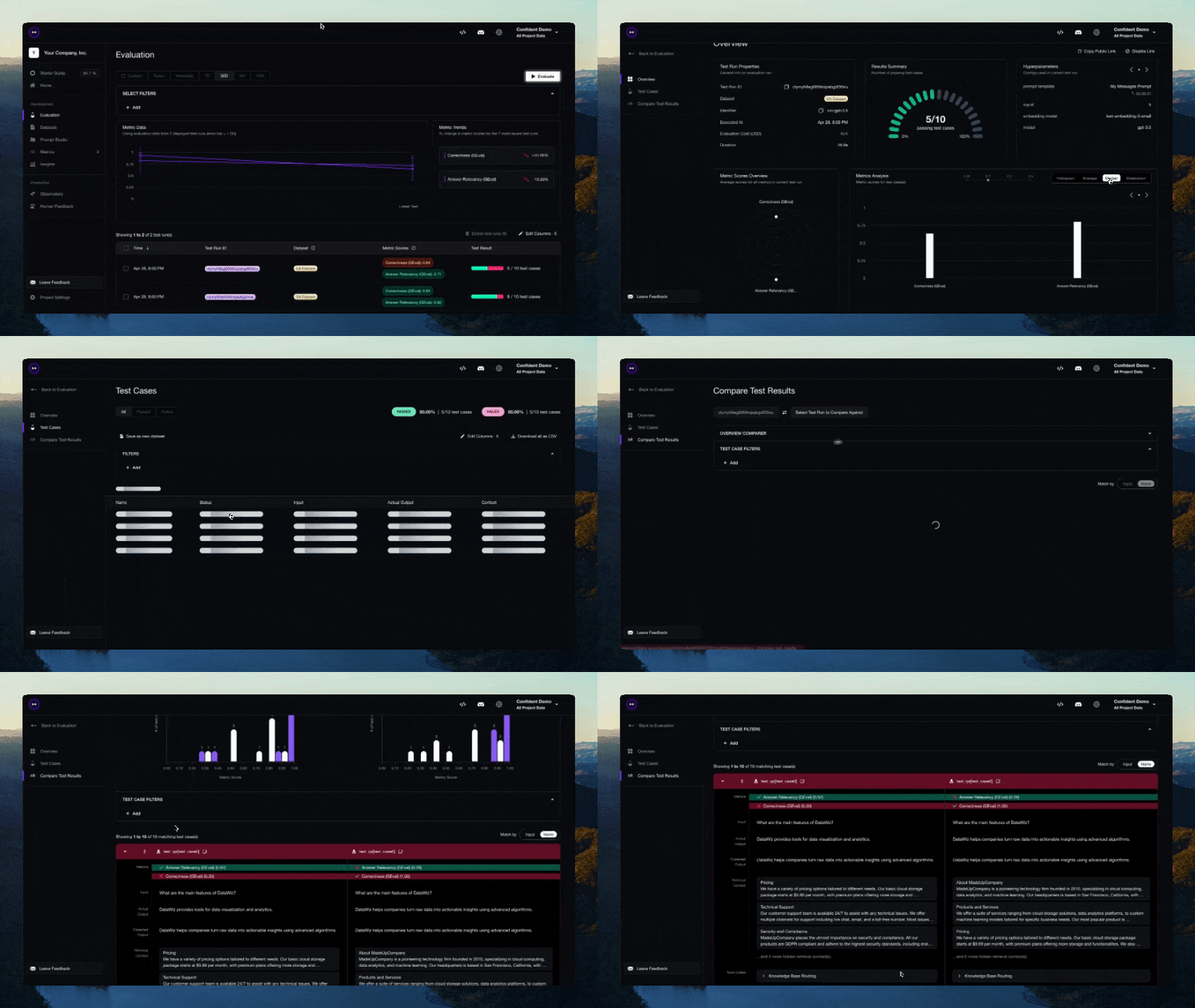
DeepEval is a simple-to-use, open-source LLM evaluation framework, for evaluating large-language model systems. It is similar to Pytest but specialized for unit testing LLM apps. DeepEval incorporates the latest research to run evals via metrics such as G-Eval, task completion, answer relevancy, hallucination, etc., which uses LLM-as-a-judge and other NLP models that run locally on your machine.
Whether you're building AI agents, RAG pipelines, or chatbots, implemented via LangChain or OpenAI, DeepEval has you covered. With it, you can easily determine the optimal models, prompts, and architecture to improve your AI quality, prevent prompt drifting, or even transition from OpenAI to Claude with confidence.
[!IMPORTANT] Need a place for your DeepEval testing data to live 🏡❤️? Sign up to Confident AI to compare iterations of your LLM app, generate & share testing reports, and more.
Want to talk LLM evaluation, need help picking metrics, or just to say hi? Come join our discord.
📐 Large variety of ready-to-use LLM eval metrics (all with explanations) powered by ANY LLM of your choice, statistical methods, or NLP models that run locally on your machine covering all use cases:
npx claudepluginhub shaneholloman/deepevalAI-supervised issue tracker for coding workflows. Manage tasks, discover work, and maintain context with simple CLI commands.
 shaneholloman
Keep your coding agent up to date with the latest web best practices
 shaneholloman
Core Hugging Face Hub operations through the hf CLI, including skill installation, repo management, jobs, datasets, models, Spaces, and discovery.
shanehollomanLazy senior dev mode. Forces the simplest, shortest solution that actually works: YAGNI, stdlib first, no unrequested abstractions.
shanehollomanSkills for the NetBox ecosystem — data modeling, API integration, plugin development, change management, discovery, assurance, validation, asset lifecycle, data exchange, agent/MCP integration, automation, and migration.
shanehollomanComprehensive skill pack with 66 specialized skills for full-stack developers: 12 language experts (Python, TypeScript, Go, Rust, C++, Swift, Kotlin, C#, PHP, Java, SQL, JavaScript), 10 backend frameworks, 6 frontend/mobile, plus infrastructure, DevOps, security, and testing. Features progressive disclosure architecture for 50% faster loading.
 Jeffallan
A growing collection of Claude-compatible academic workflow bundles. Covers scientific figures, manuscript writing and polishing, reviewer assessment, citation retrieval, data availability, paper reading, literature search, response letters, paper-to-PPTX conversion, and evidence-grounded Chinese invention patent drafting. Rules are organized as reusable skill folders with explicit workflows and quality checks.
 Yuan1z0825
Complete creative writing suite with 10 specialized agents covering the full writing process: research gathering, character development, story architecture, world-building, dialogue coaching, editing/review, outlining, content strategy, believability auditing, and prose style/voice analysis. Includes genre-specific guides, templates, and quality checklists.
 greyhaven-ai
UI/UX design intelligence. Searchable local database with 84 styles, 161 palettes, 73 font pairings, 25 charts, and 17 stacks (React, Next.js, Vue, Nuxt.js, Nuxt UI, Svelte, Astro, SwiftUI, React Native, Flutter, Tailwind, shadcn/ui, Jetpack Compose, Angular, Laravel, JavaFX, Three.js). Use when designing, building, or reviewing UI: pages, components, color schemes, typography, layout, accessibility, animation, or data visualization.
 nextlevelbuilder
This skill should be used when users need to generate ideas, explore creative solutions, or systematically brainstorm approaches to problems. Use when users request help with ideation, content planning, product features, marketing campaigns, strategic planning, creative writing, or any task requiring structured idea generation. The skill provides 30+ research-validated prompt patterns across 14 categories with exact templates, success metrics, and domain-specific applications.
 Jamie-BitFlight
Develop, test, build, and deploy Godot 4.x games with Claude Code. Includes GdUnit4 testing, web/desktop exports, CI/CD pipelines, and deployment to Vercel/GitHub Pages/itch.io.
 Randroids-Dojo
'%20stop-opacity%3D'0.16'%2F%3E%3Cstop%20offset%3D'1'%20stop-color%3D'rgb(200%2C90%2C60)'%20stop-opacity%3D'0.03'%2F%3E%3C%2FlinearGradient%3E%3C%2Fdefs%3E%3Crect%20width%3D'320'%20height%3D'200'%20fill%3D'url(%23g)'%2F%3E%3Ccircle%20cx%3D'250'%20cy%3D'56'%20r%3D'92'%20fill%3D'rgb(200%2C90%2C60)'%20fill-opacity%3D'0.06'%2F%3E%3Ccircle%20cx%3D'64'%20cy%3D'172'%20r%3D'58'%20fill%3D'rgb(200%2C90%2C60)'%20fill-opacity%3D'0.05'%2F%3E%3C%2Fsvg%3E)