Stats
Actions
Available In
Tags
Lazy senior dev mode. Forces the simplest, shortest solution that actually works: YAGNI, stdlib first, no unrequested abstractions.
LLM-as-judge design the lazy way: pick direct-scoring vs pairwise, mitigate judge bias, calibrate rubrics and confidence, validate against humans. A judge call is context spend — load only the criteria, evidence, and passes that earn the verdict. Use when the user says "LLM as judge", "score this output", "pairwise comparison", "evaluator bias", "rubric calibration", "is my eval reliable", "A/B my prompt", or invokes /advanced-evaluation.
Model agent mental states as beliefs, desires, intentions over RDF context — cognitive chains, world-state grounding, the Triples→Beliefs→Triples pipeline, explainable agency traces. Use when the user says "model beliefs desires intentions", "BDI", "BDI ontology", "agent mental states", "why did the agent act", "rational agency trace", "RDF to beliefs", "neuro-symbolic", or invokes /bdi-mental-states.
Compress long agent sessions and oversized codebases without losing load-bearing facts — structured summaries, compaction triggers, artifact-trail preservation, durable handoff summaries. Use when the user says "compress context", "summarize this session", "compaction strategy", "handoff summary", "the agent forgot what files it edited", "context window is full", "tokens per task", or invokes /context-compression.
Diagnose and fix context failures: lost-in-middle, poisoning, distraction, confusion, clash. Detection signals + mitigation per pattern, degradation thresholds, the write/select/compress/isolate framework. Use when an agent degrades over a long conversation, "lost in the middle", "context poisoning", "context clash", "context confusion", "agent got worse", "ignoring earlier context", or invokes /context-degradation.
The mental models behind context engineering: what context is, the anatomy of a context window, attention mechanics, the U-shaped (lost-in-middle) curve, and why signal density beats volume. Conceptual grounding, not operational tactics. Use when the user says "what is context engineering", "explain context windows", "attention budget", "lost in the middle", "why does quality beat quantity", "onboard me on context", or invokes /context-fundamentals.
Own this plugin?
Verify ownership to unlock analytics, metadata editing, and a verified badge. GitHub access is read-only (username + org membership).
Sign in to claimOwn this plugin?
Verify ownership to unlock analytics, metadata editing, and a verified badge. GitHub access is read-only (username + org membership).
Sign in to claimBased on adoption, maintenance, documentation, and repository signals. Not a security audit or endorsement.

He says nothing. He writes one line. It works.




80-94% less code · 3-6× faster · 47-77% cheaper
Median of 10 runs across Haiku, Sonnet, and Opus. Reproduce it yourself.
NWBZPWNR — a fork of ponytail. Same lazy senior dev, plus extra skills (
ponytail-skill,ponytail-claude-md).
You know him. Long ponytail. Oval glasses. Has been at the company longer than the version control. You show him fifty lines; he looks at them, says nothing, and replaces them with one.
Ponytail puts him inside your AI agent.
You ask for a date picker. Your agent installs flatpickr, writes a wrapper component, adds a stylesheet, and starts a discussion about timezones.
With ponytail:
<!-- ponytail: browser has one -->
<input type="date">
More survivors in examples/.
Five everyday tasks (email validator, debounce, CSV sum, countdown timer, rate limiter), three models, three arms: no skill, the caveman skill, and ponytail. Ten runs per cell, median reported.
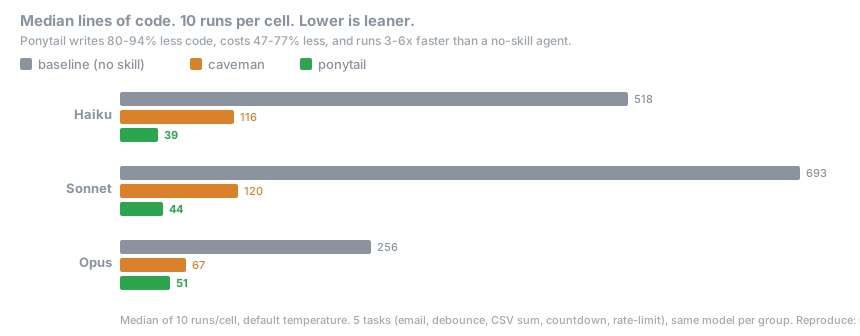
80-94% less code, 47-77% less cost, and 3-6× faster than a no-skill agent, on every model. Every shortcut ponytail takes is marked in the code with a ponytail: comment naming its upgrade path. Reproduce it yourself: npx promptfoo eval -c benchmarks/promptfooconfig.yaml. Method and raw numbers: benchmarks/. Production-grade tasks, where an unconstrained agent bloats far more, are written up in benchmarks/results/.
Before writing code, the agent stops at the first rung that holds:
1. Does this need to exist?   → no: skip it (YAGNI)
2. Stdlib does it?            → use it
3. Native platform feature?   → use it
4. Installed dependency?      → use it
5. One line?                  → one line
6. Only then: the minimum that works
Lazy, not negligent: trust-boundary validation, data-loss handling, security, and accessibility are never on the chopping block.
The most effort ponytail will ever ask of you:
/plugin marketplace add DietrichGebert/ponytail
/plugin install ponytail@ponytail
codex plugin marketplace add DietrichGebert/ponytail
codex
Open /plugins, select the Ponytail marketplace, and install Ponytail. Then
open /hooks, review and trust its two lifecycle hooks, and start a new thread.
pi install git:github.com/DietrichGebert/ponytail
Run OpenCode from a checkout of this repo (the plugin reuses its hooks/ and skills/), and add to opencode.json:
{ "plugin": ["./.opencode/plugins/ponytail.mjs"] }
Injects the ruleset every turn at the active level; adds /ponytail and /ponytail-review. OpenCode also auto-loads this repo's AGENTS.md, so the rules hold even without the plugin. The plugin adds the lite/full/ultra/off levels.
That was it. He'd be proud. He won't say it.
Active every session. /ponytail-review finds what to delete in your diff. /ponytail ultra exists for when the codebase has wronged you personally. /ponytail-help explains the rest.
This fork adds three more. /ponytail-skill writes a new skill the lazy way — runs the ladder first and tells you when the skill shouldn't exist at all. /ponytail-claude-md updates CLAUDE.md without bloating it: every line is a per-session token tax, so it adds only what overrides a default and routes the rest elsewhere. /ponytail-critique audits a plan before you build it — keep / cut / shrink / defer verdicts on whether each piece is worth the code, the forward gate to /ponytail-review's backward one.
npx claudepluginhub robertbarclayy/nwbzpwnr --plugin ponytailLazy senior dev mode. Forces the simplest, shortest solution that actually works: YAGNI, stdlib first, no unrequested abstractions.
 DietrichGebert
Evidence-gated AI coding workflow: scan → analyze → plan → TDD → execute → fix → verify → review, powered by Codebase Memory MCP >= 0.9.0 with optional Serena LSP intelligence. Includes blast-radius planning, test/cycle gates, independent review, and Windows Git Bash hook auto-resolution.
 datit309
Comprehensive skill pack with 66 specialized skills for full-stack developers: 12 language experts (Python, TypeScript, Go, Rust, C++, Swift, Kotlin, C#, PHP, Java, SQL, JavaScript), 10 backend frameworks, 6 frontend/mobile, plus infrastructure, DevOps, security, and testing. Features progressive disclosure architecture for 50% faster loading.
 Jeffallan
Develop, test, build, and deploy Godot 4.x games with Claude Code. Includes GdUnit4 testing, web/desktop exports, CI/CD pipelines, and deployment to Vercel/GitHub Pages/itch.io.
 Randroids-Dojo
Consult multiple AI coding agents (Gemini, OpenAI, Grok, Perplexity, plus codex, antigravity, and grok CLIs when installed) to get diverse perspectives on coding problems
 hex
hexProduction-grade engineering skills for AI coding agents — covering the full software development lifecycle from spec to ship.
 addyosmani
'%20stop-opacity%3D'0.16'%2F%3E%3Cstop%20offset%3D'1'%20stop-color%3D'rgb(200%2C90%2C60)'%20stop-opacity%3D'0.03'%2F%3E%3C%2FlinearGradient%3E%3C%2Fdefs%3E%3Crect%20width%3D'320'%20height%3D'200'%20fill%3D'url(%23g)'%2F%3E%3Ccircle%20cx%3D'250'%20cy%3D'56'%20r%3D'92'%20fill%3D'rgb(200%2C90%2C60)'%20fill-opacity%3D'0.06'%2F%3E%3Ccircle%20cx%3D'64'%20cy%3D'172'%20r%3D'58'%20fill%3D'rgb(200%2C90%2C60)'%20fill-opacity%3D'0.05'%2F%3E%3C%2Fsvg%3E)