Stats
Actions
Available In
Tags

Manage systems engineering models — author requirements, specifications, ontologies, and semantic contracts; analyze model quality, coverage, and change impact; orchestrate verification traceability and refactoring via CLI.
Model quality and diagnostic skill for Reqvire. Use when (1) analyzing model structure, coverage gaps, and improvement recommendations, (2) checking verification coverage and identifying unverified leaf requirements, (3) linting and fixing model quality issues, (4) finding redundant verify relations, or (5) analyzing change impact for modified requirements and capabilities.
Expert workflow for authoring Reqvire native concept schemes and concepts as SKOS thesauri. Use when creating or revising `concept-scheme` or `concept` elements, designing controlled vocabularies, concept taxonomies, broader/narrower/related links, labels, definitions, scope notes, examples, mappings, concept scheme namespaces, or concept references to native concept elements. Use instead of ontology-authoring when the task is terminology/thesaurus/concept curation rather than structural OWL/Turtle vocabulary or SHACL contracts.
Expert workflow for creating, extending, and validating Reqvire structural ontology elements for IT engineering, systems engineering, MBSE, and system-of-interest modeling. Use for competency-question-driven OWL/Turtle vocabulary, semantic-contract boundaries, ontology hierarchy, domain/range/property modeling, individuals, axioms, SHACL target vocabulary, structural-to-concept bridges, and Reqvire validation; trigger when the assistant needs to add or revise ontology elements, author
Expert semantic engineering and MBSE skill for Reqvire. Use when (1) exploring engineering knowledge graphs, (2) adding capabilities with proper ontology, requirement, and verification traceability, (3) refactoring cluttered models and extracting specifications, (4) generating implementation tasks from capability-scoped requirement changes, including governance metadata, owner routing, priority, risk, and status, (5) validating model health or checking coverage, (6) any work involving reqvire commands. Triggers on capability modeling, ontology-driven engineering, requirement governance, ownership/owner routing, specification extraction, verification traceability, change impact analysis, model refactoring, EARS patterns, or any reqvire CLI usage.
Own this plugin?
Verify ownership to unlock analytics, metadata editing, and a verified badge. GitHub access is read-only (username + org membership).
Sign in to claimOwn this plugin?
Verify ownership to unlock analytics, metadata editing, and a verified badge. GitHub access is read-only (username + org membership).
Sign in to claimBased on adoption, maintenance, documentation, and repository signals. Not a security audit or endorsement.
A semantic engineering framework for building verifiable and traceable software.
Reqvire is a Git-native semantic engineering model for ontologies, capabilities, requirements, contracts, verification plans, evidence, and implementation links. It keeps engineering intent close to the codebase, computes typed change impact across the model, and gives engineers and AI assistants scoped implementation context constrained by requirements, contracts, and verification evidence.
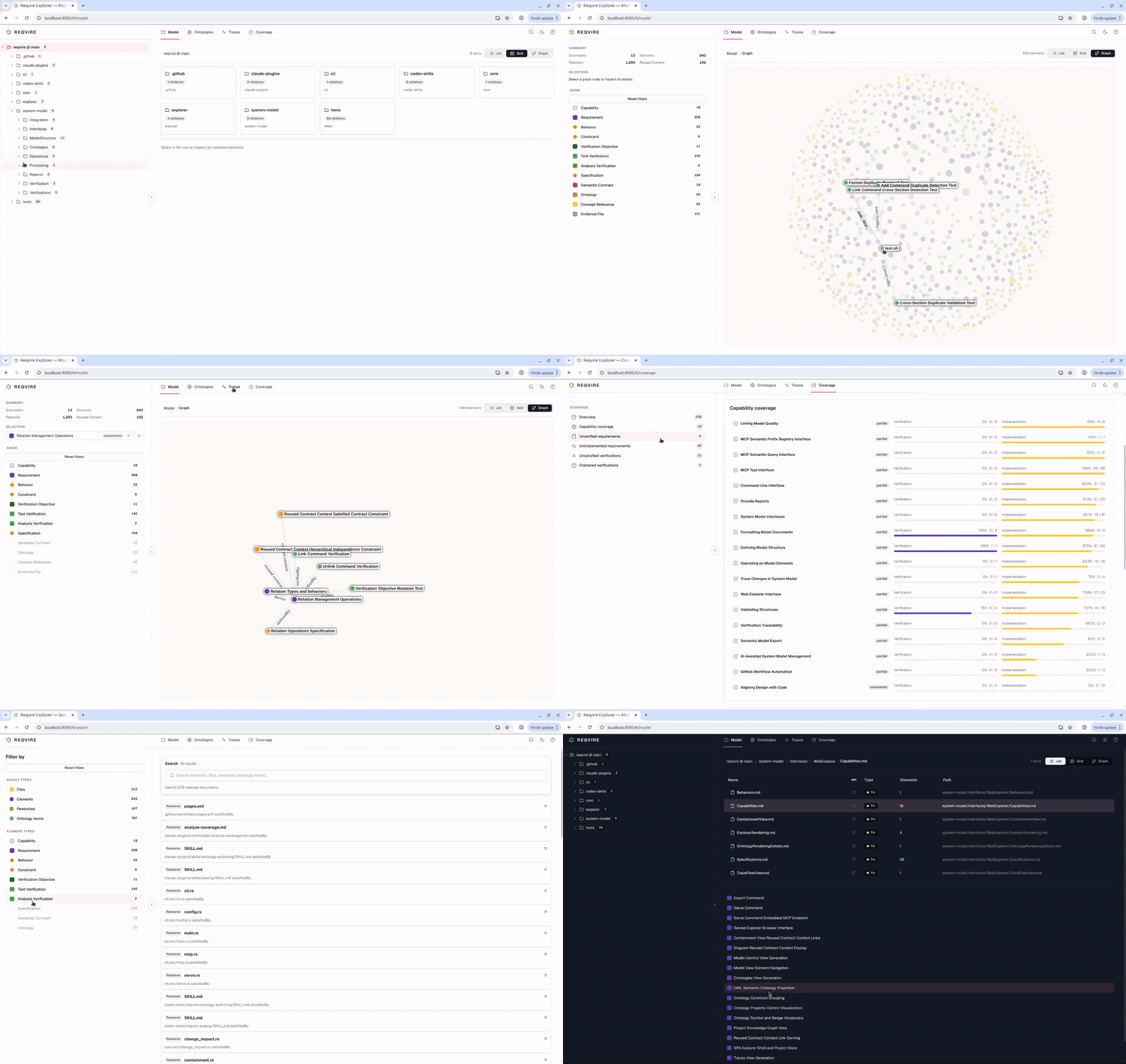
Use the CLI, Explorer UI, and MCP tools to navigate from intent to code, understand what changes affect, and keep implementation work aligned with the verified system model.
Use Reqvire to:
Reqvire 1.0.0 is the first stable release. It formalizes the current model around ontologies, capabilities, requirements, semantic contracts, verification objectives, and concrete verification evidence.
For older workspaces, preview supported breaking model updates with:
reqvire migrate
reqvire migrate --fix
reqvire migrate is dry-run by default; --fix applies deterministic migrations such as legacy document header cleanup, verification-objective holder creation, contract relation cleanup, and legacy Contract Bindings heading migration to Contract Bindings.
curl -fsSL https://raw.githubusercontent.com/reqvire-org/reqvire/main/scripts/install.sh | bash
Validate a Reqvire workspace:
reqvire validate
Open the Explorer UI from an installed Reqvire binary:
reqvire serve
Then open the printed local URL, usually:
http://localhost:8080/
No-install npm form:
npx -y @reqvire-org/reqvire@latest --workspace /absolute/path/to/workspace serve
The effective workspace root is the path used for Reqvire identifiers and relative paths. It must contain at least one eligible Git worktree; files under the workspace but outside Git worktrees are ignored by model processing.
The Explorer UI is embedded in release/npm binaries. Source builds are for development and must build the Explorer bundle before compiling Rust.
Reqvire exposes model context through an MCP server and ships setup assets for Claude Code and Codex. Full setup details live in the documentation: https://www.reqvire.org/coding_assistants.html
Start the MCP server with the Reqvire CLI:
reqvire --workspace /absolute/path/to/workspace mcp
Convenience no-install form using the npm package:
npx -y @reqvire-org/reqvire@latest --workspace /absolute/path/to/workspace mcp
This exposes Reqvire engineering context to AI assistants through the Model Context Protocol (MCP).
Reqvire MCP uses Streamable HTTP. Start the server with the command above, then point MCP clients at:
http://127.0.0.1:8081/mcp
Example MCP client configuration:
{
  "mcpServers": {
    "reqvire-myrepository": {
      "type": "http",
      "url": "http://127.0.0.1:8081/mcp"
    }
  }
}
The MCP server exposes tools, resources, and prompts. Prompt templates include regular Reqvire workflows such as model exploration, change planning, and verification coverage review, plus semantic workflows for vocabulary-driven SPARQL query construction and verification search.
Enable mutation tools:
reqvire --workspace /absolute/path/to/workspace mcp --enable-mutations
The Reqvire Claude Code plugin is distributed through the reqvire-org plugin marketplace. Marketplace installation is the default Claude Code path:
/plugin marketplace add https://github.com/reqvire-org/reqvire
/plugin install reqvire@reqvire-org
For environments that use the local Claude skills folder directly:
npx claudepluginhub reqvire-org/reqvire --plugin reqvireVerifiable AI-Augmented Engineering framework with traceable requirements, independent verification, and compliance-ready artifacts
 Agile-V
AI assistant framework for sphinx-needs projects: change analysis, traceability, MECE, authoring, verification, and release management
 useblocks
Spec authoring, review, matrix, and planning skills for Agent IX.
 agent-ix
Spec-Driven Development (SDD) plugin for Claude Code providing a comprehensive workflow for building features with requirements, design, tasks, and implementation phases.
 yi-john-huang
AI-augmented Innovation & Development Workflow: V-Model phases from business analysis to security audit
 pssah4
Specification-driven development workflow: specify → plan → tasks → implement
 deepeshBodh
'%20stop-opacity%3D'0.16'%2F%3E%3Cstop%20offset%3D'1'%20stop-color%3D'rgb(200%2C90%2C60)'%20stop-opacity%3D'0.03'%2F%3E%3C%2FlinearGradient%3E%3C%2Fdefs%3E%3Crect%20width%3D'320'%20height%3D'200'%20fill%3D'url(%23g)'%2F%3E%3Ccircle%20cx%3D'250'%20cy%3D'56'%20r%3D'92'%20fill%3D'rgb(200%2C90%2C60)'%20fill-opacity%3D'0.06'%2F%3E%3Ccircle%20cx%3D'64'%20cy%3D'172'%20r%3D'58'%20fill%3D'rgb(200%2C90%2C60)'%20fill-opacity%3D'0.05'%2F%3E%3C%2Fsvg%3E)