Stats
Actions
Available In
Tags

Plan, execute, and validate work items using Delivery Graph Engineering (DGE). Convert raw demands into structured delivery graphs with tracks, dependencies, and validation contracts. Execute nodes one at a time with evidence-based gating, sync progress to external task trackers, and visualize status as kanban boards. Ships a dge CLI for the full pipeline from design to summary.
Review Delivery Graph work for implementation quality, graph consistency, validation coverage, and unresolved risks.
Capture reusable learning from completed Delivery Graph nodes, tracks, or demands.
Drive a raw demand all the way to done from a single command - design, plan, and evidence-gated execution - stopping only at two judgment gates and on genuine failure or ambiguity.
Design a structured demand from a raw request, including its gap register, requirements, and acceptance criteria for Delivery Graph Engineering.
Drive the ready queue end to end - implement each ready node, gate it on evidence, and stop on the first failure.
Own this plugin?
Verify ownership to unlock analytics, metadata editing, and a verified badge. GitHub access is read-only (username + org membership).
Sign in to claimOwn this plugin?
Verify ownership to unlock analytics, metadata editing, and a verified badge. GitHub access is read-only (username + org membership).
Sign in to claimBased on adoption, maintenance, documentation, and repository signals. Not a security audit or endorsement.
Executables (bin/) — files in this plugin's bin/directory are added to the Bash tool's PATH while the plugin is enabled.
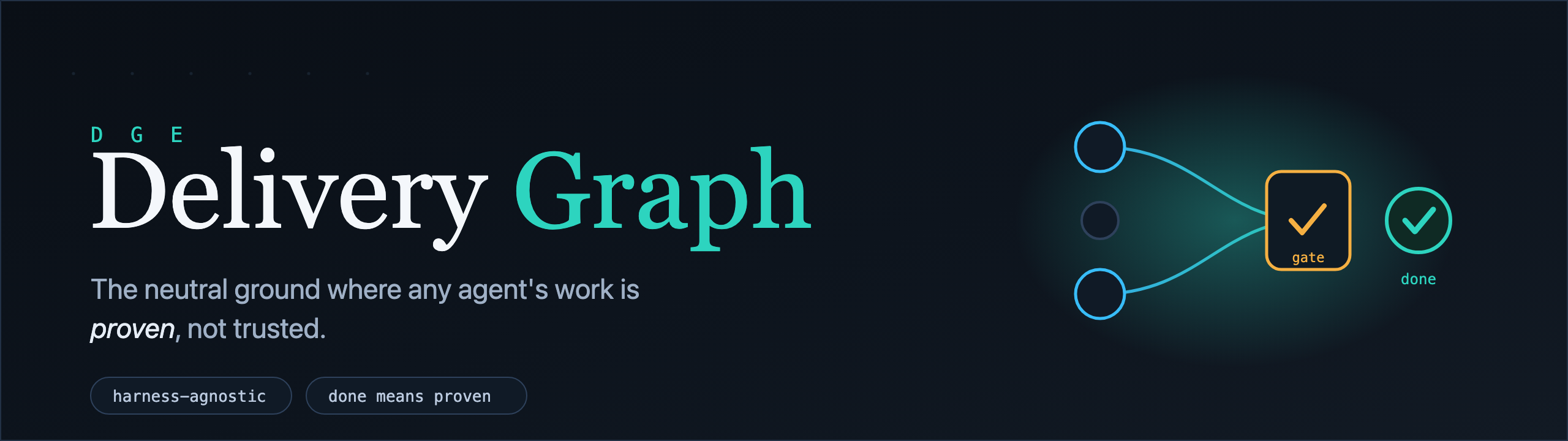
The neutral ground where any agent's work is proven, not trusted.
Whatever coding agent you use — Claude Code, Copilot CLI, Kimi — it works against one
evidence-gated delivery graph, and done is enforced by the engine, not claimed by the
agent. A node cannot reach done until its validation evidence exists on disk. The tool
decides completion; the agent doesn't get to say "it's done" and be believed.
That gate is the same regardless of which agent produced the work — which is what makes DGE neutral ground: an objective arbiter every agent's output must pass.
DGE also brings the discipline every serious agentic workflow needs — clarify before coding,
plan before execution, work in isolated units, validate before completion, review before merge,
capture learnings — and models delivery as a graph rather than a linear checklist. But the
discipline is table stakes; the enforced, evidence-gated, agent-neutral done is the point.
Every graph also has a local, self-contained viewer at delivery-graph/view/index.html. It turns
the canonical store into a desktop workspace: choose a demand, follow its dependency graph, see
which validation criteria are proven, and inspect a node only when you select it. The viewer stays
offline and refreshes at a user-selected rate, so it is a readable projection of the graph rather
than another source of truth.
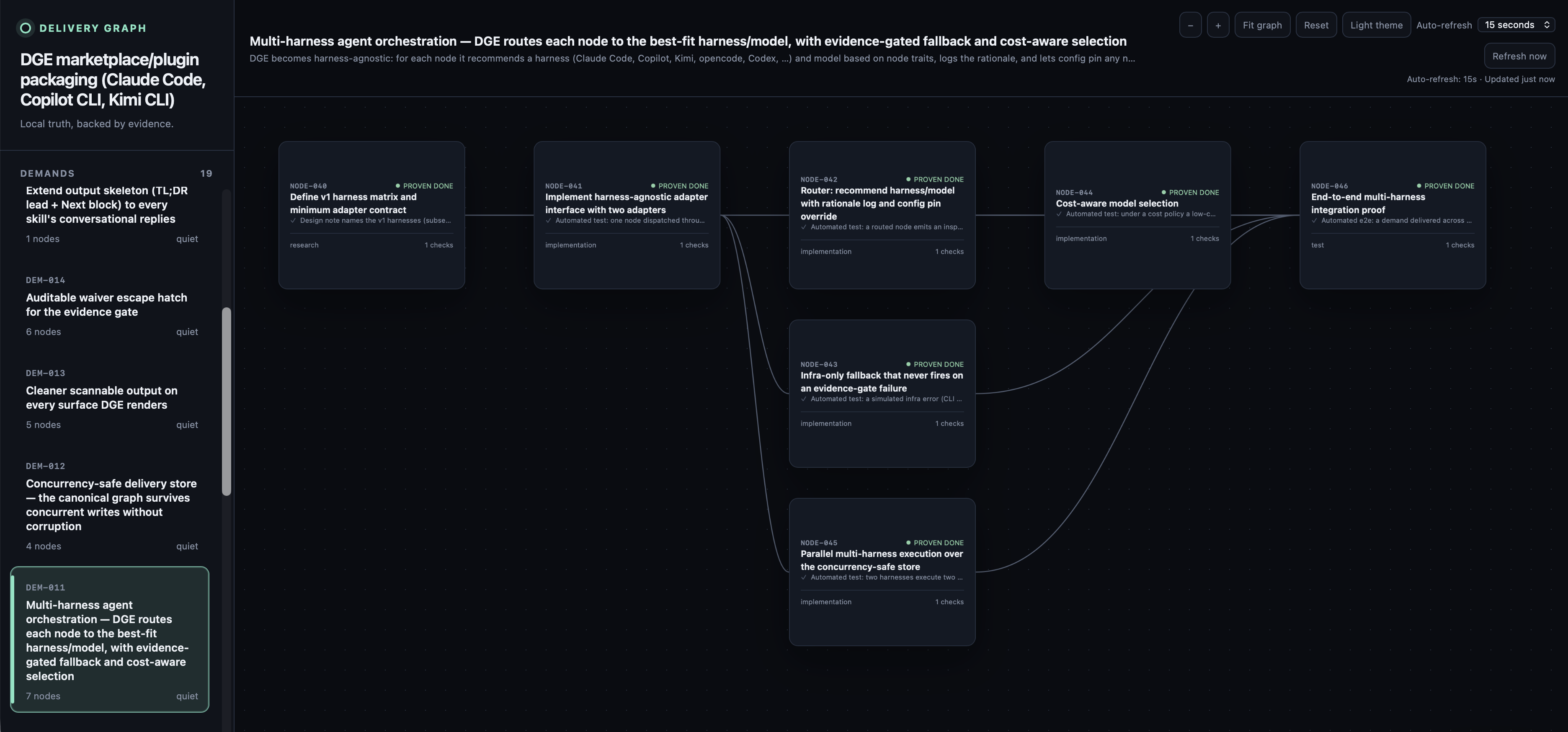
Generate or refresh the viewer whenever you work with the graph:
npx dge status
# Open delivery-graph/view/index.html in your browser
Every coding agent today trusts itself to declare work complete — and agents are documented to
over-report "done." In DGE, completion is a state-machine invariant: verified can only be
minted by running dge verify against real evidence, and done requires verified. There is no
path — not even a "quiet" or automated one — that reaches done without proof.
dge CLI is a plain binary and graph.json is a plain file, so
Claude Code, Copilot CLI, and others read and write the same delivery graph. DGE rides on top
of harnesses; it is not itself a harness.graph.json — the source of truth
harnesses treat as ephemeral.Built for what no single harness can do. Because the ground is neutral and completion is objective, DGE is designed toward different agents building and verifying each other's work against one source of truth. That parallel, cross-agent validation is on the roadmap — local concurrency and risk-based verifier-policy substrates exist today; production control-plane wiring, isolated worktrees, and durable run history make it fully real.
Add DGE to any repo and drive one node from demand to evidence-gated done. Runs fully
locally — no Linear, Azure DevOps, or credentials required.
# 1. Install the CLI (npm) + the /dge-* slash commands
npm install --save-dev github:rafaelolsr/delivery-graph
npx dge install-skills                 # auto-detects .claude/ or .github/

# 2. Create the canonical graph store
npx dge init --title "My delivery graph"

# 3. Author one demand -> requirement -> track -> node
npx dge add-demand --title "Safer releases" --source "user" --outcome "Every completed node has proof"
npx dge add-requirement --demand DEM-001 --statement "Nodes require validation evidence" --acceptance "Verify fails without evidence" --evidence "Evidence manifest"
npx dge add-track --title "Validation"
npx dge add-node --title "Add evidence gate" --type test --track TRK-validation --requirements REQ-001 --validation "npm test"

# 4. Capture proof and close the node (fails without passing evidence)
npx dge evidence run NODE-001 --satisfies "npm test" -- npm test
npx dge done NODE-001
npx dge status --save
Then reload skills in Claude Code (restart the session or /reload-plugins). New here? The
getting-started walkthrough explains each step.
npx claudepluginhub rafaelolsr/delivery-graph --plugin delivery-graphAnalyzes a codebase and generates animated HTML architecture reports — diagrams, data flows, component directories, metrics, and insights.
 rafaelolsr
Agentic Delivery OS - AI-powered software delivery system
 juliusz-cwiakalski
Skill-driven planning and execution loop for coding agents: one planr entry point, an autonomous planr-loop, and evidence-backed task graph skills powered by the planr CLI.
 instructa
Evidence-gated AI coding workflow: scan → analyze → plan → TDD → execute → fix → verify → review, powered by Codebase Memory MCP >= 0.9.0 with optional Serena LSP intelligence. Includes blast-radius planning, test/cycle gates, independent review, and Windows Git Bash hook auto-resolution.
 datit309
Claude Code integration for MCP Task Orchestrator — schema-aware context, note-driven workflow
 jpicklyk
General development utilities including Mermaid diagram creation for software documentation
 el-feo
Project orchestration from planning to delivery. Master Scrum, Kanban, sprint planning, roadmaps, retrospectives, team metrics, and stakeholder management.
 dotclaude
'%20stop-opacity%3D'0.16'%2F%3E%3Cstop%20offset%3D'1'%20stop-color%3D'rgb(200%2C90%2C60)'%20stop-opacity%3D'0.03'%2F%3E%3C%2FlinearGradient%3E%3C%2Fdefs%3E%3Crect%20width%3D'320'%20height%3D'200'%20fill%3D'url(%23g)'%2F%3E%3Ccircle%20cx%3D'250'%20cy%3D'56'%20r%3D'92'%20fill%3D'rgb(200%2C90%2C60)'%20fill-opacity%3D'0.06'%2F%3E%3Ccircle%20cx%3D'64'%20cy%3D'172'%20r%3D'58'%20fill%3D'rgb(200%2C90%2C60)'%20fill-opacity%3D'0.05'%2F%3E%3C%2Fsvg%3E)