Stats
Actions
Available In
Tags
Codebase intelligence for Claude Code. Indexes your codebase into five layers (Graph, Git, Docs, Decisions, Code Health) and exposes them through nine task-shaped MCP tools — so Claude understands architecture, ownership, hotspots, why code is built the way it is, and where the defect risk lives.
Report unreachable files, unused exports, and zombie packages, tiered by confidence.
Work with architectural decisions — list, inspect health, add, or confirm auto-proposed decisions.
Diagnose the Repowise setup — install, API keys, index/store drift — and optionally repair it.
Show Repowise code-health — KPIs, lowest-scoring files, refactoring targets, trends, or per-file markers.
Set up Repowise for this codebase. Installs if needed, asks about your preferences, and runs the indexing.
Use when the user asks about code health, code quality, complexity, technical debt, which files are risky or hard to maintain, what to refactor next, untested hotspots, or coverage gaps in a Repowise-indexed codebase (.repowise/ directory exists). Also use to get a before/after health read when planning or finishing a refactor.
Use when exploring, understanding, or answering questions about a codebase that has Repowise indexed (a .repowise/ directory in the project root). Activates for "how does X work", "explain the architecture", "where is Y implemented", "what does this module do", or any task that needs an understanding of structure before diving into source files.
Use when the user asks about cleanup, removing unused code, refactoring, reducing bundle size, or identifying dead code in a Repowise-indexed codebase (.repowise/ directory exists). Also activates when discussing technical debt, code hygiene, or repository maintenance.
Use before modifying, refactoring, or deleting files in a codebase that has Repowise indexed (indicated by a .repowise/ directory). Activates when Claude is about to edit code, especially shared utilities, core modules, or files the user didn't explicitly mention. Helps assess impact and avoid breaking things.
Use when reviewing a set of changes before they merge — a PR, a branch diff, or the working-tree changes you just made — in a Repowise-indexed codebase (.repowise/ directory exists). Activates for "review this PR", "is this safe to merge", "what's the blast radius of these changes", "did I miss anything", or "what else should change with this".
Executes bash commands
Hook triggers when Bash tool is used
Modifies files
Hook triggers on file write and edit operations
Own this plugin?
Verify ownership to unlock analytics, metadata editing, and a verified badge. GitHub access is read-only (username + org membership).
Sign in to claimOwn this plugin?
Verify ownership to unlock analytics, metadata editing, and a verified badge. GitHub access is read-only (username + org membership).
Sign in to claimBased on adoption, maintenance, documentation, and repository signals. Not a security audit or endorsement.
Five intelligence layers · Nine MCP tools · 15 languages · Multi-repo workspaces · One pip install







Hosted for teams → · Docs · Discord · Contact
Layers · Code Health · Refactoring · Benchmarks · Languages · Quickstart · MCP tools · Comparison · Hosted
measure, locate, and fix what your AI ships
code health that predicts real bugs · ROC AUC 0.74 across 21 repos · 2.3× CodeScene's defects under a fixed review budget
graph-aware refactoring plans your agent can execute · up to −96% context tokens · −70% agent tool calls at answer-quality parity
Measured, reproducible, on public codebases. See the benchmarks ↓
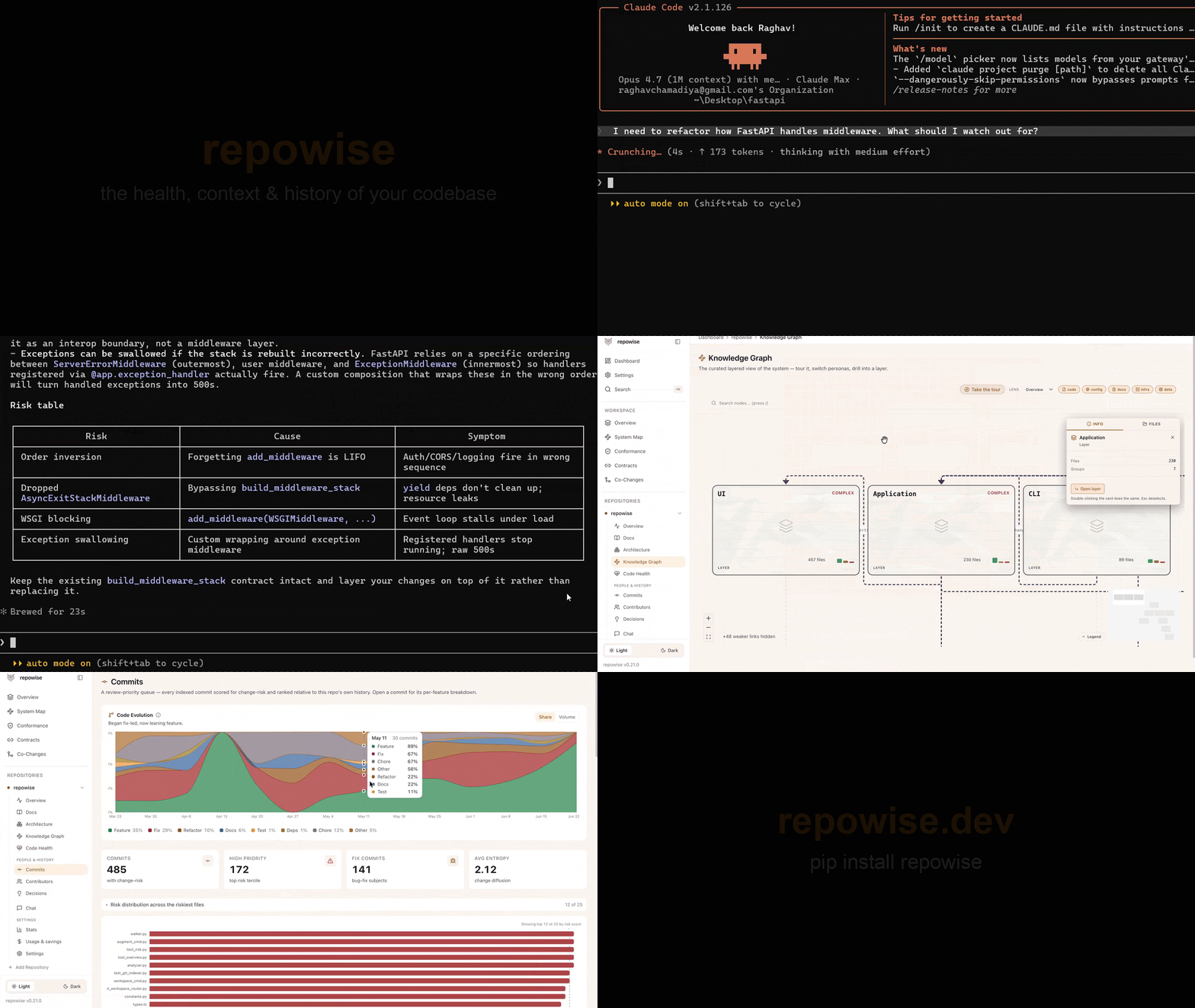
AI now writes a large and growing share of the code, and the humans accountable for it have to trust what ships. A score that says "this file is risky" isn't enough: you need to know where the risk concentrates and how to fix it.
repowise closes that loop. It indexes your codebase once and scores every file for defect risk, maintainability, and performance from 25 deterministic markers, calibrated against a real defect corpus, no LLM, in under 30 seconds (the proof ↓). The same index then locates the risk through a real dependency graph and git history, and generates the fix: concrete, graph-aware refactoring plans (split this god class, move this method, break this dependency cycle, dedup this clone) that your coding agent can execute.
And because it is all one index, your agent gets the rest for free: five
intelligence layers: dependency graph, git history, auto-generated docs,
architectural decisions, and code health, exposed to Claude Code, Codex, and any
MCP-compatible agent through nine task-shaped tools. Your agent answers "why
does auth work this way?" instead of "here is what auth.ts contains", with
fewer tool calls, fewer file reads, and lower cost per query, at comparable
answer quality (benchmarks ↓). One index: context your agent can
use, signals your team can trust, and the fix it can apply.
Data & metrics skills: Data Analysis Standard, Retention Analysis, Product Health Analysis. Structure metric deep-dives, funnel analysis, cohort studies and churn investigations.
 pratik-saptarshi
Compliance & trust skills for regulated and enterprise teams: SOC 2 Readiness, GDPR Compliance, HIPAA Safeguards, ISO 27001 ISMS, Vendor Security Review, and Data Retention Policy. Each ships a stdlib scoring/validation script.
pratik-saptarshiDeveloper-relations & open-source maintainer skills: Launch Post (Show HN/Product Hunt), Docs Quickstart, Conference Talk Proposal, Changelog Writer, README Writer, and Contributor Guide. Ship and grow developer tools and OSS projects.
pratik-saptarshiProduce real, editable Office files (not markdown): Excel Model (live formulas), Slide Deck (.pptx), and Word Document (.docx). Generated via openpyxl / python-pptx / python-docx — needs a code-execution environment (Claude Code, API code tool, or Claude.ai).
pratik-saptarshiVision-first skills: point a camera or screenshot at the work and get the structured artifact — whiteboard photos become specs, competitor screenshots become teardowns, slide photos become board pre-reads, chart images become data tables. Built for multimodal models (Fable 5, Sonnet, Gemini); attach images in the playground or paste them in Claude Code.
pratik-saptarshinpx claudepluginhub pratik-saptarshi/repowise --plugin repowiseUpstash Context7 MCP server for up-to-date documentation lookup. Pull version-specific documentation and code examples directly from source repositories into your LLM context.
 upstash
Consult multiple AI coding agents (Gemini, OpenAI, Grok, Perplexity, plus codex, antigravity, and grok CLIs when installed) to get diverse perspectives on coding problems
 hex
hexComprehensive skill pack with 66 specialized skills for full-stack developers: 12 language experts (Python, TypeScript, Go, Rust, C++, Swift, Kotlin, C#, PHP, Java, SQL, JavaScript), 10 backend frameworks, 6 frontend/mobile, plus infrastructure, DevOps, security, and testing. Features progressive disclosure architecture for 50% faster loading.
 Jeffallan
A growing collection of Claude-compatible academic workflow bundles. Covers scientific figures, manuscript writing and polishing, reviewer assessment, citation retrieval, data availability, paper reading, literature search, response letters, paper-to-PPTX conversion, and evidence-grounded Chinese invention patent drafting. Rules are organized as reusable skill folders with explicit workflows and quality checks.
 Yuan1z0825
Upstash Context7 MCP server for up-to-date documentation lookup. Pull version-specific documentation and code examples directly from source repositories into your LLM context.
 anthropics
Comprehensive feature development workflow with specialized agents for codebase exploration, architecture design, and quality review
anthropics
'%20stop-opacity%3D'0.16'%2F%3E%3Cstop%20offset%3D'1'%20stop-color%3D'rgb(200%2C90%2C60)'%20stop-opacity%3D'0.03'%2F%3E%3C%2FlinearGradient%3E%3C%2Fdefs%3E%3Crect%20width%3D'320'%20height%3D'200'%20fill%3D'url(%23g)'%2F%3E%3Ccircle%20cx%3D'250'%20cy%3D'56'%20r%3D'92'%20fill%3D'rgb(200%2C90%2C60)'%20fill-opacity%3D'0.06'%2F%3E%3Ccircle%20cx%3D'64'%20cy%3D'172'%20r%3D'58'%20fill%3D'rgb(200%2C90%2C60)'%20fill-opacity%3D'0.05'%2F%3E%3C%2Fsvg%3E)