Stats
Actions
Available In
Tags
Vision-first skills: point a camera or screenshot at the work and get the structured artifact — whiteboard photos become specs, competitor screenshots become teardowns, slide photos become board pre-reads, chart images become data tables. Built for multimodal models (Fable 5, Sonnet, Gemini); attach images in the playground or paste them in Claude Code.
Extract pixel-level data from an image of a chart or graph and produce a structured data table. Use when asked to extract data from a chart image, transcribe numbers from a graph, digitise a chart, or turn a screenshot of data into a table. Produces a structured table with extracted values, confidence levels, and a reconstructed chart source. Best used with Claude Opus 4.7 or newer for reliable chart data extraction.
Autopsy a slide deck from photos or screenshots of its slides — the narrative arc, the numbers, and what each slide is hiding. Use when given slide images (a competitor's pitch, a conference talk, your own deck before a big meeting) and asked what the deck argues, whether it holds up, or how to counter or improve it. Produces a slide-by-slide read, the reconstructed argument chain, weak links, and the questions the deck is engineered to avoid. Requires image input.
Tear down a competitor's product from screenshots of its actual UI — onboarding, pricing page, core flows. Use when given screenshots of a rival's app or website and asked what they're doing, how their flow works, or what to learn/steal/avoid. Produces a UX-and-strategy teardown grounded in what is visibly on screen, with an inferences-vs-observations split. Requires image input. For a market-level teardown without screenshots use competitor-teardown.
Turn photos of a whiteboard, sticky-note wall, or napkin sketch into a structured spec the team can execute. Use when given whiteboard photos after a workshop, sketch images of a flow or architecture, or asked to 'write up what we drew'. Produces a structured write-up — decisions, flows, open questions, owners — that preserves everything on the board and flags what was ambiguous. Requires image input.
Own this plugin?
Verify ownership to unlock analytics, metadata editing, and a verified badge. GitHub access is read-only (username + org membership).
Sign in to claimOwn this plugin?
Verify ownership to unlock analytics, metadata editing, and a verified badge. GitHub access is read-only (username + org membership).
Sign in to claimBased on adoption, maintenance, documentation, and repository signals. Not a security audit or endorsement.




















🎉 Now published in the official Anthropic Claude plugin directory — install it straight from the /plugin marketplace in Claude Code.
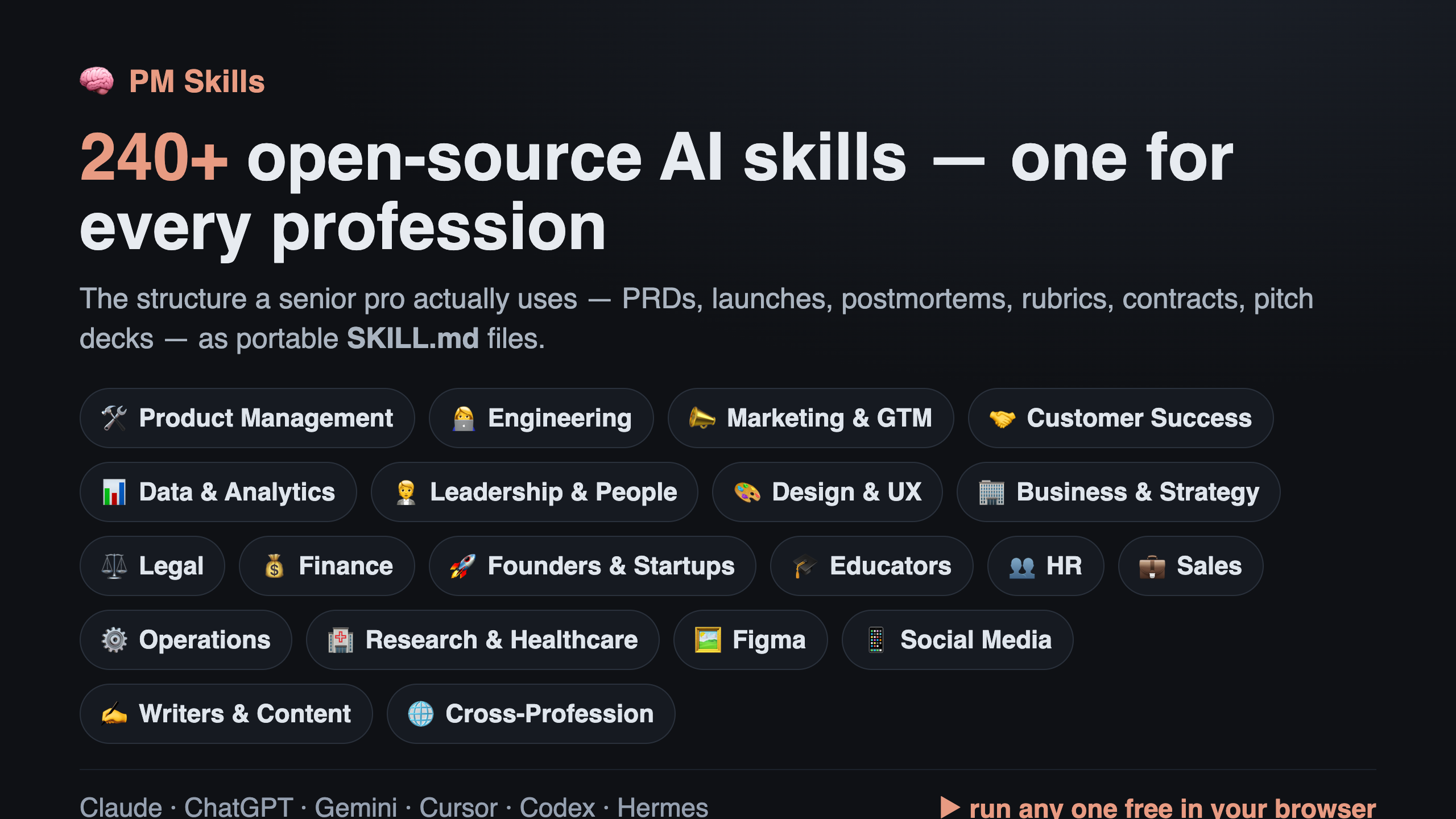
Generic AI gives you filler. These give you the structure a senior pro actually uses — PRDs, exec updates, launch plans, postmortems — as open-source
SKILL.mdfiles. Across 25 professions, not just product management. One source, every AI tool.
🆕 Now plugs into your stack — automate skills in n8n, build apps on Lovable, and run them in your Obsidian vault, all via a read-only REST API on the hosted Worker.
npx claudepluginhub pratik-saptarshi/pm-claude-skills --plugin pm-visionCompliance & trust skills for regulated and enterprise teams: SOC 2 Readiness, GDPR Compliance, HIPAA Safeguards, ISO 27001 ISMS, Vendor Security Review, and Data Retention Policy. Each ships a stdlib scoring/validation script.
 pratik-saptarshi
Developer-relations & open-source maintainer skills: Launch Post (Show HN/Product Hunt), Docs Quickstart, Conference Talk Proposal, Changelog Writer, README Writer, and Contributor Guide. Ship and grow developer tools and OSS projects.
pratik-saptarshiCodebase intelligence for Claude Code. Indexes your codebase into five layers (Graph, Git, Docs, Decisions, Code Health) and exposes them through nine task-shaped MCP tools — so Claude understands architecture, ownership, hotspots, why code is built the way it is, and where the defect risk lives.
pratik-saptarshiProduce real, editable Office files (not markdown): Excel Model (live formulas), Slide Deck (.pptx), and Word Document (.docx). Generated via openpyxl / python-pptx / python-docx — needs a code-execution environment (Claude Code, API code tool, or Claude.ai).
pratik-saptarshiData & metrics skills: Data Analysis Standard, Retention Analysis, Product Health Analysis. Structure metric deep-dives, funnel analysis, cohort studies and churn investigations.
pratik-saptarshiUI/UX design intelligence. Searchable local database with 84 styles, 192 palettes, 74 font pairings, 25 charts, and 22 stacks (React, Next.js, Vue, Nuxt.js, Nuxt UI, Svelte, Astro, SwiftUI, React Native, Flutter, Tailwind, shadcn/ui, Jetpack Compose, Angular, Laravel, JavaFX, WPF, WinUI, Avalonia, Uno Platform, UWP, Three.js). Use when designing, building, or reviewing UI: pages, components, color schemes, typography, layout, accessibility, animation, or data visualization.
 nextlevelbuilder
Comprehensive skill pack with 66 specialized skills for full-stack developers: 12 language experts (Python, TypeScript, Go, Rust, C++, Swift, Kotlin, C#, PHP, Java, SQL, JavaScript), 10 backend frameworks, 6 frontend/mobile, plus infrastructure, DevOps, security, and testing. Features progressive disclosure architecture for 50% faster loading.
 Jeffallan
A growing collection of Claude-compatible academic workflow bundles. Covers scientific figures, manuscript writing and polishing, reviewer assessment, citation retrieval, data availability, paper reading, literature search, response letters, paper-to-PPTX conversion, and evidence-grounded Chinese invention patent drafting. Rules are organized as reusable skill folders with explicit workflows and quality checks.
 Yuan1z0825
Intelligent draw.io diagramming plugin with AI-powered diagram generation, multi-platform embedding (GitHub, Confluence, Azure DevOps, Notion, Teams, Harness), conditional formatting, live data binding, and MCP server integration for programmatic diagram creation and management.
 markus41
Complete creative writing suite with 10 specialized agents covering the full writing process: research gathering, character development, story architecture, world-building, dialogue coaching, editing/review, outlining, content strategy, believability auditing, and prose style/voice analysis. Includes genre-specific guides, templates, and quality checklists.
 greyhaven-ai
Persistent file-based planning for AI coding agents. Crash-proof markdown plans (task_plan.md, findings.md, progress.md) that survive context loss and /clear, with an opt-in completion gate and multi-agent shared state. Manus-style. Works with Claude Code, Codex CLI, Cursor, Kiro, OpenCode and 60+ agents via the SKILL.md standard. Includes Arabic, German, Spanish, and Chinese (Simplified and Traditional).
 OthmanAdi
'%20stop-opacity%3D'0.16'%2F%3E%3Cstop%20offset%3D'1'%20stop-color%3D'rgb(200%2C90%2C60)'%20stop-opacity%3D'0.03'%2F%3E%3C%2FlinearGradient%3E%3C%2Fdefs%3E%3Crect%20width%3D'320'%20height%3D'200'%20fill%3D'url(%23g)'%2F%3E%3Ccircle%20cx%3D'250'%20cy%3D'56'%20r%3D'92'%20fill%3D'rgb(200%2C90%2C60)'%20fill-opacity%3D'0.06'%2F%3E%3Ccircle%20cx%3D'64'%20cy%3D'172'%20r%3D'58'%20fill%3D'rgb(200%2C90%2C60)'%20fill-opacity%3D'0.05'%2F%3E%3C%2Fsvg%3E)
