paxm
One memory experience for every AI agent and every memory provider.



Local-first memory infrastructure for Codex, Claude Code, Pi, and MCP clients.
Use SQLite out of the box, connect Zep or Mem0, or bring any provider behind a
small JSON-RPC adapter.
Install · How it works · Providers · Documentation
Why paxm
Memory systems tend to optimize the memory engine and leave integration to
everyone else. Users must wire SDKs into each agent, or remember to call MCP
tools and skills manually. Provider authors must build a separate integration
for every agent runtime.
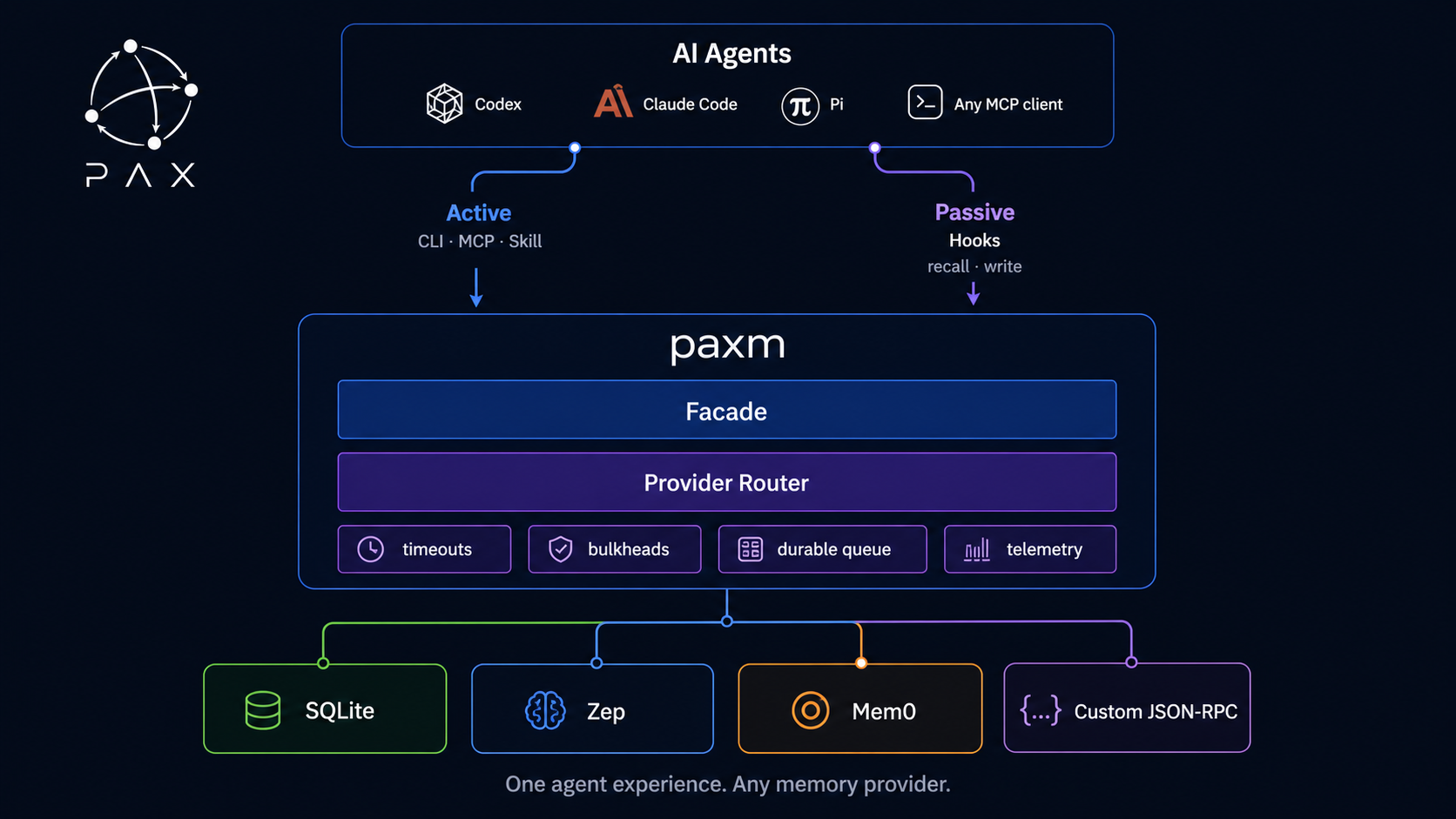
paxm removes that duplication. Agents get one consistent active and passive
memory surface. Providers implement one adapter contract. Users keep control of
credentials, routing policy, hooks, and where their data lives.
AI agents -> CLI / MCP / skills / hooks -> paxm -> any memory provider
What you get
- Active memory through CLI commands, MCP tools, and an agent skill.
- Passive memory through lifecycle hooks that recall context and capture
durable writes without relying on the model to call a tool.
- Provider independence through a common search/write contract and
multi-provider routing.
- Local-first defaults with SQLite and no required account or API key.
- Failure isolation with per-provider timeouts, an overall passive-recall
budget, bulkheads, and partial-result fallback.
- Durable passive writes through a local queue with retry, deduplication,
and crash-safe state.
- Operational visibility through local event logs, latency histograms,
provider errors, timeout counts, and
paxm history.
What paxm is not
paxm is not another sophisticated memory engine or a hosted memory cloud. It
does not try to own embeddings, knowledge graphs, semantic consolidation,
reranking research, or long-term memory intelligence.
Those capabilities belong to memory providers. Paxm focuses on the integration
and runtime layer: agent entry points, lifecycle hooks, provider routing,
failure isolation, durable delivery, and telemetry.
The built-in SQLite provider is a practical local baseline, not a claim to
state-of-the-art memory quality. Use Zep, Mem0, or a custom adapter when you need
more advanced retrieval and memory behavior without rebuilding every agent
integration.
Quick start
Choose the path for the agent you use. The Codex plugin is the shortest path:
Codex plugin
codex plugin marketplace add pax-beehive/paxm --ref paxm-memory-v0.1.3
codex plugin add paxm-memory@pax-agent-nexus
paxm setup --integration codex-plugin
Start a new Codex task and trust the Pax Agent neXus hooks when /hooks asks.
The plugin installs its reviewed paxm binary, registers active-memory skills,
and owns the passive Codex hooks. Provider credentials remain user-managed.
Claude Code plugin
Install the paxm CLI, then install the Claude Code plugin:
curl -fsSL https://github.com/pax-beehive/paxm/releases/latest/download/install.sh | bash
claude plugin marketplace add pax-beehive/paxm
claude plugin install paxm-claude@pax-memory
paxm setup --integration claude-plugin
The Claude plugin includes active-memory skills, the paxm MCP server, and five
lifecycle hooks: SessionStart, UserPromptSubmit, PostToolUse,
PostToolUseFailure, and Stop.
CLI, MCP, or Pi
Install the latest release and run interactive setup. SQLite provides a full
local flow without an account or API key.
curl -fsSL https://github.com/pax-beehive/paxm/releases/latest/download/install.sh | bash
paxm setup
paxm config doctor
Write and recall a memory:
paxm remember --profile ltm --text "We chose SQLite for the local memory layer"
paxm recall --query "local memory layer"
paxm history --days 7
Select Pi during setup to install its passive extension. Any MCP-compatible
client can use paxm mcp serve without installing passive hooks.
How it works
Agents reach paxm in two ways:
| Path | Entry points | Best for |
|---|
| Active | CLI, MCP, skill | Deliberate recall, explicit writes, inspection |
| Passive | Agent lifecycle hooks | Prompt-time recall and automatic turn capture |
 ArtemisAI
 memsy-io
 NeoLi00
 eleboucher
 timescale
 ourmem
'%20stop-opacity%3D'0.16'%2F%3E%3Cstop%20offset%3D'1'%20stop-color%3D'rgb(200%2C90%2C60)'%20stop-opacity%3D'0.03'%2F%3E%3C%2FlinearGradient%3E%3C%2Fdefs%3E%3Crect%20width%3D'320'%20height%3D'200'%20fill%3D'url(%23g)'%2F%3E%3Ccircle%20cx%3D'250'%20cy%3D'56'%20r%3D'92'%20fill%3D'rgb(200%2C90%2C60)'%20fill-opacity%3D'0.06'%2F%3E%3Ccircle%20cx%3D'64'%20cy%3D'172'%20r%3D'58'%20fill%3D'rgb(200%2C90%2C60)'%20fill-opacity%3D'0.05'%2F%3E%3C%2Fsvg%3E)