Stats
Actions
Available In
Tags

Manage persistent semantic memory for Claude Code coding agents by automatically storing and recalling context from file operations, with tools to inspect and audit memory.
Matches all tools
Hooks run on every tool call, not just specific ones
Admin access level
Server config contains admin-level keywords
Own this plugin?
Verify ownership to unlock analytics, metadata editing, and a verified badge. GitHub access is read-only (username + org membership).
Sign in to claimOwn this plugin?
Verify ownership to unlock analytics, metadata editing, and a verified badge. GitHub access is read-only (username + org membership).
Sign in to claimBased on adoption, maintenance, documentation, and repository signals. Not a security audit or endorsement.
Modifies files
Hook triggers on file write and edit operations
Modifies files
Hook triggers on file write and edit operations
Requires secrets
Needs API keys or credentials to function
Requires secrets
Needs API keys or credentials to function
English · 中文 · Architecture
memX turns completed work into structured, searchable, self-maintained memory, then injects only the evidence an agent needs for the current query. It connects natively to Codex, Claude Code, and OpenClaw, and reaches any MCP-compatible client through the same local memory layer.
| Suite | Scope | R@3 success rate |
|---|---|---|
| LongMemEval-S | Long-context memory retrieval | 94.2% |
| Real engineering cases | 30 cases, each with 20+ turns | 100% |
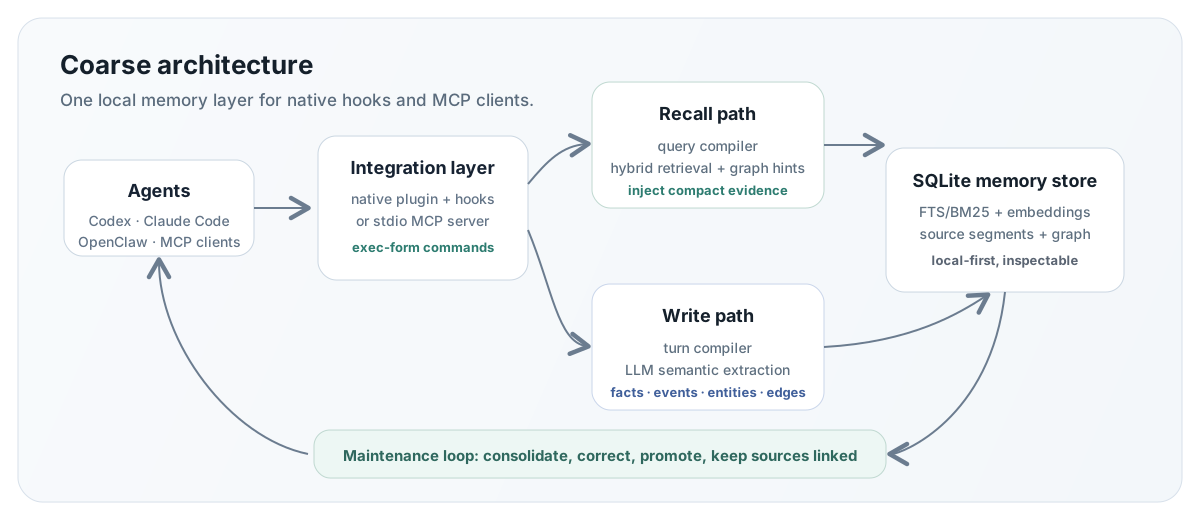
 | Codex | native hooks, MCP hidden by default |
 | Claude Code | native hooks, MCP hidden by default |
 | OpenClaw | native + hooks |
| MCP | MCP clients | any MCP-compatible client |
Requirements: Node.js 22.14+ or Node 24. OpenClaw installs require OpenClaw 2026.3.25+. Python 3 is needed only for the default local embedding runtime.
The README commands use the GitHub package spec. A fresh run pulls current GitHub code, so installs
do not wait for an npm publish. To use the npm release channel later, replace
github:NeoLi00/memX with @neoli00/memx.
Fill in these values before running a command:
--llm-provider: the provider adapter memX should call. Choose one of openai-compatible,
anthropic, google, or ollama.--llm-base-url: the base URL for that provider. Examples: https://api.openai.com/v1,
https://api.anthropic.com/v1, https://generativelanguage.googleapis.com/v1beta, or
http://127.0.0.1:11434 for Ollama.--llm-model: the model memX uses for memory compilation, recall planning, and maintenance.
Pick a fast, low-cost model with reliable JSON output.--llm-api-key: the API key for the provider. Use --llm-api-key-env PROVIDER_API_KEY if you
want the config to reference an environment variable instead of storing plaintext. For local
Ollama, omit the key.The default embedding setup is local sentence-transformers-local with
intfloat/multilingual-e5-small. Add --embedding-provider and --embedding-model only when you
want to override that default. Use --dry-run to preview the files and exec-form commands before
writing anything.
For Codex and Claude Code, native hooks are the default lifecycle path for automatic recall and
turn capture. Quickstart installs the native plugin, writes the shared memX config, starts or
refreshes the managed local memX service, and keeps MCP memory tools hidden with --mcp-tools none
by default. This prevents duplicate recall/write and prevents the agent from reading audit data as a
side channel. Use --mcp-tools full only when you intentionally want the agent to see the complete
MCP tool set. Generic MCP quickstart stays full by default because it has no native lifecycle
hooks. Default native memories are also host-scoped, so Codex and Claude Code do not share the same
local database unless you deliberately override the database path and actor settings.
If http://127.0.0.1:3878 is already used by an unmanaged memX-compatible service, quickstart stops
instead of silently reusing it. Stop the old service or pass a free local URL, for example
--memx-url http://127.0.0.1:3888.
This installs the shared memX config, a local Claude Code plugin marketplace, native lifecycle hooks, and the managed local memX service in one run.
npx -y -p github:NeoLi00/memX memx quickstart claude-code \
  --llm-provider openai-compatible \
  --llm-base-url https://llm.example.com/v1 \
  --llm-model fast-memory-model \
  --llm-api-key sk-your-provider-key
npx claudepluginhub neoli00/memxPersistent memory with reinforcement learning for coding agents. Powered by Turso.
 glommer
Persistent memory for AI coding agents. Survives across sessions and compactions.
 Gentleman-Programming
Skills and hooks for rekal: memory redirect hooks, session capture (rekal-save), project bootstrap (rekal-init), and maintenance (rekal-hygiene).
 janbjorge
Persistent memory for AI coding agents -- captures tool usage, compresses via LLM, injects context into future sessions. 12 hooks, 41 MCP tools, 4 skills, real-time viewer.
 rohitg00
MeMesh — Local memory for Claude Code and MCP coding agents. One SQLite file, zero cloud required.
 PCIRCLE-AI
Persistent memory for Claude Code — memories survive across sessions, projects, and machines
 ourmem
'%20stop-opacity%3D'0.16'%2F%3E%3Cstop%20offset%3D'1'%20stop-color%3D'rgb(200%2C90%2C60)'%20stop-opacity%3D'0.03'%2F%3E%3C%2FlinearGradient%3E%3C%2Fdefs%3E%3Crect%20width%3D'320'%20height%3D'200'%20fill%3D'url(%23g)'%2F%3E%3Ccircle%20cx%3D'250'%20cy%3D'56'%20r%3D'92'%20fill%3D'rgb(200%2C90%2C60)'%20fill-opacity%3D'0.06'%2F%3E%3Ccircle%20cx%3D'64'%20cy%3D'172'%20r%3D'58'%20fill%3D'rgb(200%2C90%2C60)'%20fill-opacity%3D'0.05'%2F%3E%3C%2Fsvg%3E)