Unofficial D&D Claude Dungeon Master
with Cinematic Display Companion — Couch Co-op Edition
Ruleset: D&D 5e — 2014 (SRD 5.1) by default; 2024 (SRD 5.2) opt-in per campaign. Choose at /dm:dnd new time; legacy campaigns are auto-prompted to migrate (with backup) on first load. See the Ruleset section for mechanic differences and dataset details.
Claude runs the game. You play. The TV shows the story. Your phone is your controller.
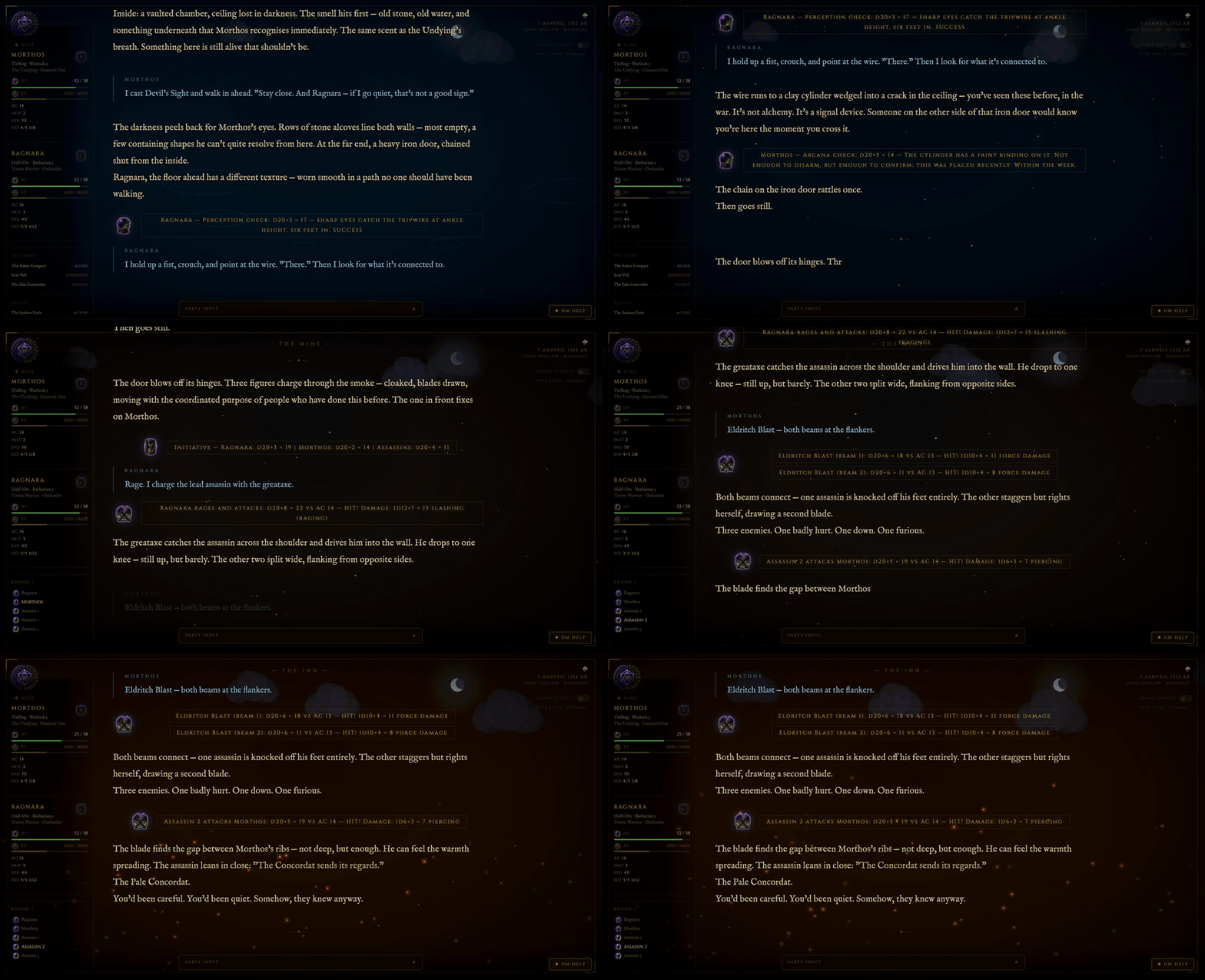
An unofficial D&D 5e (2014 ruleset / SRD 5.1) Dungeon Master skill for Claude Code — persistent campaigns, full 5e mechanics, and an optional cinematic display companion that streams typewriter narration, dice rolls, and live character stats to any screen — TV via Chromecast, tablet, phone, or second monitor — while players submit their actions from a phone or tablet.
Built for groups who want a real DM experience without needing one at the table.

What This Is
You run /dm:dnd load my-campaign in Claude Code. Claude becomes your DM — rolling dice, voicing NPCs, tracking HP and XP, and running combat. If you have a TV or tablet nearby, the cinematic display companion puts the narration on screen in real time — typewriter effect, atmospheric backgrounds that shift with the scene, a dynamic sky canvas, and a live party stat sidebar. Open it on any device on your network and everyone at the table can follow along. Players submit their actions from their phones; Claude picks them up automatically and runs the next turn.
There are two ways to play, and they serve different needs:
Improvised campaigns — Claude generates the world from scratch and auto-creates a committed three-act narrative arc from the setting, factions, and threats it just built. The arc gives the story a defined shape without scripting what happens — beats are defined by consequence ("what changes") not by event, so Claude stays flexible on how each beat lands while committing to the fact that it must. The arc advances across sessions, can be revised when players redirect the story, and continues into a new arc when all six beats resolve. This is Claude as a full creative collaborator: world-builder, improv partner, and story architect in one.
Structured campaigns — Use /dm:dnd import to drop in a pre-written source (official WotC modules, published third-party campaigns, or a custom DM-written document in PDF, markdown, DOCX, or plain text format). Claude reads and chunks the source, extracts the structure type (linear, hub-and-spoke, or faction-web), and builds all campaign files automatically — acts, chapters, key story beats, telegraph scenes, NPCs, factions, locations, and quest hooks. The campaign runs with enforced deterministic structure: required beats must land in each chapter, Claude telegraphs before delivering them, and steers with world pressure rather than walls when players drift. Drop in the Lost Mine of Phandelver and Claude will run it chapter by chapter with the same twelve DM standards applied to every scene.
Both modes share the same DM engine. The twelve applied behavioral standards are enforced as hard constraints in every session regardless of which mode you're in — improvised or structured, the DM improvises within situations, lets choices matter, makes every NPC a person, and controls pace deliberately.
It also manages a deep web of campaign data without overloading the LLM — coherent and complete, without burning tokens on context that isn't needed yet:
- DM instructions — split across three files with staggered load timing; core rules always in the system prompt, script syntax and command procedures loaded once at session start
- Campaign data — NPC roster indexed at load, full entries pulled only when a character becomes relevant; quest hooks and worldbuilding text in cold storage until called for
- Session history — archived as continuity summaries, not raw transcripts; full campaign history available for reference without front-loading token weight
- Compaction resilience — a compact Live State Flags block in
state.md anchors faction stances, player cover, and NPC dispositions; re-read at any claim to keep world continuity grounded in source files rather than Claude's increasingly lossy impression of them
A campaign can run dozens of sessions deep — with coherent recall of past events, NPC attitudes, and long-tail consequences — without the context bloat that forces other implementations to summarize, forget, or reset.
It is not an official Wizards of the Coast product. It uses Claude as the DM engine. It takes the rules seriously and the storytelling even more seriously.