Stats
Actions
Available In
Tags

Calibrated per-subagent reasoning effort: classify each subtask, dispatch it to the cheapest tier that still passes.
Blind grader for effortmining. Grades one artifact against a task prompt and a fixed rubric ONLY. The input payload deliberately carries no field naming the tier, agent, or model that produced the artifact, so the grade cannot be biased by effort level. Skeptic-first, rounds scores down, emits strict JSON consumed by bench/effort.py. Pinned to medium effort (one tier below the miner workers) to avoid grader-effort confounds. Use for non-deterministic benchmark tasks and runtime audit of dispatched work.
Delegate worker pinned to HIGH reasoning effort, the Opus 4.8 model default. Pick for diagnosis, multi-constraint logic, or tracing where the work is figuring out what and the answer is short. Pilot v1 (2026-07-06) calibrates this tier for T3-moderate-reasoning — the class with the real quality gradient, where low fails a third of the time and high reaches full pass at ~157 median output tokens. Identical to the other miner agents except its effort frontmatter.
Delegate worker pinned to LOW reasoning effort, the cheapest tier. Pick for mechanical retrieval, extraction, and reformatting with an explicit output template and no reasoning required. Fitted table (v1+v2, 2026-07-07) calibrates this tier for T1-mechanical, T2-simple-transform, and — with fit-blindness warnings — T4-hard-reasoning and R-research (their fitting tasks saturated; route genuinely hard instances to miner-xhigh instead). C-coding moved to miner-medium in the 2026-07-07 refit. Identical to the other miner agents except its effort frontmatter.
Delegate worker pinned to MAX reasoning effort, the most expensive tier and session-only. Pilot v1 (2026-07-06) calibrates no class to this tier and found saturation at max in all four classes — it never improved quality over xhigh and only cost more (no strict regression observed). Reserve it for work harder than the pilot suite where xhigh is genuinely insufficient; do not use by default. Identical to the other miner agents except its effort frontmatter.
Delegate worker pinned to MEDIUM reasoning effort. Calibrated for C-coding since the 2026-07-07 refit (the C6 invariant task breaks low; medium sits at the quality ceiling at ~1/7th of max's tokens).
Drive the effortmining A/B benchmark harness, the deterministic Python core (bench/effort.py) that measures pass-rate and token cost per (task-class, effort-tier) and fits the calibration table the effortmine skill dispatches from. Use to validate the instrument, run the matrix, grade, analyze, report, or refit. This skill shells out to the harness; it does not compute results itself.
Decompose a request into subtasks, classify each by difficulty (T1 mechanical through T4 hard reasoning, plus R-research and C-coding), and dispatch each to the cheapest calibrated reasoning-effort tier a blind grader still accepts. Use when you want a multi-part job done at the right effort per part instead of burning one uniform (usually too-high) effort on everything. The per-subtask effort is applied by dispatching to a tier-pinned worker agent (miner-low through miner-max), because Claude Code has no per-spawn effort parameter.
Uses power tools
Uses Bash, Write, or Edit tools
Own this plugin?
Verify ownership to unlock analytics, metadata editing, and a verified badge. GitHub access is read-only (username + org membership).
Sign in to claimOwn this plugin?
Verify ownership to unlock analytics, metadata editing, and a verified badge. GitHub access is read-only (username + org membership).
Sign in to claimBased on adoption, maintenance, documentation, and repository signals. Not a security audit or endorsement.


-green)

Spend the reasoning each subtask deserves — no more, no less.
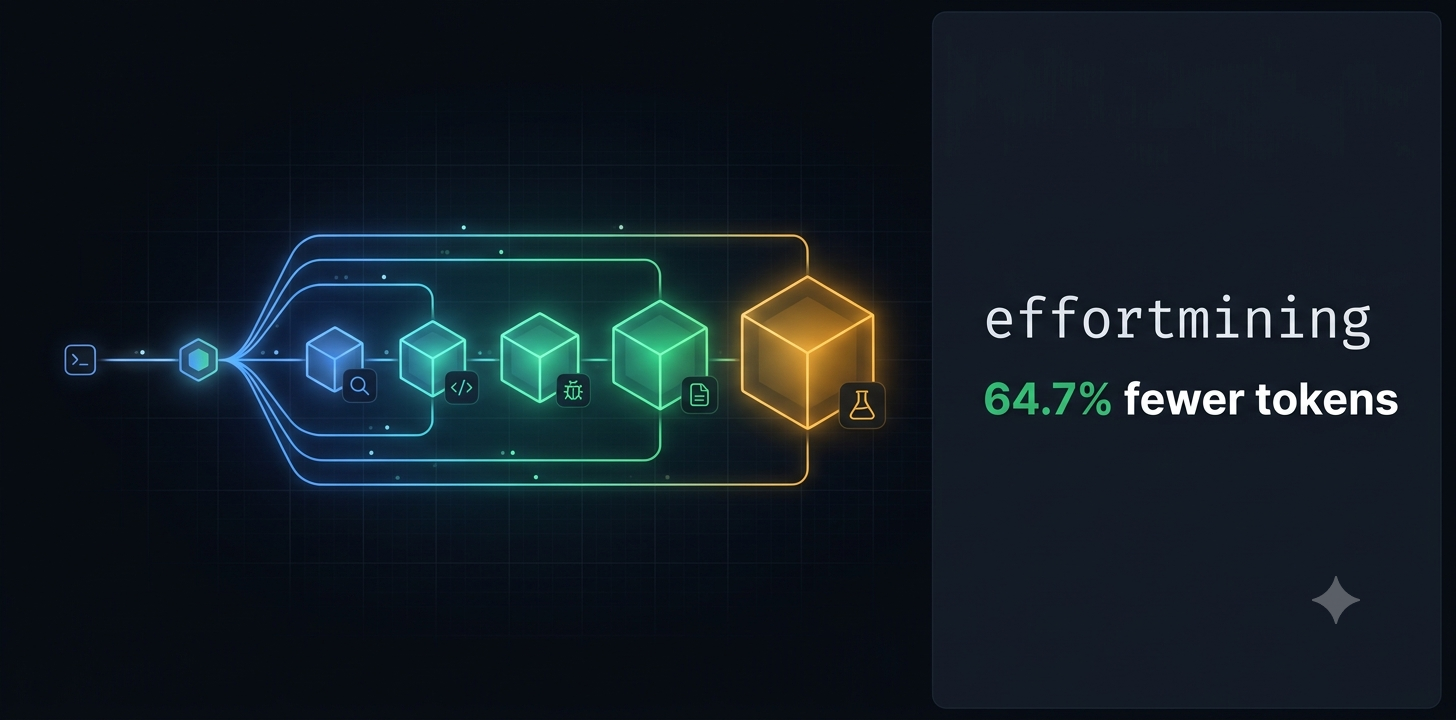
Claude Code makes every helper agent think as hard as your whole session. Most helpers don't need to. effortmining right-sizes reasoning effort per subagent and cuts output-token spend ~64.7% with no drop in quality — measured, not vibes.
claude plugin marketplace add nagisanzenin/effortmining
claude plugin install effortmining@effortmining
Requires Python 3 (stdlib only). Start a new session — that's it. It works from the first delegation, nothing to configure.
Claude Code has a "how hard should I think" dial (low → max). When it spawns a subagent, that subagent inherits your session's setting — there's no way to set effort per spawn. So every helper runs at the same effort, whether it's grepping a file or debugging a crash. And effort costs tokens.
  SESSION EFFORT: max        (no per-spawn setting — every helper inherits it)

  grep a file ......... max     <- overkill
  reformat a list ..... max     <- overkill
  read a diff ......... max     <- overkill
  run the tests ....... max     <- overkill
  debug a crash ....... max     <- the only job that actually needed it
It classifies each subtask, looks up the cheapest effort tier proven sufficient for that kind of work, and dispatches a worker pinned at that tier.
  effortmining right-sizes each job:

  grep a file ......... low
  reformat a list ..... low
  read a diff ......... low
  run the tests ....... low
  debug a crash ....... high

  four cheap jobs go cheap, the hard one keeps its effort.
  => 64.7% fewer output tokens, same pass rate.
Measured (~450 pre-registered runs on claude-opus-4-8): calibrated dispatch used 64.7% fewer output tokens (95% CI [60.8, 67.8]) than effort inheritance, at an identical pass rate. max never beat xhigh anywhere. Two pre-registered tests failed and are published below, not buried.
Thinking harder genuinely burns more tokens — but past a point it buys nothing. Median output tokens per tier, across the same tasks, with every tier reaching the quality ceiling:
  low    101  ██
  high   158  ███
  xhigh  295  ██████
  max    696  ██████████████   <- 7x low, and it never won a single task
max doesn't get things wrong — it just costs 7x for the same answer. That gap, multiplied across every subagent your session spawns, is the waste effortmining removes.
Ambient (default): install and forget. A SessionStart hook injects a one-line dispatch policy, and from then on Claude picks the right-effort worker on its own. On a new session you'll see:
[effortmining] calibration table 6 cells, fitted 2026-07-07 · /effortmine to dispatch calibrated
[effortmining] ambient dispatch policy: ... T1-mechanical->miner-low · T3-moderate-reasoning->miner-high ...
Watch the task line when Claude delegates — you'll see miner-low doing grunt work instead of a full-effort agent. Your explicit effort requests always override the table.
Precise: hand a multi-part job to the orchestrator and watch it decompose:
/effortmine (1) extract the domains from these emails into a sorted list: [email protected], [email protected], [email protected]
(2) this function should return the second-largest unique number but breaks on some inputs — find and fix:
def second_largest(xs): s = sorted(set(xs)); return s[-2]
It classifies (1) as mechanical → miner-low, (2) as diagnosis → miner-high, dispatches both, and tells you why.
Measured: /effort-bench — re-run the benchmark on your own account, or refit the table for a different model with python3 bench/effort.py calibrate. The whole pipeline is deterministic and resumable.
1. Five workers, one line apart. Claude Code's Agent tool has no per-spawn effort parameter — you can override a subagent's model, not its effort (verified against the CLI binary and docs, see docs/research/). The only place effort can be set is an agent's definition file. So effortmining ships five workers that are byte-identical except one frontmatter line:
  agents/  — pick a tier by picking a file:

  miner-low.md     ->  effort: low
  miner-medium.md  ->  effort: medium
  miner-high.md    ->  effort: high
  miner-xhigh.md   ->  effort: xhigh
  miner-max.md     ->  effort: max
npx claudepluginhub nagisanzenin/effortminingEvidence-based learning engine: first-principles curricula, generation-first Socratic tutoring, free-recall verification with receipts, FSRS-scheduled memory, and interactive explorable artifacts. Learn anything; keep it.
 nagisanzenin
Enhances Claude Code from producing raw code into delivering production-ready systems. 14 specialized agents handle architecture, tested code, security audit, CI/CD, and documentation. Use for building apps/websites/services, adding features, hardening, deployment, testing, review, or architecture design.
nagisanzeninA roster of 60 fully-specified human voice profiles plus a deterministic AI-tell scanner. Write, humanize, audit, and mass-produce social posts that read as distinct, genuine people — verified by stylometry, not vibes.
nagisanzeninThis skill should be used when the model's ROLE_TYPE is orchestrator and needs to delegate tasks to specialist sub-agents. Provides scientific delegation framework ensuring world-building context (WHERE, WHAT, WHY) while preserving agent autonomy in implementation decisions (HOW). Use when planning task delegation, structuring sub-agent prompts, or coordinating multi-agent workflows.
 Jamie-BitFlight
Multi-agent collaboration plugin for Claude Code. Spawn N parallel subagents that compete on code optimization, content drafts, research approaches, or any problem that benefits from diverse solutions. Evaluate by metric or LLM judge, merge the winner. 7 slash commands, agent templates, git DAG orchestration, message board coordination.
 alirezarezvani
Smart LLM routing with Claude subscription monitoring, complexity-first model selection, and 20+ AI providers
 Chuzom
Multi-agent orchestration via li o flow and li o fanout
 ohdearquant
Honey (I Shrunk the AI) — three reflexive levers that cut agent token cost: less code (YAGNI/stdlib-first), less prose, and denser agent-to-agent handoffs (ESON/compact-JSON). Plus on-demand satellites (review, eco, gain, compress) and a hive of read-only subagents that return compressed handoffs. Auto-intensity lite/full/ultra; correctness and safety-critical paths stay exact.
 Green-PT
Concentrated Claude. Zero fluff, max power per token.
 mirkobozzetto
'%20stop-opacity%3D'0.16'%2F%3E%3Cstop%20offset%3D'1'%20stop-color%3D'rgb(200%2C90%2C60)'%20stop-opacity%3D'0.03'%2F%3E%3C%2FlinearGradient%3E%3C%2Fdefs%3E%3Crect%20width%3D'320'%20height%3D'200'%20fill%3D'url(%23g)'%2F%3E%3Ccircle%20cx%3D'250'%20cy%3D'56'%20r%3D'92'%20fill%3D'rgb(200%2C90%2C60)'%20fill-opacity%3D'0.06'%2F%3E%3Ccircle%20cx%3D'64'%20cy%3D'172'%20r%3D'58'%20fill%3D'rgb(200%2C90%2C60)'%20fill-opacity%3D'0.05'%2F%3E%3C%2Fsvg%3E)
