Stats
Actions
Available In
Tags

Make AI coding agents follow a repeatable engineering workflow with memory, verification, skills, and multi-agent setup
AI DevKit · Exchange information with active Codex, Claude Code, and other AI agents using ai-devkit agent list, detail, and send. Use when an agent needs to find another active agent, read its recent context, send it information, or request information back.
AI DevKit · Manage running AI agents with ai-devkit agent commands. Use when an agent needs to identify itself, list agents, start workers, inspect agent detail, assign work, group agents, resume sessions, stop agents, or delegate work to other agents.
AI DevKit · Supervise multi-agent workflows over repeated passes: poll progress, unblock waiting agents, coordinate dependencies, relay outputs, resolve conflicts, and verify completion. Use only for ongoing multi-agent coordination, not one-off list/detail/send/start/kill actions.
AI DevKit · Update CHANGELOG.md Unreleased items from git commits since the latest release. Use when users ask to update changelog/release notes from recent commits, with one concise line per commit and commit/PR links.
AI DevKit · Safe git commit workflow for AI coding agents. Use when the user asks to commit, prepare a commit, stage changes, create a PR-ready checkpoint, or finish work with a conventional commit while avoiding unrelated user changes.
Own this plugin?
Verify ownership to unlock analytics, metadata editing, and a verified badge. GitHub access is read-only (username + org membership).
Sign in to claimOwn this plugin?
Verify ownership to unlock analytics, metadata editing, and a verified badge. GitHub access is read-only (username + org membership).
Sign in to claimBased on adoption, maintenance, documentation, and repository signals. Not a security audit or endorsement.
English | 中文
The control plane for AI coding agents.
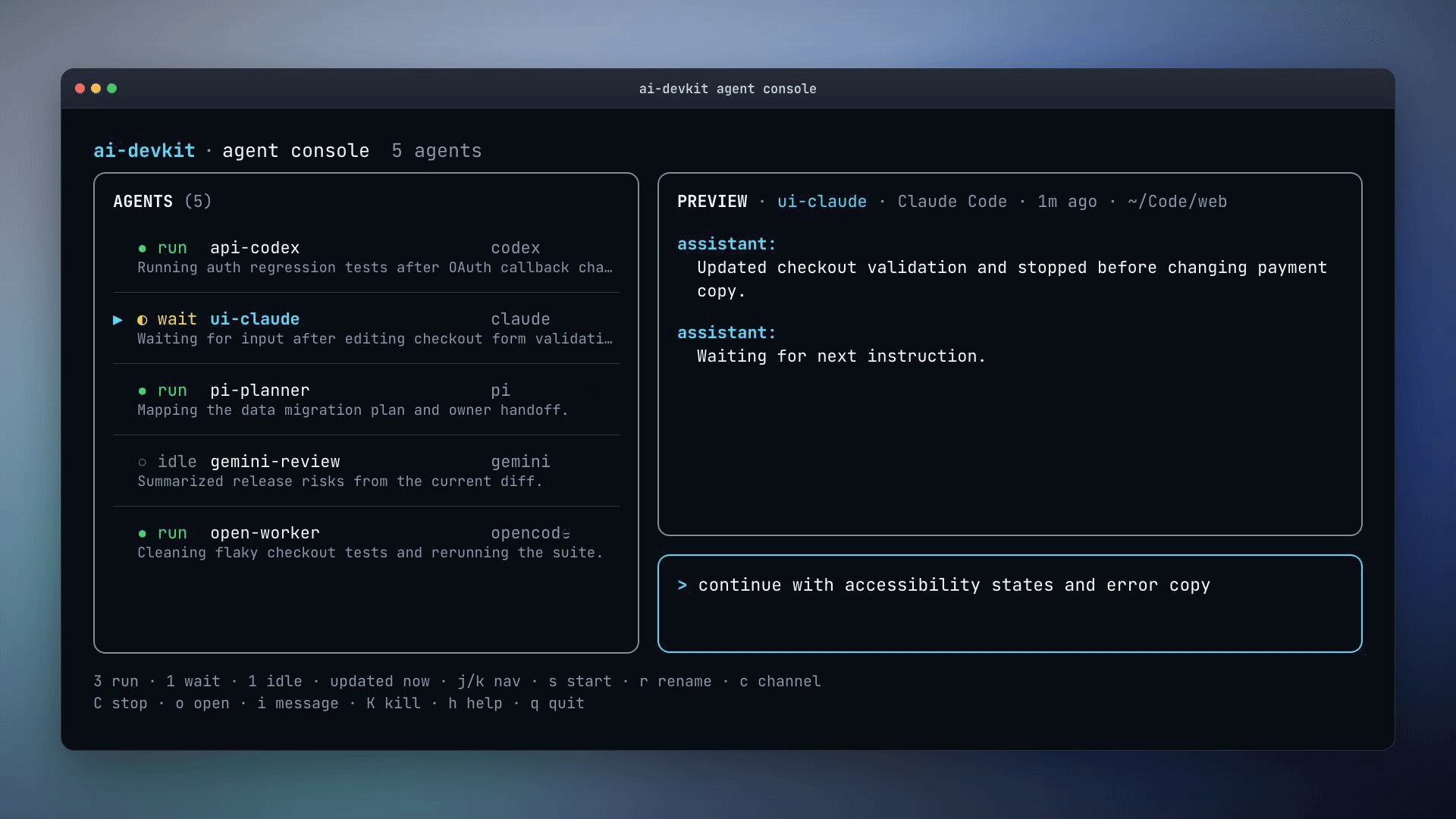
AI DevKit gives Claude Code, Codex CLI, Gemini CLI, opencode, Pi, Cursor, GitHub Copilot, Devin, and other coding agents one local-first operating layer: one config, one console, local memory retrieval, cross-agent communication, and composable engineering skills led by dev-lifecycle.
.ai-devkit.json reconciles setup across the coding tools your team usesagent console is a live TUI dashboard for supervising local agents across providersagent send lets you route prompts, logs, and test output to running agents@ai-devkit/memory stores decisions, conventions, and fixes in local SQLite so agents search when needed instead of carrying everything in every promptdev-lifecycle, verify, tdd, review, debugging, security, docs, and simplification skills combine into reliable workflowsThe future is many AI coding agents. AI DevKit is the layer that makes them manageable.
Run npx ai-devkit@latest init and your project gets:
| What you need | What AI DevKit installs |
|---|---|
| One setup source | .ai-devkit.json for the agents and workflow you choose |
| Running-agent visibility | agent list, agent detail, and agent console |
| Addressable agents | agent send, --stdin, --wait, and agent groups where supported |
| Retrieval-based memory | Local SQLite memory exposed through MCP and CLI, searched only when useful |
| Composable senior-engineer workflow | dev-lifecycle plus verification, TDD, debugging, review, security, docs, and simplification skills |




Developers whose AI coding setup has grown from one assistant into a small, messy team of agents:
CLAUDE.md / .cursor/rules / AGENTS.md / MCP setup per toolBefore AI DevKit, your agents are powerful but scattered. After AI DevKit, they have shared setup, a control surface, searchable memory, communication paths, and reusable skills that travel with your repo without bloating every prompt.
| Without AI DevKit | With AI DevKit |
|---|---|
| You manage agents as isolated terminal tabs | You supervise them from ai-devkit agent console |
| You hand-maintain every agent setup | One config reconciles agent files, skills, and MCP setup |
| You copy logs and context between sessions | agent send routes prompts and stdin to running agents |
| You repeat project rules in every chat | Agents retrieve relevant memory and docs only when useful |
| The agent jumps from prompt to code | dev-lifecycle guides requirements, design, planning, implementation, testing, and review |
| "Done" means the agent stopped editing | "Done" requires fresh verification output |
npx ai-devkit@latest init
One wizard. Pick your agents, install the control-plane pieces you need, and give every tool the same operating model. It writes project-local files you can review and commit. Re-run it whenever your agent list or workflow changes.
Here's what lands in your repo:
your-project/
├── .ai-devkit.json              # single source of truth (re-run init anytime)
├── .claude/                     # or .cursor/, .codex/, etc. per agent you picked
│   ├── skills/                  # dev-lifecycle, verify, memory, tdd, ...
│   └── settings.json            # MCP servers wired up (incl. @ai-devkit/memory)
└── docs/ai/
    ├── requirements/            # phase 1 — what to build, why
    ├── design/                  # phase 2 — how it'll be built
    ├── planning/                # phase 3 — task-by-task plan
    ├── implementation/          # phase 4 — execution notes
    └── testing/                 # phase 5 — coverage strategy
AI DevKit ships a agent control plane for everyday multi-agent work:
# List running sessions across providers
ai-devkit agent list

# Open the live terminal UI
ai-devkit agent console
npx claudepluginhub mvanhorn/ai-devkitResearch any topic across Reddit, X, YouTube, TikTok, Instagram, Hacker News, Polymarket, GitHub, and 5+ more sources. AI agent scores by upvotes, likes, and real money - not editors.
 mvanhorn
Generate production Go CLIs from API descriptions or OpenAPI specs
mvanhornResearch any topic across Reddit, X, YouTube, TikTok, Instagram, Hacker News, Polymarket, GitHub, and 5+ more sources. AI agent scores by upvotes, likes, and real money - not editors.
mvanhornComprehensive skill pack with 66 specialized skills for full-stack developers: 12 language experts (Python, TypeScript, Go, Rust, C++, Swift, Kotlin, C#, PHP, Java, SQL, JavaScript), 10 backend frameworks, 6 frontend/mobile, plus infrastructure, DevOps, security, and testing. Features progressive disclosure architecture for 50% faster loading.
 Jeffallan
Develop, test, build, and deploy Godot 4.x games with Claude Code. Includes GdUnit4 testing, web/desktop exports, CI/CD pipelines, and deployment to Vercel/GitHub Pages/itch.io.
 Randroids-Dojo
Lazy senior dev mode. Forces the simplest, shortest solution that actually works: YAGNI, stdlib first, no unrequested abstractions.
 DietrichGebert
Tools to maintain and improve CLAUDE.md files - audit quality, capture session learnings, and keep project memory current.
 anthropics
A growing collection of Claude-compatible academic workflow bundles. Covers scientific figures, manuscript writing and polishing, reviewer assessment, citation retrieval, data availability, paper reading, literature search, response letters, paper-to-PPTX conversion, and evidence-grounded Chinese invention patent drafting. Rules are organized as reusable skill folders with explicit workflows and quality checks.
 Yuan1z0825
Reliable automation, in-depth debugging, and performance analysis in Chrome using Chrome DevTools and Puppeteer
 ChromeDevTools
'%20stop-opacity%3D'0.16'%2F%3E%3Cstop%20offset%3D'1'%20stop-color%3D'rgb(200%2C90%2C60)'%20stop-opacity%3D'0.03'%2F%3E%3C%2FlinearGradient%3E%3C%2Fdefs%3E%3Crect%20width%3D'320'%20height%3D'200'%20fill%3D'url(%23g)'%2F%3E%3Ccircle%20cx%3D'250'%20cy%3D'56'%20r%3D'92'%20fill%3D'rgb(200%2C90%2C60)'%20fill-opacity%3D'0.06'%2F%3E%3Ccircle%20cx%3D'64'%20cy%3D'172'%20r%3D'58'%20fill%3D'rgb(200%2C90%2C60)'%20fill-opacity%3D'0.05'%2F%3E%3C%2Fsvg%3E)