Stats
Actions
Available In
Tags

Generate Spring Boot service code from BPMN process models, enforce team style guides with automated validation rules, and migrate between bpmn-to-code API versions. Supports Gradle and Maven project setup for Kotlin and Java.
Interactively author a BPMN_STYLE_GUIDE.md for your project — a handbook that explains how the team models BPMN processes (naming, allowed elements, IDs, topics, engine-specific special cases). The output is a document humans can read; embedded YAML annotations let downstream skills enforce the rules. Use when the user asks to 'create a BPMN style guide', 'set up BPMN conventions', or 'define BPMN naming rules'.
Create a complete Spring Boot service project from a BPMN file with hexagonal architecture. Bootstraps via Spring Initializr, configures bpmn-to-code, and generates workers, use cases, and services wired to ProcessApi constants — no raw strings anywhere. Use when the user wants to start a new process service from a BPMN model.
Generate a Kotlin BpmnValidationRule implementation for ONE rule from BPMN_STYLE_GUIDE.md. Use when drafting / iterating on a single rule, or when the user asks to 'generate a rule for <slug>', 'create the element-id-format rule', or 'add just this one rule to the test module'. For all rules at once, use generate-rules-to-enforce-bpmn-styleguide.
Generate Kotlin BpmnValidationRule implementations for every deterministic (or hybrid) rule in BPMN_STYLE_GUIDE.md, so they can be enforced at test time by the bpmn-to-code-testing module. llm-only rules stay in the style guide for /validate-bpmn-style. Use when the user asks to 'generate validation rules from the style guide', 'enforce BPMN conventions in CI', or 'automate style checks in tests'. For a single rule, use generate-rule-to-enforce-bpmn-styleguide.
Migrate generated API usage from bpmn-to-code v1.1.0 to v2.0.0. Use when the user asks to 'upgrade to v2', 'migrate from v1 to v2', 'fix TaskTypes references', or 'update bpmn-to-code API calls after upgrade'.
Own this plugin?
Verify ownership to unlock analytics, metadata editing, and a verified badge. GitHub access is read-only (username + org membership).
Sign in to claimOwn this plugin?
Verify ownership to unlock analytics, metadata editing, and a verified badge. GitHub access is read-only (username + org membership).
Sign in to claimBased on adoption, maintenance, documentation, and repository signals. Not a security audit or endorsement.
bpmn-to-code is early-stage and actively developing. The four pillars — Generate, Validate, Surface, Ship — are taking shape, but expect rough edges. Feedback and contributions are very welcome.



Type-safe constants from your BPMN model — for your compiler, your tests, and your AI agents.
Generate · Validate · Surface · Ship — a type-safe BPMN toolkit for JVM projects.
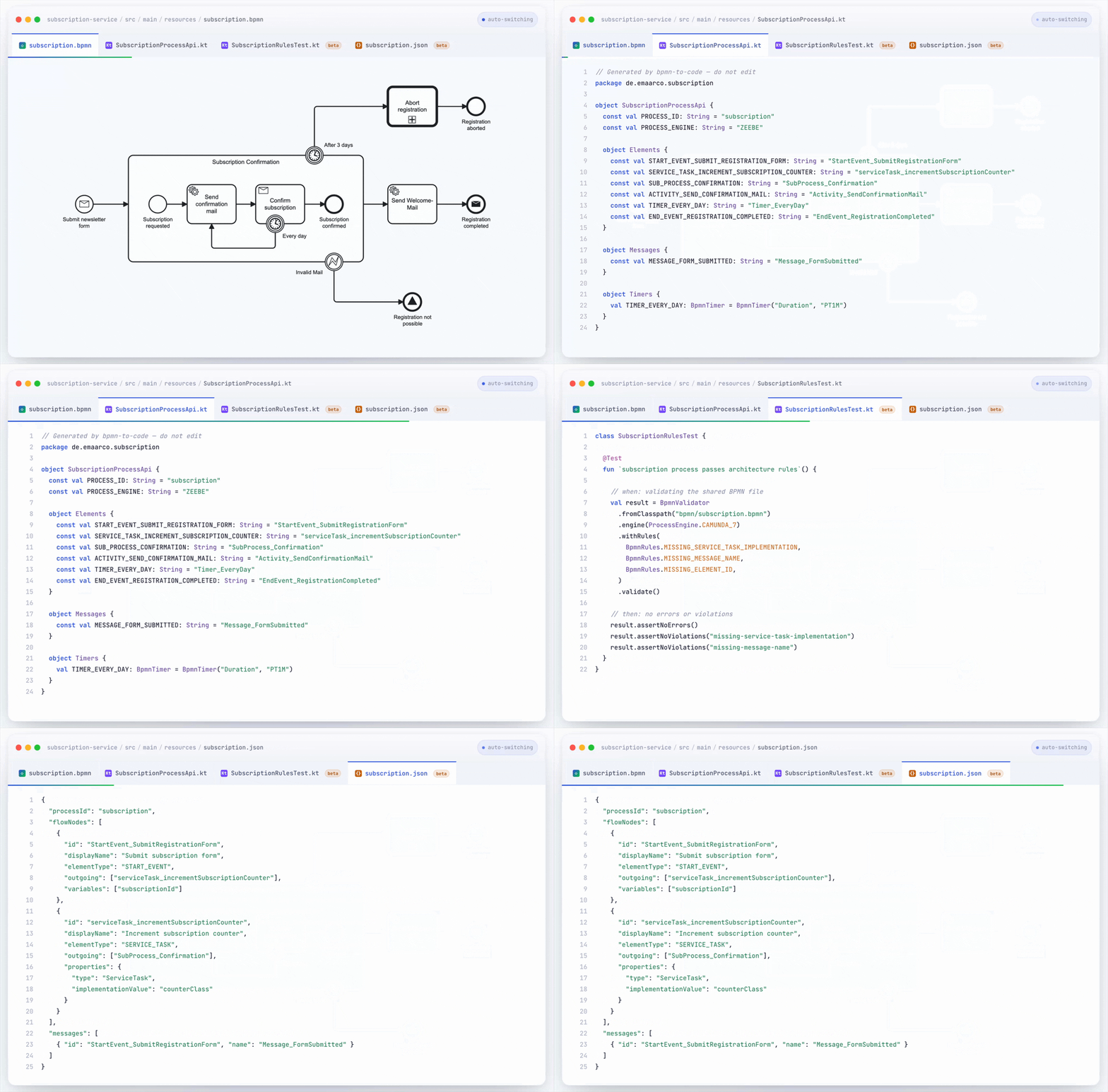
bpmn-to-code reads your BPMN files and generates typed constants from them. Every element ID, message name, and service task type becomes a compiled constant. Rename a task in the modeler → compiler error. No more silent runtime failures from hardcoded strings.
// Before
@JobWorker(type = "newsletter.sendConfirmationMail")  // copied from modeler, no safety net
fun send() { ... }

// After — generated from the BPMN model
@JobWorker(type = NewsletterSubscriptionProcessApi.ServiceTasks.NEWSLETTER_SEND_CONFIRMATION_MAIL)
fun send() { ... }
Like ArchUnit for Java, bpmn-to-code-testing lets you write architecture tests for your BPMN models. The standalone validateBpmnModels Gradle task and validate-bpmn Maven goal run the same checks in CI.
BpmnValidator
    .fromClasspath("bpmn/")
    .engine(ProcessEngine.ZEEBE)
    .validate()
    .assertNoViolations()
11 built-in rules cover missing implementations, undefined timers, empty processes, naming violations, and variable collisions. Add custom rules by implementing BpmnValidationRule.
Generates a structured JSON alongside the API. Your process is readable by AI agents, code reviewers, and CI — without opening Camunda Modeler.
{
  "processId": "newsletterSubscription",
  "flowNodes": [
    { "id": "StartEvent_SubmitRegistrationForm", "displayName": "Submit newsletter form", "elementType": "START_EVENT" },
    { "id": "Activity_SendConfirmationMail", "displayName": "Send confirmation mail", "elementType": "SERVICE_TASK" }
  ]
}
BPMN files are XML — technically readable, but full of visual layout data, namespace declarations, and rendering hints that make them noisy for AI tools. The generated JSON strips all of that away:
The result is a compact, deterministic representation that AI agents can reason about accurately — with no hallucinated element IDs, because the JSON is derived directly from the BPMN model by rule.
Drop-in agent skills that automate the entire setup workflow. Integrate the plugin into your project in one prompt, scaffold a complete process service from a BPMN file, and migrate hardcoded strings to the generated API — without touching any config manually.
/plugin marketplace add Miragon/bpmn-to-code
/plugin install bpmn-to-code@bpmn-to-code
Works with Claude Code out of the box.
plugins {
    id("io.miragon.bpmn-to-code-gradle") version "3.0.0"
}

tasks.named("generateBpmnModelApi", GenerateBpmnModelsTask::class) {
    baseDir = projectDir.toString()
    filePattern = "src/main/resources/**/*.bpmn"
    outputFolderPath = "$projectDir/src/main/kotlin"
    packagePath = "com.example.process"
    outputLanguage = OutputLanguage.KOTLIN
    processEngine = ProcessEngine.ZEEBE
}
npx claudepluginhub miragon/bpmn-to-code --plugin bpmn-to-codeUltra-compressed communication mode. Cuts ~75% of tokens while keeping full technical accuracy by speaking like a caveman.
 JuliusBrussee
Comprehensive UI/UX design plugin for mobile (iOS, Android, React Native) and web applications with design systems, accessibility, and modern patterns
 wshobson
Multi-model consensus engine integrating OpenAI Codex CLI, Gemini CLI, and Claude CLI for collaborative code review and problem-solving.
 xrf9268-hue
Curate auto-memory, promote learnings to CLAUDE.md and rules, extract proven patterns into reusable skills.
 alirezarezvani
'%20stop-opacity%3D'0.16'%2F%3E%3Cstop%20offset%3D'1'%20stop-color%3D'rgb(200%2C90%2C60)'%20stop-opacity%3D'0.03'%2F%3E%3C%2FlinearGradient%3E%3C%2Fdefs%3E%3Crect%20width%3D'320'%20height%3D'200'%20fill%3D'url(%23g)'%2F%3E%3Ccircle%20cx%3D'250'%20cy%3D'56'%20r%3D'92'%20fill%3D'rgb(200%2C90%2C60)'%20fill-opacity%3D'0.06'%2F%3E%3Ccircle%20cx%3D'64'%20cy%3D'172'%20r%3D'58'%20fill%3D'rgb(200%2C90%2C60)'%20fill-opacity%3D'0.05'%2F%3E%3C%2Fsvg%3E)
