Stats
Actions
Available In
Tags
De-identify PHI, extract clinical named entities, map to FHIR R4 and OMOP CDM, run compliance audits, and evaluate model fairness—all on-device.
Annotates VCF variants and normalizes HGVS nomenclature with public, license-free annotators (Ensembl VEP REST, VEP/SnpEff/ANNOVAR offline) and links variants to gnomAD population frequencies and the clinical context OpenMed extracts. Use when the user wants to predict variant consequences, map HGVS to genomic coordinates, annotate a VCF, attach allele frequencies, or pair variants with phenotype/oncology context. Trigger keywords: VCF, HGVS, variant annotation, VEP, SnpEff, ANNOVAR, consequence, missense, gnomAD, allele frequency, GRCh38, rsID, transcript. Pairs adjacent to OpenMed: combine annotated variants with Genomics/Oncology entities and phenotype from openmed.analyze_text. Tools used are free; restricted clinical databases are user-supplied.
Package multiple FHIR R4 resources produced from OpenMed output into a single valid transaction Bundle ready to POST to an EHR, using OpenMed's verified bundle assembler openmed.clinical.exporters.fhir.to_bundle. Covers deterministic urn:uuid fullUrls, automatic in-Bundle reference rewriting, request blocks (method/url) for transaction vs batch, and conditional create. Use after exporting-to-fhir when the user has several Condition/Observation/MedicationStatement resources and wants one transaction Bundle, mentions Bundle, transaction, references, or posting to a FHIR server. Builds on exporting-to-fhir; pairs after.
Adversarially scan already-de-identified clinical text for residual identifiers and emit a leakage report that blocks release on any hit. Use after OpenMed de-identification when the user asks to verify a redaction, prove no PHI/PII leaked, gate a dataset before sharing, or run a second-pass detector. Covers format and checksum detectors (SSN, Luhn for card numbers, MRN/account patterns, emails, phones, dates), entropy heuristics for high-randomness tokens, severity scoring, and a hard block-on-leak rule. This is the verification half of OpenMed's leakage-first ethos. Hand-off: re-run openmed.extract_pii on the de-id output and diff against expectations. License-free, local-first. Pairs after deidentifying-clinical-text.
Produce a signed, reproducible, no-PHI audit trail for an OpenMed de-identification run via deidentify(audit=True). Use when the user needs compliance evidence, a tamper-evident record of what was redacted and why, to verify nothing was changed, to retain proof for HIPAA/GDPR audits, or to review de-id decisions without exposing plaintext PHI. Covers the AuditReport / AuditSignature / AuditSpan / DetectorInfo fields, why audits store offsets+hashes+provenance+residual-risk and never plaintext, signing with .sign(key), and verifying with .verify(key). Pairs with OpenMed deidentifying-clinical-text and auditing-safe-harbor-checklist.
Generates and verifies 21 CFR Part 11-style audit trails — who/what/when, electronic signatures, and tamper-evidence — for OpenMed pipelines in GxP and clinical-trial (GCP) settings. Use when the user runs OpenMed in a regulated/validated environment and needs an attributable, time-stamped, tamper-evident record of each processing action, electronic-signature manifestations, or computer-system-validation (CSV) evidence. Trigger keywords: 21 CFR Part 11, Part 11, audit trail, electronic signature, e-signature, GxP, GCP, GLP, GMP, CSV, computer system validation, data integrity, ALCOA, tamper-evident, contemporaneous. Pairs adjacent to OpenMed: maps directly onto OpenMed deidentify(audit=True) -> signed AuditReport with .sign(key)/.verify(key), whose repro_hash + HMAC give the tamper-evidence and attribution Part 11 expects. This is a compliance-enablement aid, not a validation certification.
Own this plugin?
Verify ownership to unlock analytics, metadata editing, and a verified badge. GitHub access is read-only (username + org membership).
Sign in to claimOwn this plugin?
Verify ownership to unlock analytics, metadata editing, and a verified badge. GitHub access is read-only (username + org membership).
Sign in to claimBased on adoption, maintenance, documentation, and repository signals. Not a security audit or endorsement.

Turn clinical text into structured, de-identified insight, with nothing uploaded.
OpenMed extracts biomedical entities and removes 55+ PHI types entirely on the
hardware you control, so your data never leaves the device. The same 2,000+ open models run from a
phone to a GPU server, fully offline: iOS, iPadOS, and Android via OpenMedKit, React Native,
plain CPUs, Apple Silicon, NVIDIA GPUs, the browser, and REST/gRPC services.
No cloud. No vendor lock-in. No patient data leaving your network.












2,000+ models · 17 model-backed PII languages · 600+ PII checkpoints · 100% on-device · Apache-2.0
English · 简体中文 · Español · Français · Deutsch · Italiano · Português · Nederlands · العربية · हिन्दी · తెలుగు · 日本語 · Türkçe · فارسی
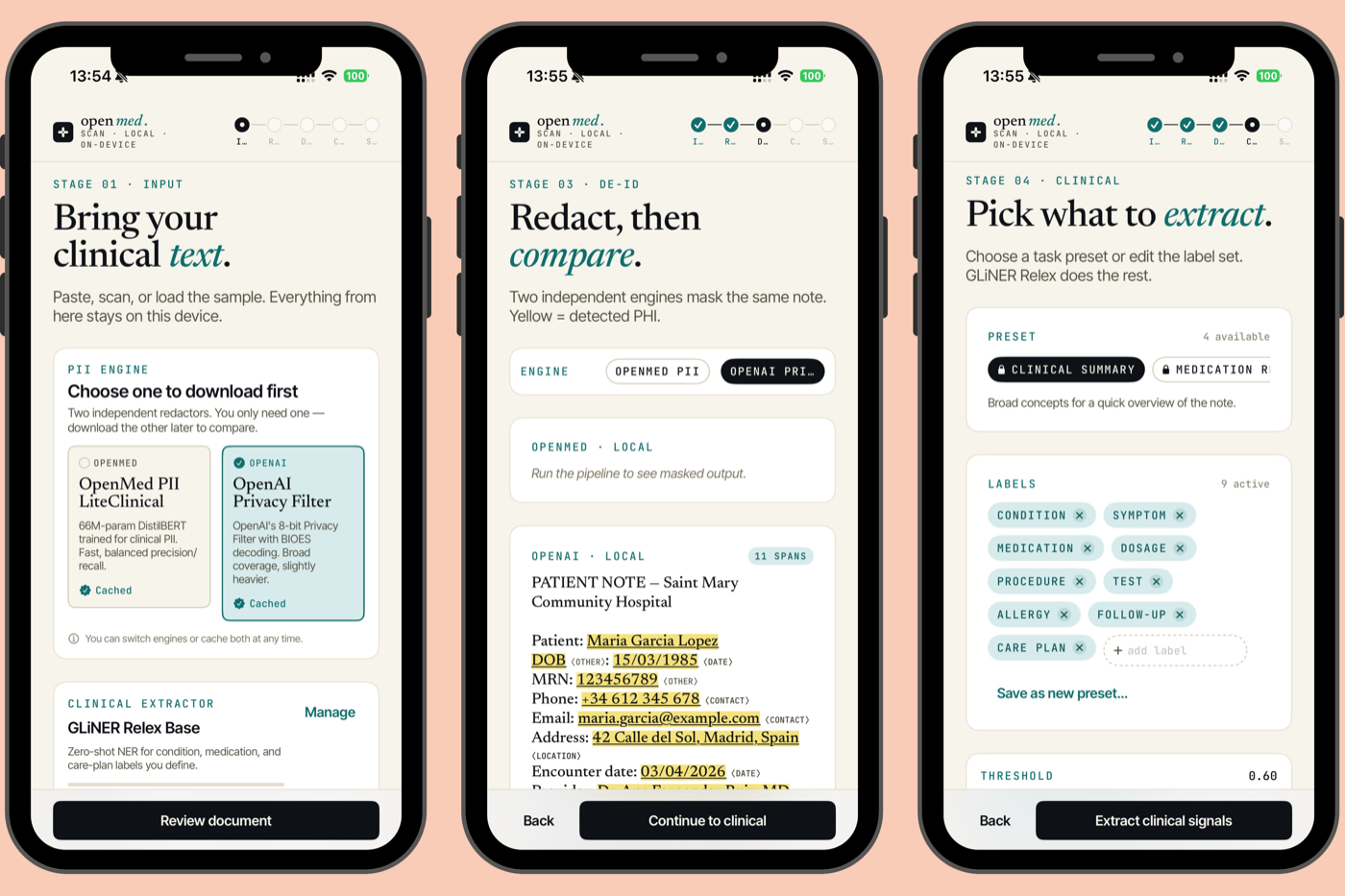
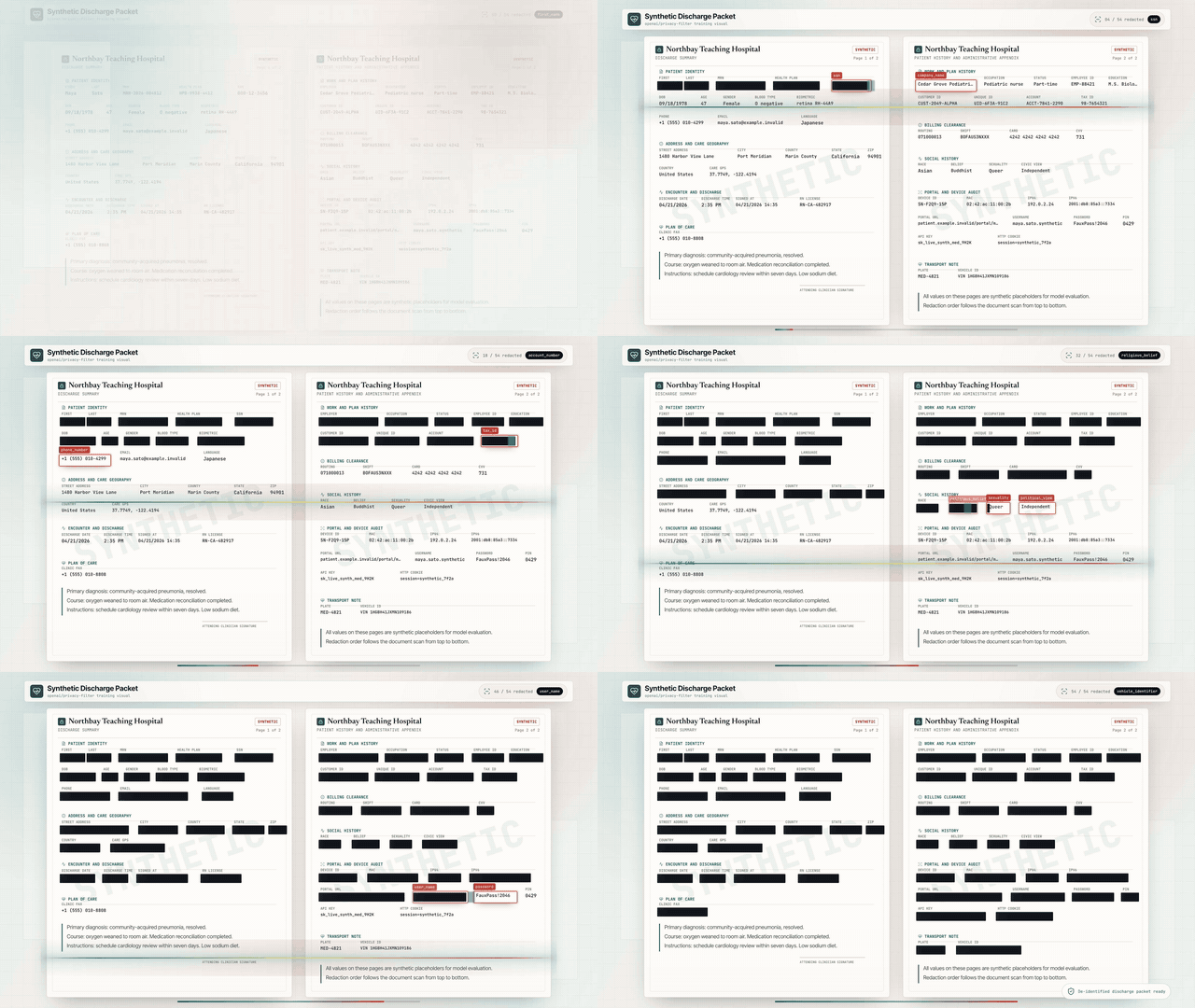
OpenMed runs entirely on the device; clinical text never leaves it. Here it is on iPhone, fully offline:
from openmed import analyze_text
npx claudepluginhub maziyarpanahi/openmed --plugin openmed-skillsClaude for Healthcare — skills for payer, provider, pharma, and general healthcare work (prior auth, ICD-10-CM coding, clinical-note extraction, trial protocols, FHIR), with a bundled local FHIR connector and hosted MCP connections to CMS Coverage, ICD-10, NPI Registry, Clinical Trials, and PubMed.
 anthropics
FHIR AI agent guardrails with 14 MCP tools. PHI redaction on every read, step-up authorization for writes, immutable audit trails, tenant isolation, Curatr data quality evaluation and correction, Fasten Connect EHR ingestion, and HealthEx portable health record export. FHIR R4 US Core v9 (stable) + FHIR R6 ballot3 (experimental). A healthclaw.io reference implementation.
 aks129
Claude Code skill pack for OpenEvidence medical AI (24 skills)
 jeremylongshore
HealthCare domain specialization with HIPAA compliance, HL7 FHIR interoperability, PHI data handling, clinical data modeling, EHR system integration, medical device software (IEC 62304), telehealth architecture, and healthcare analytics.
 rnavarych
Validate AI medical devices, manage PCCPs, monitor adverse events, and stay aligned with FDA QSR
 alexclowe
Implementation of the Dr. Ralph technique - continuous self-referential AI loops for interactive iterative development. Run Claude in a while-true loop with the same prompt until task completion.
 blencorp
'%20stop-opacity%3D'0.16'%2F%3E%3Cstop%20offset%3D'1'%20stop-color%3D'rgb(200%2C90%2C60)'%20stop-opacity%3D'0.03'%2F%3E%3C%2FlinearGradient%3E%3C%2Fdefs%3E%3Crect%20width%3D'320'%20height%3D'200'%20fill%3D'url(%23g)'%2F%3E%3Ccircle%20cx%3D'250'%20cy%3D'56'%20r%3D'92'%20fill%3D'rgb(200%2C90%2C60)'%20fill-opacity%3D'0.06'%2F%3E%3Ccircle%20cx%3D'64'%20cy%3D'172'%20r%3D'58'%20fill%3D'rgb(200%2C90%2C60)'%20fill-opacity%3D'0.05'%2F%3E%3C%2Fsvg%3E)