Stats
Actions
Available In
Tags

Learn any topic through an adaptive AI tutor that generates a structured syllabus and delivers personalized lessons using Socratic teaching, Feynman technique, and knowledge mapping, adjusting based on your feedback.
Use when 用户想以一对一苏格拉底导师的方式系统学习一个课题——开一门新课、推进课题的下一篇、提交学习反馈或说「我读完了」、或整理/查看学习日志。基于 Bloom 2 Sigma 的交互式学习系统。触发词:开个文件夹学X、我想学X、帮我学X、继续、下一篇、我读完了、整理学习、查看学习日志、interactive Socratic tutoring、Bloom 2 sigma learning。
当用户学习或接触一个新概念/新技术/新算法/新领域时使用(尤其感到陌生或有点难时)。用「跨界原则」拿用户已掌握的知识快速撬动新知识——指出他其实已经学过的同一个东西(换了名字)、结构同构的旧知识、能解释新知识的已有知识,并点出新概念体现的跨领域元知识模式。让「学新东西」变成「发现你已经会了一半」。触发场景:学 X、接触 X、这个好难、X 是什么、帮我理解 X。
用户学任何新概念/新技术/新理论的默认深度入口——一次性用五个视角把概念讲透并帮他选深入方向:crossover 用已会的撬动、occam 框定该学多深、graph 建知识地图、prototype 最小原型迭代、feynman 拷问检验。触发场景:我想学 X、理解 X、X 是什么、讲讲 X、搞懂 X、学一下 X、深入 X、给我讲讲 X。除非用户明确只要某一个视角(那时改用对应的单个 learn-* skill)。
当用户学完一个东西想自查是否真懂、或觉得「好像懂了」但不确定时使用。用「费曼学习法」让他用自己的话把概念讲出来,你扮好奇学生专挑他含糊/跳过的地方追问,把「讲不顺的模糊处」揪出来作为没真懂的漏洞,定位是缺前置知识还是没想透,判断理解是否闭环。触发场景:我学完了考考我、自查一下、我好像懂了、我讲讲你看对不对、检验我的理解、这个我真懂了吗。
当用户要系统学一个新领域、不知道从哪入手、或担心「学得不够系统」时使用。用「知识图谱学习法」和用户一起构建该领域的概念/用途/父子节点图谱(自己建图的过程本身就是学习),标出复用价值最高的节点和「从常识就能入门的点」,给出有效学习路径并回答「学到哪算够」。触发场景:系统学 X 领域、从哪开始学、学得不系统、想要 X 的全貌、规划学习路径、这个领域有多大。
Own this plugin?
Verify ownership to unlock analytics, metadata editing, and a verified badge. GitHub access is read-only (username + org membership).
Sign in to claimOwn this plugin?
Verify ownership to unlock analytics, metadata editing, and a verified badge. GitHub access is read-only (username + org membership).
Sign in to claimBased on adoption, maintenance, documentation, and repository signals. Not a security audit or endorsement.

Hire a private AI tutor for anything you want to learn.
Your AI reads how you actually learn — and teaches the next lesson just for you.
Built on Bloom's 2-Sigma research: 1-on-1 tutoring = top 2%.





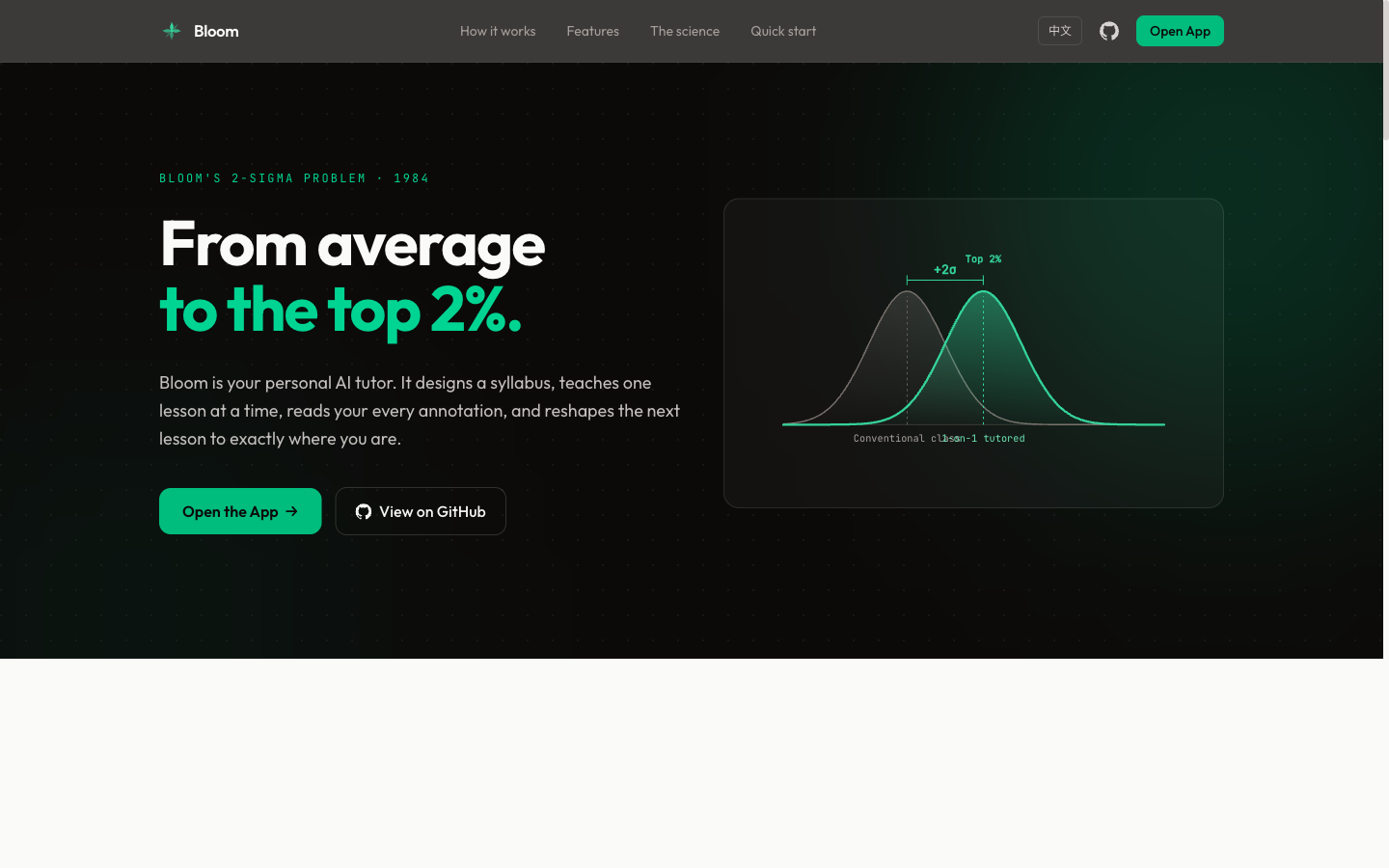
In 1984, educational psychologist Benjamin Bloom discovered that students receiving one-on-one tutoring scored 2 standard deviations (+2σ) above the classroom average — jumping to the top 2%. Bloom called this the "2 Sigma Problem": the effect is proven, but personal tutors don't scale.
Bloom solves this with AI. It generates a structured syllabus, delivers lessons one at a time, reads your annotations and feedback, then tailors the next lesson to your exact understanding level — just like a real tutor would.
| Mode | Setup | Best for |
|---|---|---|
| CLI | Claude Code + terminal | Power users who like Markdown editors |
| Web | Browser (React + FastAPI) | Visual learners, shareable setup |
Both follow the same flow: syllabus → lesson → annotate → feedback → next lesson → evaluation → summary.
Requires only Claude Code. No backend.
git clone https://github.com/Li-Evan/Bloom.git
cd Bloom

# Install the tutor skill locally for this clone
mkdir -p .claude/skills
cp -R skills/bloom-tutor .claude/skills/

claude
Then say: Create a new folder and help me learn [any topic]
Or install it as a plugin (bundles bloom-tutor plus the learn-* skills) — in Claude Code:
/plugin marketplace add Li-Evan/Bloom
/plugin install bloom@li-evan
See GUIDE.md for the full walkthrough.
git clone https://github.com/Li-Evan/Bloom.git
cd Bloom

# Configure
cp .env.example .env
# Edit .env — fill in LLM_API_KEY

# Backend
cd backend && uv sync && uv run uvicorn app.main:app --reload --port 8000

# Frontend (new terminal)
cd frontend && npm install && npm run dev
Open http://localhost:5173. Click New Course, choose Topic, Source Upload, or Project Files, and start learning.
cp .env.example .env   # fill in API key
docker compose up -d   # visit http://localhost:3000
Create course → AI generates syllabus + lesson 01
                        ↓
        Read lesson → highlight text → add annotations
                        ↓
        Write feedback → answer thought questions
                        ↓
        Click "Done Reading" → AI generates next lesson
        (answer review + annotation responses + new content)
                        ↓
        Repeat until all mastery items checked ✅
                        ↓
        Auto-generate evaluation → then summary
Upload PDF / TXT / MD → AI generates syllabus + source-reading chapter
                          ↓
       Read source → highlight text → ask and get an immediate answer
                          ↓
       Click "Done Reading" → AI reads the full source + Q&A, then generates the next lesson
                          ↓
       Continue with the normal adaptive lesson flow
npx claudepluginhub li-evan/bloom --plugin bloomEvidence-based learning engine: first-principles curricula, generation-first Socratic tutoring, free-recall verification with receipts, FSRS-scheduled memory, and interactive explorable artifacts. Learn anything; keep it.
 nagisanzenin
Interactive learning companion — creates personalized learning plans, quizzes with adaptive difficulty, and tracks progress across sessions
 kirilxd
Adaptive learning tutor for any subject — personalized curriculum, level diagnostics, quizzes, and four goal modes including full exam prep.
 Dhruvdubey17
Adaptive tutor skill with 10 teaching modes, active teaching tools, and a browser-based visual companion — runs code, creates exercises, generates interactive diagrams, quizzes, and walkthroughs. Makes Claude act as an interactive coach for learning any subject.
 JEFF7712
Teach the user a new skill or concept, within this workspace.
 mattpocock
Skill mapping, practice plans, and learning retrospectives. Builds personalized roadmaps with milestones and practice checkpoints, and runs periodic reviews to adjust based on progress.
 kdoroszewicz
'%20stop-opacity%3D'0.16'%2F%3E%3Cstop%20offset%3D'1'%20stop-color%3D'rgb(200%2C90%2C60)'%20stop-opacity%3D'0.03'%2F%3E%3C%2FlinearGradient%3E%3C%2Fdefs%3E%3Crect%20width%3D'320'%20height%3D'200'%20fill%3D'url(%23g)'%2F%3E%3Ccircle%20cx%3D'250'%20cy%3D'56'%20r%3D'92'%20fill%3D'rgb(200%2C90%2C60)'%20fill-opacity%3D'0.06'%2F%3E%3Ccircle%20cx%3D'64'%20cy%3D'172'%20r%3D'58'%20fill%3D'rgb(200%2C90%2C60)'%20fill-opacity%3D'0.05'%2F%3E%3C%2Fsvg%3E)