Stats
Actions
Available In
Tags

Lean senior-dev mode for Claude Code: ponytail's discipline plus better questions with ASCII sketches, optimal code, fewer comments, and a real sync after a change. One always-on mode, a tiny ruleset, no token-heavy ceremony.
Scan the whole repository against capybaraa's rules: lean, ask, optimal, terse, clean, sync. A ranked, codebase-wide report of over-engineering, dead code, bad complexity, filler comments, missing validation, and docs/tests out of sync with the code. One line per finding, biggest impact first, lists only, does not apply fixes. Use when the user says "audit this repo against the rules", "capybaraa audit", "/capybaraa-audit", "what can I delete from this repo", or "find the bloat".
Quick reference for capybaraa, what it does, the lean ladder and five habits, and how to turn it on or off. Use when the user types /capybaraa-help or asks how capybaraa works.
Review the current diff against capybaraa's rules: lean, ask, optimal, terse, clean, sync. Finds guessed specs, speculative abstractions, bad complexity, filler comments, mess left behind, and docs/tests left out of sync. One line per finding, lists only, does not apply fixes. Use when the user says "review against the rules", "capybaraa review", "/capybaraa-review", or asks what's wrong with a change before they ship it.
Find and fix drift between the code and everything that describes it: docs, README, comments, tests, sibling code, config, version strings. Lists each gap, confirms, then updates in one pass and deletes the stale. Use when the user says "capybaraa sync", "/capybaraa-sync", "keep the docs in sync", "did anything go stale after that change", or after a rename/refactor/version bump that ripples outward.
Turn capybaraa on or off, or explain what it is. Use when the user types /capybaraa, says "capybaraa", "stop capybaraa", "start capybaraa", or asks what capybaraa does.
Own this plugin?
Verify ownership to unlock analytics, metadata editing, and a verified badge. GitHub access is read-only (username + org membership).
Sign in to claimOwn this plugin?
Verify ownership to unlock analytics, metadata editing, and a verified badge. GitHub access is read-only (username + org membership).
Sign in to claimBased on adoption, maintenance, documentation, and repository signals. Not a security audit or endorsement.

The chillest senior dev in the swamp. Doesn't panic, doesn't over-build. Asks first, ships clean, leaves.




~20% less code than a bare agent, fully complete and 100% safe on the adversarial tier · plus the questions ponytail skips
You know the type. Unbothered, has seen every framework rise and fall and didn't migrate to any of them. You hand over a vague ticket and fifty lines of someone's first draft. He reads it, asks the two questions that actually matter, draws a little box-and-arrow on a napkin, and replaces the whole thing with the part you needed.
Capybaraa puts that habit inside Claude Code: ponytail's lean discipline plus a few things it skips. Ask the deciding question before building the wrong thing, pick the right data structure, write fewer comments, and sync the docs after a change. The ruleset stays tiny on purpose, a plugin that preaches lean while injecting a wall of rules every turn is the irony it avoids.
The ticket: "add user settings persistence."
Claude can already ask good questions here, that's what plan mode is for. But in a plain run it tends to guess the spec and start building, and you find out it guessed wrong once it is written. In our benchmark, on a ticket like this the bare agent wrote ~300 lines of a settings panel nobody specified; capybaraa wrote zero and asked first.
The asking is Claude's; capybaraa's specific add is the ASCII sketch on the options. When it asks, it draws the choices so the tradeoff is obvious at a glance (unless the choice is shapeless and a sketch adds nothing), and it leans on asking the deciding questions even outside plan mode rather than guessing:
🦫 two questions before I touch code:

   ┌── settings ──┐
   │ theme        │   store where?   local / your API / both
   │ language     │   per-device, or synced to the account?
   └──────────────┘

   1. just these two fields now, or more coming?
   2. per-device, or synced?

   edge cases I'll handle: no-JS fallback, unknown saved value, first load.
Then it builds the smallest thing that fits your answers and stops. No invented spec, no files you didn't need, nothing left half-done. The rest is plain lean: reuse what's there, the right data structure, few comments, and a sync of the docs after.
That is the whole pitch: ask when it's ambiguous, build lean, leave it clean. The rest of this README is how it does that, and the numbers that show it.
We measured it instead of asserting it. The agentic benchmark runs real headless Claude Code sessions (claude -p) in throwaway workspaces and puts capybaraa next to its honest peers: a bare agent (no plugin), caveman (a prose-compression skill), and ponytail (the pure-minimal plugin, loaded live). Same model, same task, same seed; the only change is the arm.
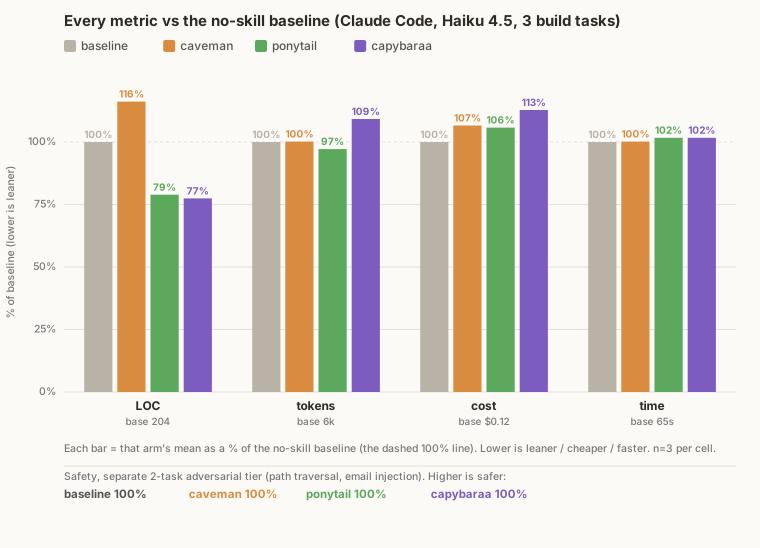
| vs the bare baseline | lines of code | output tokens | cost | time | complete | safe |
|---|---|---|---|---|---|---|
| caveman | 116% | 100% | 107% | 100% | 3/3 | 100% |
| ponytail | 79% | 97% | 106% | 102% | 3/3 | 100% |
| capybaraa | 77% | 109% | 113% | 102% | 3/3 | 100% |
Read it straight, no spin:
1. capybaraa writes the least code, and stays complete and safe. At 77% of the bare agent's lines it is the leanest arm, a hair under ponytail (79%) and far under caveman (116%), while scoring fully complete (3/3) and 100% on the adversarial safety tier. The saving is real bloat removed, not a dropped feature: most of it is feat-palette, 84 lines against the bare agent's 138.
npx claudepluginhub katipally/capybaraa --plugin capybaraaConsult multiple AI coding agents (Gemini, OpenAI, Grok, Perplexity, plus codex and antigravity CLIs when installed) to get diverse perspectives on coding problems
 hex
hexComprehensive skill pack with 66 specialized skills for full-stack developers: 12 language experts (Python, TypeScript, Go, Rust, C++, Swift, Kotlin, C#, PHP, Java, SQL, JavaScript), 10 backend frameworks, 6 frontend/mobile, plus infrastructure, DevOps, security, and testing. Features progressive disclosure architecture for 50% faster loading.
 Jeffallan
Develop, test, build, and deploy Godot 4.x games with Claude Code. Includes GdUnit4 testing, web/desktop exports, CI/CD pipelines, and deployment to Vercel/GitHub Pages/itch.io.
 Randroids-Dojo
Lazy senior dev mode. Forces the simplest, shortest solution that actually works: YAGNI, stdlib first, no unrequested abstractions.
 DietrichGebert
Production-grade engineering skills for AI coding agents — covering the full software development lifecycle from spec to ship.
 addyosmani
Comprehensive feature development workflow with specialized agents for codebase exploration, architecture design, and quality review
 anthropics
'%20stop-opacity%3D'0.16'%2F%3E%3Cstop%20offset%3D'1'%20stop-color%3D'rgb(200%2C90%2C60)'%20stop-opacity%3D'0.03'%2F%3E%3C%2FlinearGradient%3E%3C%2Fdefs%3E%3Crect%20width%3D'320'%20height%3D'200'%20fill%3D'url(%23g)'%2F%3E%3Ccircle%20cx%3D'250'%20cy%3D'56'%20r%3D'92'%20fill%3D'rgb(200%2C90%2C60)'%20fill-opacity%3D'0.06'%2F%3E%3Ccircle%20cx%3D'64'%20cy%3D'172'%20r%3D'58'%20fill%3D'rgb(200%2C90%2C60)'%20fill-opacity%3D'0.05'%2F%3E%3C%2Fsvg%3E)