Stats
Actions
Available In
Tags

Plan, implement, and review software tasks using structured .flow/ workflows with autonomous subagents, multi-model review gates, and codebase readiness assessments. Supports epic planning, task execution, code reviews, and project health checks.
Audit `.flow/memory/` entries against the current codebase — Keep / Update / Consolidate / Replace / Delete per entry
Synthesize the current conversation into a flow-next spec at `.flow/specs/<spec-id>.md` — source-tagged, mandatory read-back, no silent overwrite
[deprecated] Renamed to /flow-next:spec-completion-review — invokes the new skill
John Carmack-level implementation review via RepoPrompt or Codex
Interview & refine a spec, task, or spec file in-depth
Used by /flow-next:prime to analyze build system, scripts, and CI configuration. Do not invoke directly.
Used by /flow-next:prime to analyze CLAUDE.md and AGENTS.md quality and completeness. Do not invoke directly.
Token-efficient codebase exploration using RepoPrompt codemaps and slices. Use when you need deep codebase understanding without bloating context.
Identify documentation that may need updates based on the planned changes.
Find the most relevant framework/library docs for the requested change.
Audit `.flow/memory/` entries against the current codebase and decide Keep / Update / Consolidate / Replace / Delete per entry. Triggers on /flow-next:audit, "audit memory", "review memory", "refresh learnings", "sweep stale memory", "consolidate overlapping memory entries". Optional `mode:autofix` token in arguments runs without questions and marks ambiguous as stale. Optional scope hint after the mode token (concept, category, module, or path) narrows what gets audited.
Synthesize the current conversation context into a flow-next spec at `.flow/specs/<spec-id>.md` via `flowctl spec create + spec set-plan` — agent-native, source-tagged, with mandatory read-back before write. Triggers on /flow-next:capture, "capture spec", "lock down what we discussed", "make a spec from this conversation", "convert conversation to spec". Optional `mode:autofix` token runs without questions and requires `--yes` to commit. Optional `--rewrite <spec-id>` overwrites an existing spec; `--from-compacted-ok` overrides the compaction-detection refusal; `--override-strategy` proceeds despite a contradiction with an active STRATEGY.md track (and prompts to record the override as a decision).
Show spec dependency graph and execution order. Use when asking 'what's blocking what', 'execution order', 'dependency graph', 'what order should specs run', 'critical path', 'which specs can run in parallel'.
Drive any UI surface like a real user - a web app, a Chromium-backed desktop app (Electron / WebView2, reached over CDP), or a genuinely native app (macOS AppKit/SwiftUI, or a non-CDP webview) reached via the Cua Driver / Computer Use. Detects the surface, picks the best available driver, degrades gracefully. Use to navigate sites, verify deployed UI, test web or desktop apps, capture baseline screenshots, drive a sign-in flow, scrape data, fill forms, run an e2e check, or inspect current page state. Triggers on "check the page", "verify UI", "test the site", "test this app", "drive the app", "automate this desktop app", "read docs at", "look up API", "visit URL", "browse", "screenshot", "scrape", "e2e test", "login flow", "capture baseline", "see how it looks", "inspect current", "before redesign", "Electron app", "native app".
Export RepoPrompt context to a markdown file for review with an external LLM (ChatGPT, Claude web, etc.). Use when you want Carmack-level review but prefer an external model. Triggers on "export context", "export for external review", "export plan for ChatGPT", "export impl review context", "review with an external model", "export review context".
Executes bash commands
Hook triggers when Bash tool is used
Modifies files
Hook triggers on file write and edit operations
Own this plugin?
Verify ownership to unlock analytics, metadata editing, and a verified badge. GitHub access is read-only (username + org membership).
Sign in to claimOwn this plugin?
Verify ownership to unlock analytics, metadata editing, and a verified badge. GitHub access is read-only (username + org membership).
Sign in to claimnpx claudepluginhub gmickel/flow-next --plugin flow-nextBased on adoption, maintenance, documentation, and repository signals. Not a security audit or endorsement.
Uses power tools
Uses Bash, Write, or Edit tools
Uses power tools
Uses Bash, Write, or Edit tools






AI coding agents that ship like engineers - not slot machines.
The workflow layer for AI coding agents: durable specs, re-anchored workers, adversarial reviews, receipts.
Everything lives in your repo. Zero external dependencies. Uninstall: rm -rf .flow/.
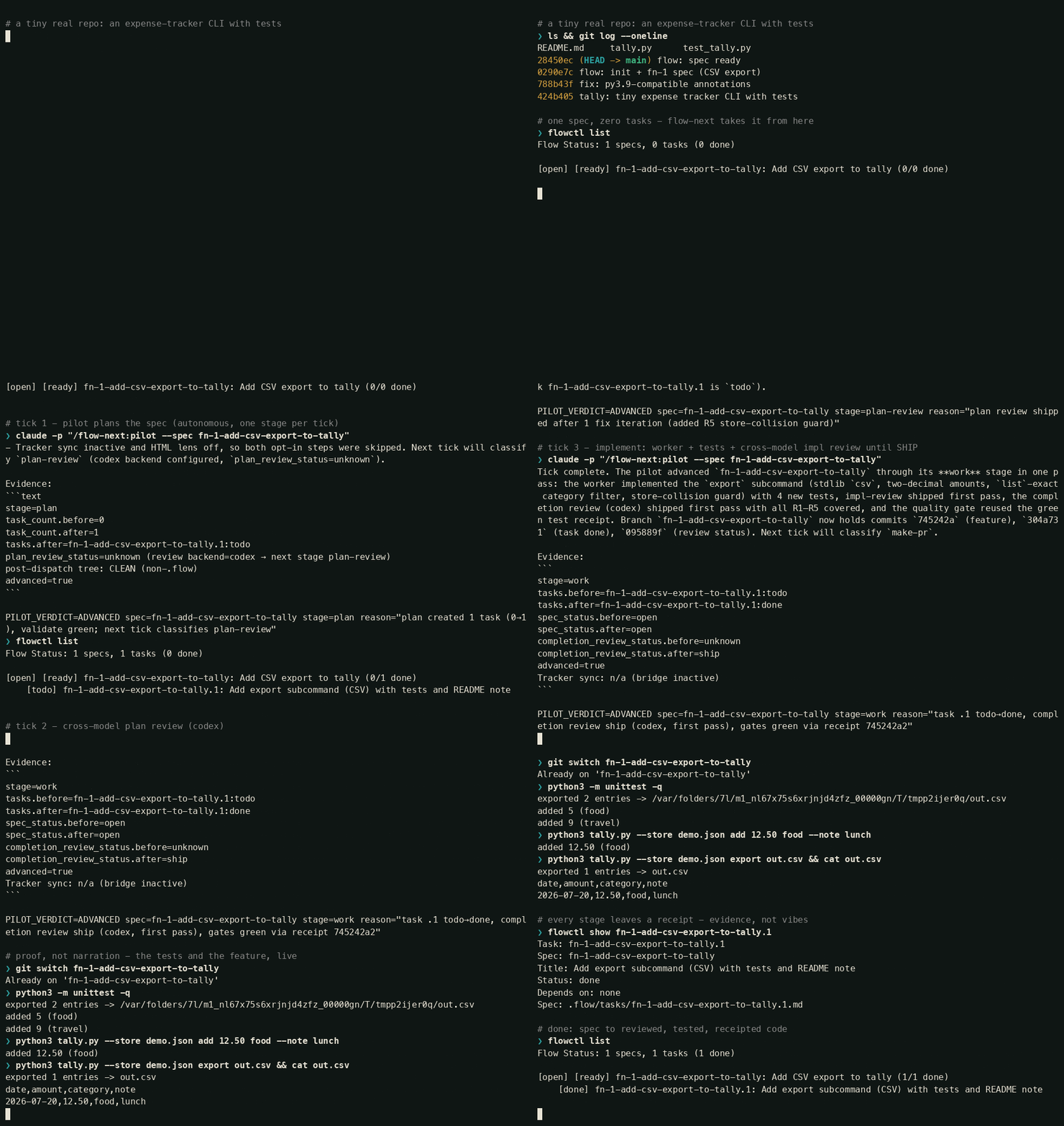
Proof, not adjectives: a real recorded run - plan → cross-model plan review (catches a missing guard, fix, SHIP) → implement + tests → impl review SHIP → the receipt. Nothing staged; every frame is live output.
ℹ️ The recording drives each tick with claude -p "…" (Claude Code's non-interactive / headless mode) so the whole run captures unattended. In normal use you just type the prompt or /flow-next:… command in your interactive session — same pipeline, same gates.
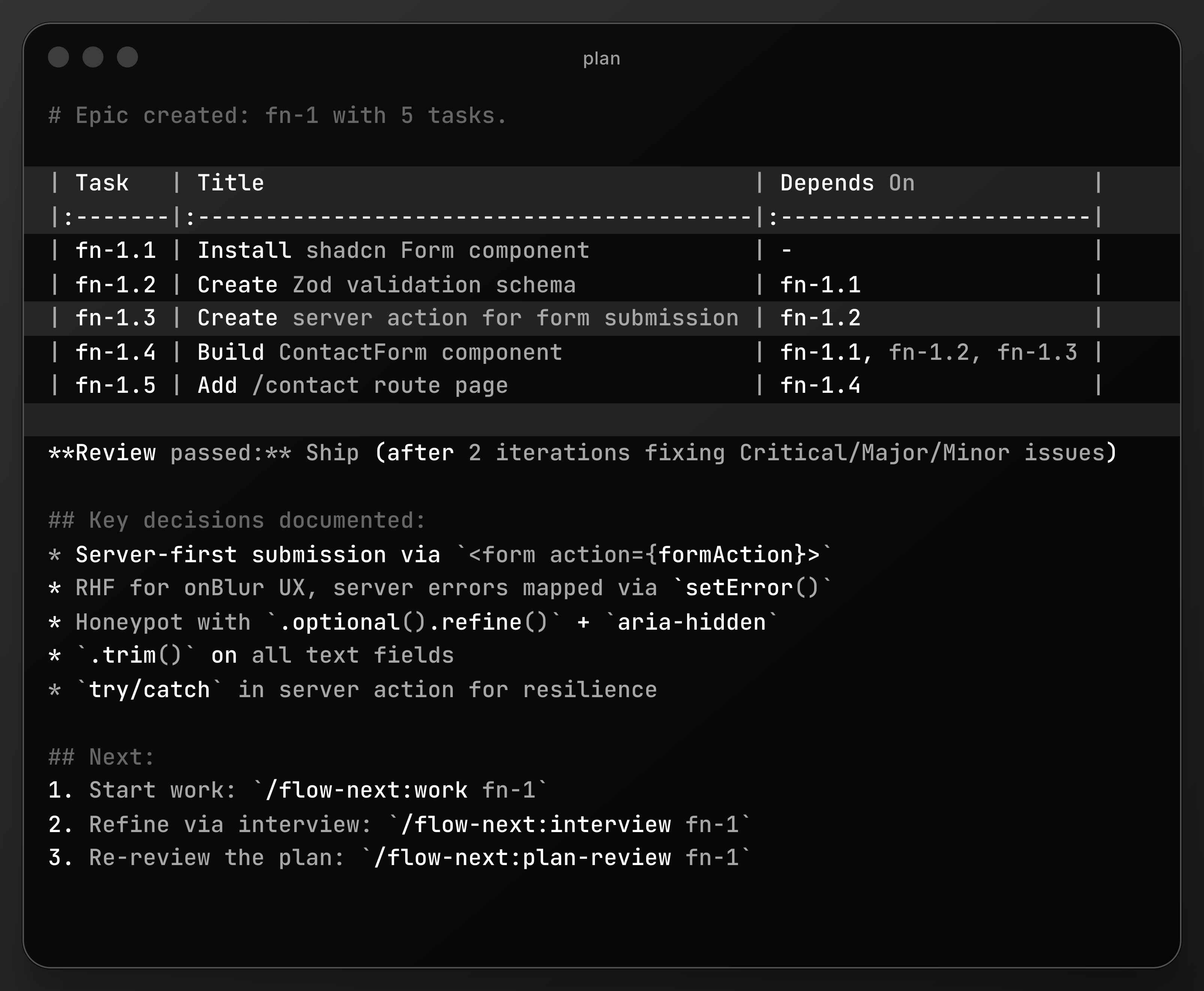
A real /flow-next:plan result - dependency-ordered tasks, cross-model review iterated to SHIP, key decisions documented.
📖 Doc index · 👥 Teams guide · 💬 Discord
Agentic engineering compresses implementation from weeks to hours — and quietly removes every safety valve pre-agentic Agile relied on. The standups, the hallway clarification, the mid-flight course correction that used to finish a vague ticket over a two-week cycle: gone. When an agent can ship the task in one sitting, a rough ticket plus a chat scrollback is the whole work surface.
That work surface fails predictably. Agents drift mid-task, forget requirements, overfit to recent context, and hand reviewers 10K-line diffs with no focus signal. The bottleneck didn't disappear — it moved upstream, to requirements, review, and verification. The spec has to carry the weight.
Flow-Next fixes the operating model, not just the prompt. It turns rough intent into durable specs, specs into context-sized task graphs, task graphs into re-anchored worker runs, and implementation into reviewed PRs with receipts. Between idea and merge it defines six named handover objects — each reviewable on its own, verified by a different model, and frozen at handover.
The artifact chain is not bureaucracy. It is the conversation that would otherwise be missing.
Flow-Next is an AI agent orchestration plugin: 28 agent-native skills covering the full lifecycle — idea → spec → tasks → review → ship → maintain — layered on a bundled pure-stdlib Python CLI (flowctl). The host agent is the intelligence; flowctl is the deterministic plumbing. No external services, no SaaS, no global config.
agent-flow — Claude Code plugin for automated bug-fix, feature, and scaffold workflows. Issue tracker to merged PR via a pipeline of specialized AI agents.
 asysta-act
Multi-agent development workflow (/crew) — planning, implementation, review, documentation, evals, and audit gates. Commands, agents, and skills are auto-discovered from the repo.
 Spiris-Innovation-Tech-Dev
Corca Workflow Framework — consolidated hooks and skill orchestration for structured development sessions
 corca-ai
AI-Driven Engineering workflow commands for managing issues, tasks, implementation, and PRs.
 SaschaHeyer
Plan and autonomously build a software task end-to-end. Recons the codebase, applies preloaded memory, decomposes into the right number of phases, gets one confirmation, then prepares a single ready-to-paste /goal command — one paste between you and done — that drives execution to completion with built-in retry, fix-spec recovery, and per-phase memory writeback. Works on Claude Code and Codex.
 robzilla1738
Opinionated 5-phase development lifecycle for Claude Code — language-agnostic, repo-local bin/* delegation
 benkruger
'%20stop-opacity%3D'0.16'%2F%3E%3Cstop%20offset%3D'1'%20stop-color%3D'rgb(200%2C90%2C60)'%20stop-opacity%3D'0.03'%2F%3E%3C%2FlinearGradient%3E%3C%2Fdefs%3E%3Crect%20width%3D'320'%20height%3D'200'%20fill%3D'url(%23g)'%2F%3E%3Ccircle%20cx%3D'250'%20cy%3D'56'%20r%3D'92'%20fill%3D'rgb(200%2C90%2C60)'%20fill-opacity%3D'0.06'%2F%3E%3Ccircle%20cx%3D'64'%20cy%3D'172'%20r%3D'58'%20fill%3D'rgb(200%2C90%2C60)'%20fill-opacity%3D'0.05'%2F%3E%3C%2Fsvg%3E)
