Stats
Actions
Available In
Tags

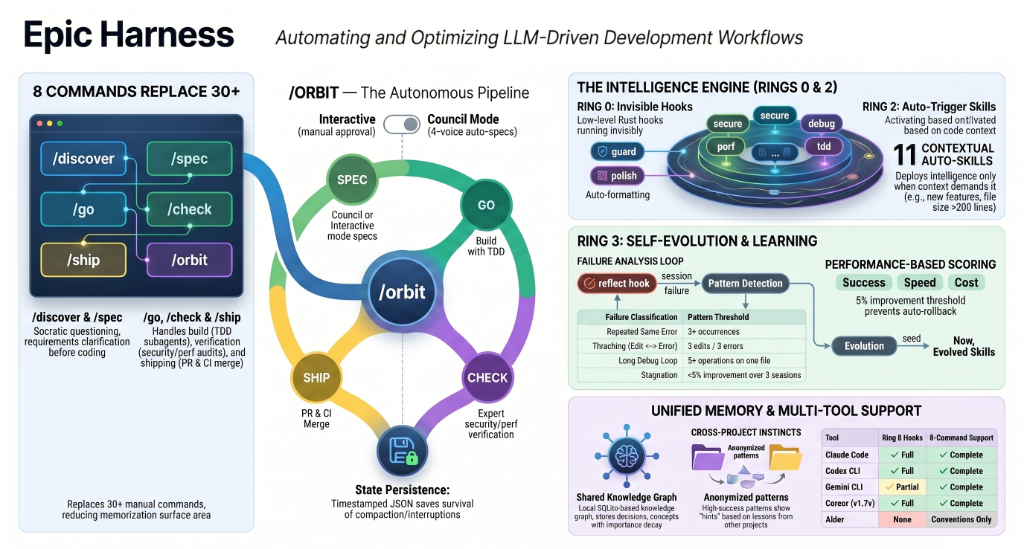
Automate the full development lifecycle from spec to PR with self-evolving skills, TDD enforcement, code quality audits, security reviews, and multi-agent orchestration, all triggered by simple commands or automatic hooks.
HarnessX Critic (Tier 2.1) — adversarial review of evolved-skill proposals against trace evidence. Detects reward hacking and manifest/evidence contradictions. Out-of-band LLM counterpart to the in-loop deterministic critic in src/evolve/critic.rs.
Core router. Always active. Auto-invokes matching skill before every response. Runs confusion protocol on high-risk ambiguity.
Loop-breaking self-diagnosis. Use when 3+ consecutive failures occur, circular retries persist, or context overwhelms the session.
Audit phase. Parallel review: code quality + security + tests. Semantic dedup of cross-mode findings. Outputs PASS/WARN/FAIL per dimension. Validates spec coverage.
Conventional Commits 1.0 generator. Stages relevant files, infers type(scope): description, never uses --no-verify.
Own this plugin?
Verify ownership to unlock analytics, metadata editing, and a verified badge. GitHub access is read-only (username + org membership).
Sign in to claimOwn this plugin?
Verify ownership to unlock analytics, metadata editing, and a verified badge. GitHub access is read-only (username + org membership).
Sign in to claimBased on adoption, maintenance, documentation, and repository signals. Not a security audit or endorsement.
A self-evolving AI coding agent harness — 3 commands, 26 skills, 1 autonomous pipeline, learns from your failures.
Less to memorize. More intelligence per keystroke. Gets smarter every session.
English | 日本語 | 한국어 | Deutsch | Français | 简体中文 | 繁體中文 | Português | Español | हिन्दी







A Claude Code plugin that consolidates 30+ commands into 3 commands + 26 auto-trigger skills, and evolves new skills from your own failure patterns.

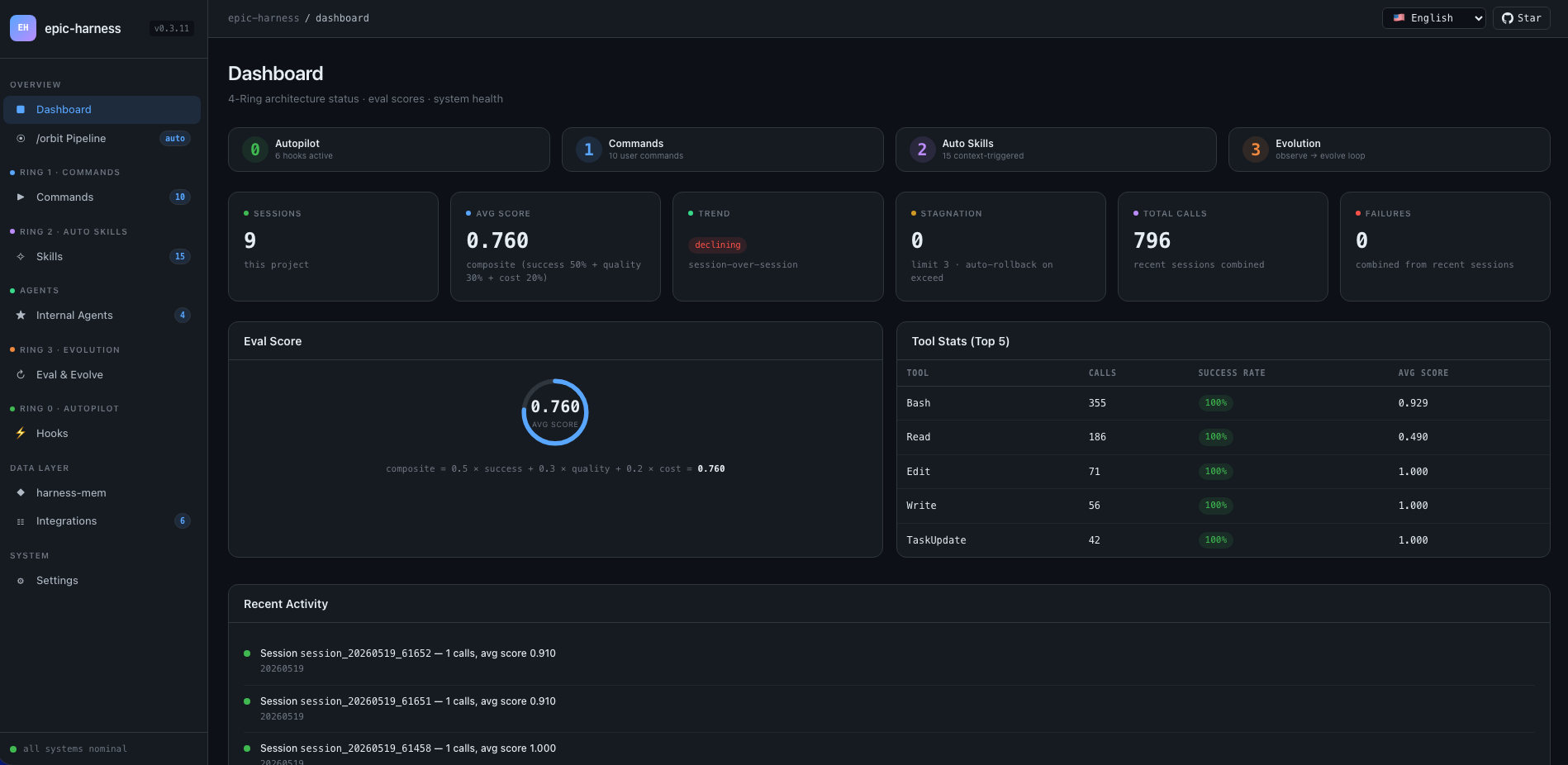
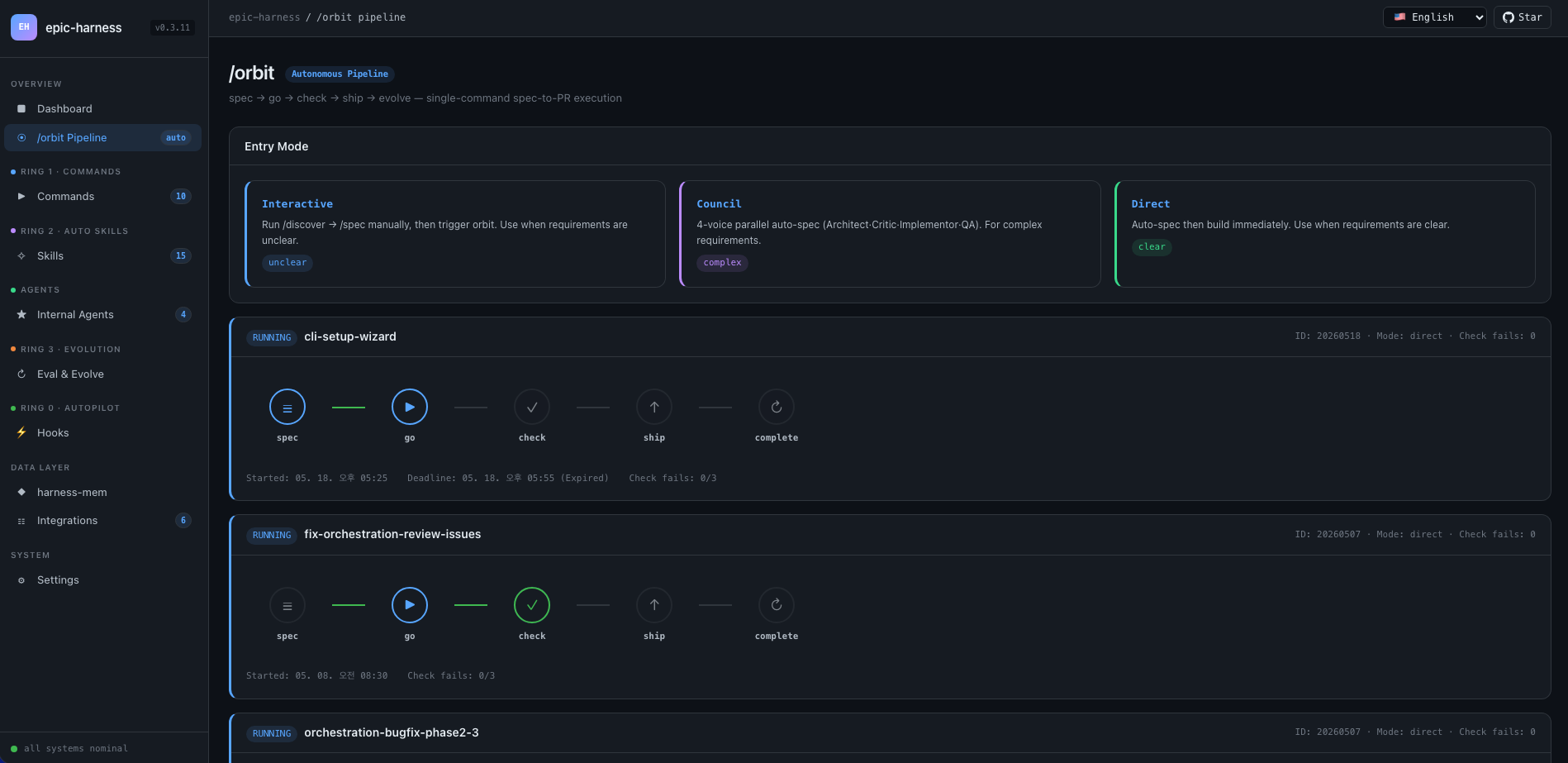
10-screen real-time metrics for eval scores, tool stats, orbit pipelines, evolved skills, and hook health. Opens automatically with the first Claude Code session — no manual setup needed. The Eval & Evolve screen surfaces the HarnessX evolution-engine state: reward-hacking warnings, seesaw solved-task registry, variant pool, and the adaptation landscape (persistent failures + untried edit types).
# Auto-launches on first session (default: http://localhost:7700)
# Configure port or disable in ~/.harness/config.toml:
[dashboard]
port = 7700       # set to 0 to disable auto-launch
auto_open = true  # open browser on first session
Screens: Dashboard · /orbit Pipeline · Commands (3) · Skills (26) · Live Agents · Eval & Evolve · Hooks (6) · Integrations (6) · harness-mem · Settings
One command ships a feature end-to-end. Skills fire without you asking. The agent gets smarter after every session.
$ /orbit "Add JWT auth to the login API"
→ spec approved → go (TDD subagents) → check (PASS) → ship (PR + CI) → evolve
Or invoke pipeline skills directly:
/spec "Add JWT auth to the login API"   # clarifies requirements → SPEC-*.md
/go                                      # auto-plans → TDD subagents → 4 min
/check                                   # parallel review + security + tests → PASS
/ship                                    # isolated test → PR → CI green
Skills trigger automatically in the background — no extra commands:
Writing a feature?    → tdd fires (Red→Green→Refactor enforced)
Test fails?           → debug fires (root-cause first, no random fixes)
Touching auth or DB?  → secure fires (OWASP checklist, no shortcuts)
File hits 200 lines?  → simplify fires (extract, rename, reduce)
npx claudepluginhub epicsagas/epic-harness --plugin epic-harnessAI-native publishing system — autonomous multi-phase workflows from ideation to EPUB/PDF. Fiction, non-fiction, technical, screenplay, poetry, game, academic, and custom genres.
 epicsagas
Local-first memory server — hybrid BM25+vector search, vault management, lint, and launchd lifecycle for project knowledge.
epicsagasSoftware engineering knowledge graph — design patterns, laws, refactorings, and code smells with graph traversal and AI-powered code analysis.
epicsagasAuto-compress .md, .html, .txt files read by Claude Code via PostToolUse hook.
epicsagasObsidian vault lifecycle management — inbox AI classification, graph strengthening, MOC regeneration, and multi-vault sync.
 epicsagas
Autonomous agent orchestrator for full development lifecycles with zero human input, session budget management, and crash recovery
 athola
Autonomous multi-agent development framework with spec-driven sprints and convergent iteration
 jeremylongshore
A suite of expert AI agents and skills implementing Harness Engineering — autonomous TDD/DDD orchestration, phase-isolated agents, adversarial QA, critical code review, and persistent project memory for disciplined, high-quality software engineering workflows.
 romabeckman
Long-running agent harness with 5-layer memory architecture, GitHub integration via gh CLI, autonomous batch processing with a dedicated implementer subagent, Agent Teams with ATDD, quality-gate hooks, and 6 Agent Skills
 panayiotism
Production-grade engineering skills for AI coding agents — covering the full software development lifecycle from spec to ship.
 addyosmani
Development autopilot — 28 lifecycle skills + 3 methodology agents + 25 hooks (10 default-on, 15 opt-in) enforcing Three Red Lines discipline. Standalone-capable orchestration that coexists with Superpowers.
 cookys
'%20stop-opacity%3D'0.16'%2F%3E%3Cstop%20offset%3D'1'%20stop-color%3D'rgb(200%2C90%2C60)'%20stop-opacity%3D'0.03'%2F%3E%3C%2FlinearGradient%3E%3C%2Fdefs%3E%3Crect%20width%3D'320'%20height%3D'200'%20fill%3D'url(%23g)'%2F%3E%3Ccircle%20cx%3D'250'%20cy%3D'56'%20r%3D'92'%20fill%3D'rgb(200%2C90%2C60)'%20fill-opacity%3D'0.06'%2F%3E%3Ccircle%20cx%3D'64'%20cy%3D'172'%20r%3D'58'%20fill%3D'rgb(200%2C90%2C60)'%20fill-opacity%3D'0.05'%2F%3E%3C%2Fsvg%3E)