Stats
Actions
Available In
Tags

Local codebase intelligence + change-safety gates for coding agents. Pre-indexes your repo's symbols, call graph, deps, and git history into SQLite (28 languages, 100% local, zero API keys), then exposes a lean 16-tool MCP core preset: graph-precise search, callers/impact blast radius, coupling, dead code, taint reachability, and pre-merge verify/critique gates that catch regressions, broken references, AI-slop duplication, and convention drift before they ship.
Own this plugin?
Verify ownership to unlock analytics, metadata editing, and a verified badge. GitHub access is read-only (username + org membership).
Sign in to claimOwn this plugin?
Verify ownership to unlock analytics, metadata editing, and a verified badge. GitHub access is read-only (username + org membership).
Sign in to claimBased on adoption, maintenance, documentation, and repository signals. Not a security audit or endorsement.
The local codebase intelligence layer that lets AI coding agents earn the right to change code — with evidence for what was checked.




Credential-free · 100% local by default (opt-in metrics-push is the only outbound surface) · tamper-evident ChangeEvidence packets · Apache 2.0 · runs entirely on your machine
267 commands · 243 MCP tools (16 in the default core preset) · 28 languages
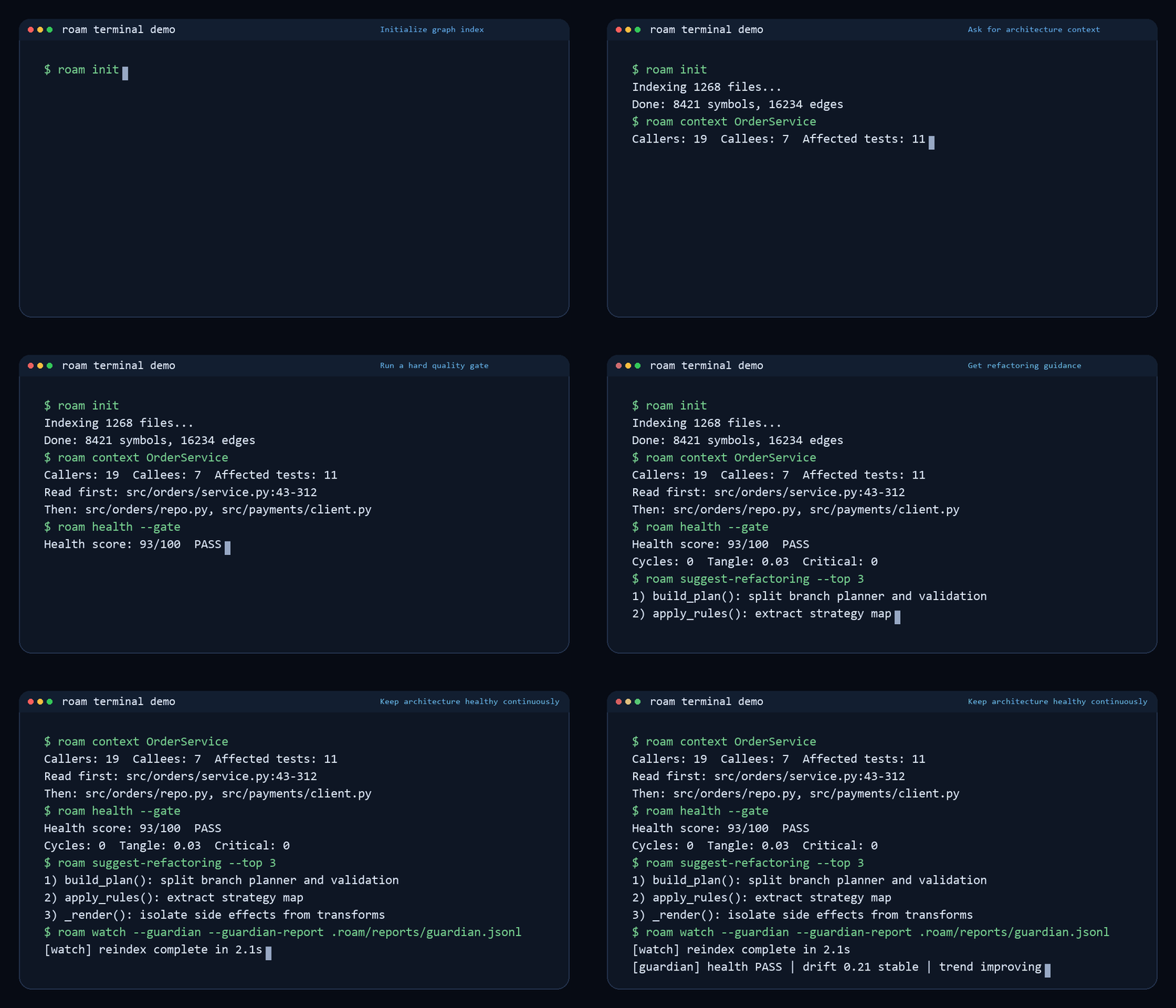
METR and FrontierCode both point at the same gap: passing tests is not the same as mergeable code. Roam is an agent-first CLI surface that gives the agent local graph facts before it edits, gates risky changes, and emits scoped evidence after the run. In the agent/review tools surveyed as of 2026-06-12, the differentiator is this combination:
pip install and run.roam metrics-push) is opt-in, summary-only, and prints its exact payload under --dry-run.ChangeEvidence packets. A Roam-guided change can compile into one portable packet — HMAC-chained run ledger + signed Code Graph Attestation + signed PR bundle — answering eight questions: who acted, what authority existed, what context was read, what changed, what could break, what policy applied, what verified it, who accepted risk. PR Replay maps those eight questions today: structural change/risk/policy axes are in scope, context and verification are partial, and missing identity/authority/approval evidence is disclosed instead of invented. Cursor logs the run; Roam records and verifies the evidence its producers captured.read_only / safe_edit / migration / autonomous_pr) with a closed-enum policy_decision, and each decision receipt is HMAC-linked into the signed run ledger. Inside-server controls; the gateway layer (Interlock / Lasso / Portkey) composes on top — see dev/MCP-SECURITY-POSTURE.md.Underneath sits a SQLite-backed graph of symbols, calls, imports, layers, git history, runtime traces, smells, clones, security flows, and algorithmic patterns across 28 languages — the same local facts queried before, during, and after a change.
Dependency-aware, not string-based. Roam knows Flask has 47 dependents and 31 affected tests; grep knows it appears 847 times. One command replaces 5-10 tool calls — <0.5s per query, plain-ASCII output, --json and --sarif envelopes for agents and CI.
| Without Roam | With Roam | |
|---|---|---|
| Tool calls | 8 | 1 |
| Wall time | ~11s | <0.5s |
| Tokens consumed | ~15,000 | ~3,000 |
Illustrative — a typical agent workflow on a 200-file Python project (Flask). Reproducible smoke transcript in docs/fresh-install-smoke.md; full indexing-rate harness in benchmarks/. Exact numbers vary with repo size, agent prompt, and model.
Ten minutes from pip install to a verdict on whether your next edit is safe.
pip install "roam-code[mcp]"          # 1. install with MCP server for Claude Code / Cursor / Continue
cd /path/to/your/repo
roam init                             # 2. index the repo into .roam/index.db (one-time, ~30s on most repos)
roam health                           # 3. composite 0-100 score: complexity, cycles, dark-matter coupling, dead code
roam preflight <symbol>               # 4. blast radius + tests + complexity + architecture rules before you edit
npx claudepluginhub dubdev720/roam-code-godotComprehensive skill pack with 66 specialized skills for full-stack developers: 12 language experts (Python, TypeScript, Go, Rust, C++, Swift, Kotlin, C#, PHP, Java, SQL, JavaScript), 10 backend frameworks, 6 frontend/mobile, plus infrastructure, DevOps, security, and testing. Features progressive disclosure architecture for 50% faster loading.
 Jeffallan
Develop, test, build, and deploy Godot 4.x games with Claude Code. Includes GdUnit4 testing, web/desktop exports, CI/CD pipelines, and deployment to Vercel/GitHub Pages/itch.io.
 Randroids-Dojo
A growing collection of Claude-compatible academic workflow bundles. Covers scientific figures, manuscript writing and polishing, reviewer assessment, citation retrieval, data availability, paper reading, literature search, response letters, paper-to-PPTX conversion, and evidence-grounded Chinese invention patent drafting. Rules are organized as reusable skill folders with explicit workflows and quality checks.
 Yuan1z0825
Consult multiple AI coding agents (Gemini, OpenAI, Grok, Perplexity, plus codex, antigravity, and grok CLIs when installed) to get diverse perspectives on coding problems
 hex
hexAccess thousands of AI prompts and skills directly in your AI coding assistant. Search prompts, discover skills, save your own, and improve prompts with AI.
 f
fUpstash Context7 MCP server for up-to-date documentation lookup. Pull version-specific documentation and code examples directly from source repositories into your LLM context.
 upstash
'%20stop-opacity%3D'0.16'%2F%3E%3Cstop%20offset%3D'1'%20stop-color%3D'rgb(200%2C90%2C60)'%20stop-opacity%3D'0.03'%2F%3E%3C%2FlinearGradient%3E%3C%2Fdefs%3E%3Crect%20width%3D'320'%20height%3D'200'%20fill%3D'url(%23g)'%2F%3E%3Ccircle%20cx%3D'250'%20cy%3D'56'%20r%3D'92'%20fill%3D'rgb(200%2C90%2C60)'%20fill-opacity%3D'0.06'%2F%3E%3Ccircle%20cx%3D'64'%20cy%3D'172'%20r%3D'58'%20fill%3D'rgb(200%2C90%2C60)'%20fill-opacity%3D'0.05'%2F%3E%3C%2Fsvg%3E)