Stats
Actions
Available In
Tags

Lazy senior dev mode. Forces the simplest, shortest solution that actually works: YAGNI, stdlib first, no unrequested abstractions.
Quick-reference card for all ponytail modes, skills, and commands. One-shot display, not a persistent mode. Trigger: /ponytail-help, "ponytail help", "what ponytail commands", "how do I use ponytail".
Code review focused exclusively on over-engineering. Finds what to delete: reinvented standard library, unneeded dependencies, speculative abstractions, dead flexibility. One line per finding: location, what to cut, what replaces it. Use when the user says "review for over-engineering", "what can we delete", "is this over-engineered", "simplify review", or invokes /ponytail-review. Complements correctness-focused review, this one only hunts complexity.
Forces the laziest solution that actually works, simplest, shortest, most minimal. Channels a senior dev who has seen everything: question whether the task needs to exist at all (YAGNI), reach for the standard library before custom code, native platform features before dependencies, one line before fifty. Supports intensity levels: lite, full (default), ultra. Use whenever the user says "ponytail", "be lazy", "lazy mode", "simplest solution", "minimal solution", "yagni", "do less", or "shortest path", and whenever they complain about over-engineering, bloat, boilerplate, or unnecessary dependencies.
Own this plugin?
Verify ownership to unlock analytics, metadata editing, and a verified badge. GitHub access is read-only (username + org membership).
Sign in to claimOwn this plugin?
Verify ownership to unlock analytics, metadata editing, and a verified badge. GitHub access is read-only (username + org membership).
Sign in to claimBased on adoption, maintenance, documentation, and repository signals. Not a security audit or endorsement.

He says nothing. He writes one line. It works.




80-94% less code · 3-6× faster · 47-77% cheaper
Median of 10 runs across Haiku, Sonnet, and Opus. Reproduce it yourself.
You know him. Long ponytail. Oval glasses. Has been at the company longer than the version control. You show him fifty lines; he looks at them, says nothing, and replaces them with one.
Ponytail puts him inside your AI agent.
You ask for a date picker. Your agent installs flatpickr, writes a wrapper component, adds a stylesheet, and starts a discussion about timezones.
With ponytail:
<!-- ponytail: browser has one -->
<input type="date">
More survivors in examples/.
Five everyday tasks (email validator, debounce, CSV sum, countdown timer, rate limiter), three models, three arms: no skill, the caveman skill, and ponytail. Ten runs per cell, median reported.
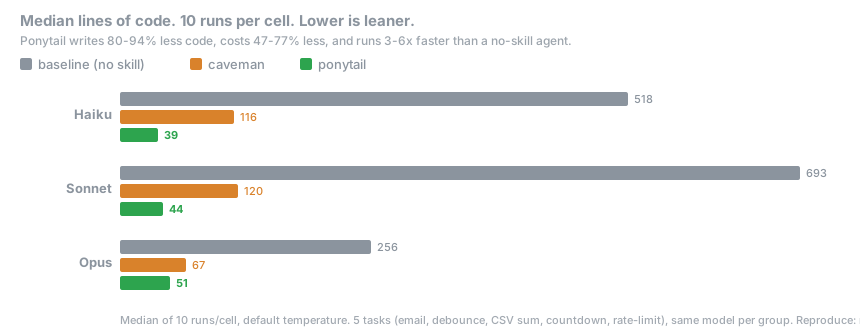
80-94% less code, 47-77% less cost, and 3-6× faster than a no-skill agent, on every model. Every shortcut ponytail takes is marked in the code with a ponytail: comment naming its upgrade path. Reproduce it yourself: npx promptfoo eval -c benchmarks/promptfooconfig.yaml. Method and raw numbers: benchmarks/. Production-grade tasks, where an unconstrained agent bloats far more, are written up in benchmarks/results/.
Before writing code, the agent stops at the first rung that holds:
1. Does this need to exist?   → no: skip it (YAGNI)
2. Stdlib does it?            → use it
3. Native platform feature?   → use it
4. Installed dependency?      → use it
5. One line?                  → one line
6. Only then: the minimum that works
Lazy, not negligent: trust-boundary validation, data-loss handling, security, and accessibility are never on the chopping block.
The most effort ponytail will ever ask of you:
/plugin marketplace add DietrichGebert/ponytail
/plugin install ponytail@ponytail
codex plugin marketplace add DietrichGebert/ponytail
codex
Open /plugins, select the Ponytail marketplace, and install Ponytail. Then
open /hooks, review and trust its two lifecycle hooks, and start a new thread.
pi install git:github.com/DietrichGebert/ponytail
Run OpenCode from a checkout of this repo (the plugin reuses its hooks/ and skills/), and add to opencode.json:
{ "plugin": ["./.opencode/plugins/ponytail.mjs"] }
Injects the ruleset every turn at the active level; adds /ponytail and /ponytail-review. OpenCode also auto-loads this repo's AGENTS.md, so the rules hold even without the plugin. The plugin adds the lite/full/ultra/off levels.
That was it. He'd be proud. He won't say it.
Active every session. /ponytail-review finds what to delete in your diff. /ponytail ultra exists for when the codebase has wronged you personally. /ponytail-help explains the rest.
In Codex, invoke the skills as @ponytail, @ponytail-review, and
@ponytail-help. Startup and mode-change text shows the current mode.
Cursor, Windsurf, Cline, Copilot, Aider, Kiro: copy the matching rules file from this repo (.cursor/rules/, .windsurf/rules/, .clinerules/, .github/copilot-instructions.md, AGENTS.md, .kiro/steering/).
Kiro: copy .kiro/steering/ponytail.md to ~/.kiro/steering/ (global) or .kiro/steering/ in your project.
Which files map to which agent: Agent portability.
When changing the compact rule text, keep the agent copies aligned:
node scripts/check-rule-copies.js
Does it need a config file? No.
No description provided.
 djpken
Production-grade engineering skills for AI coding agents — covering the full software development lifecycle from spec to ship.
djpkennpx claudepluginhub djpken/ponytailLazy senior dev mode. Forces the simplest, shortest solution that actually works: YAGNI, stdlib first, no unrequested abstractions.
 DietrichGebert
Evidence-gated AI coding workflow: scan → analyze → plan → TDD → execute → fix → verify → review, powered by Codebase Memory MCP >= 0.9.0 with optional Serena LSP intelligence. Includes blast-radius planning, test/cycle gates, independent review, and Windows Git Bash hook auto-resolution.
 datit309
Comprehensive skill pack with 66 specialized skills for full-stack developers: 12 language experts (Python, TypeScript, Go, Rust, C++, Swift, Kotlin, C#, PHP, Java, SQL, JavaScript), 10 backend frameworks, 6 frontend/mobile, plus infrastructure, DevOps, security, and testing. Features progressive disclosure architecture for 50% faster loading.
 Jeffallan
Develop, test, build, and deploy Godot 4.x games with Claude Code. Includes GdUnit4 testing, web/desktop exports, CI/CD pipelines, and deployment to Vercel/GitHub Pages/itch.io.
 Randroids-Dojo
Consult multiple AI coding agents (Gemini, OpenAI, Grok, Perplexity, plus codex, antigravity, and grok CLIs when installed) to get diverse perspectives on coding problems
 hex
hexProduction-grade engineering skills for AI coding agents — covering the full software development lifecycle from spec to ship.
 addyosmani
'%20stop-opacity%3D'0.16'%2F%3E%3Cstop%20offset%3D'1'%20stop-color%3D'rgb(200%2C90%2C60)'%20stop-opacity%3D'0.03'%2F%3E%3C%2FlinearGradient%3E%3C%2Fdefs%3E%3Crect%20width%3D'320'%20height%3D'200'%20fill%3D'url(%23g)'%2F%3E%3Ccircle%20cx%3D'250'%20cy%3D'56'%20r%3D'92'%20fill%3D'rgb(200%2C90%2C60)'%20fill-opacity%3D'0.06'%2F%3E%3Ccircle%20cx%3D'64'%20cy%3D'172'%20r%3D'58'%20fill%3D'rgb(200%2C90%2C60)'%20fill-opacity%3D'0.05'%2F%3E%3C%2Fsvg%3E)