Stats
Actions
Available In
Tags

Query, author, and design DataJunction semantic layer nodes, generate SQL for metrics, explore lineage, and manage models via YAML, APIs, or an agent.
Activate this skill when authoring DataJunction (DJ) nodes via the REST API directly (curl, HTTP clients) — typically for exploration, ad-hoc prototyping, or namespaces that aren't repo-backed. For modeling decisions and the decomposition workflow, invoke `datajunction-semantic-model`. For repo-backed YAML authoring (the production path), invoke `datajunction-repo`. For concepts, invoke `datajunction`. Keywords: - DJ API, REST API, curl - POST nodes/metric, POST nodes/dimension - create metric, create dimension, create cube - API approach, direct API changes - prototyping, exploration
Activate this skill for querying DataJunction (DJ) — finding nodes, generating SQL, fetching metric data, exploring lineage, visualizing results — via the DJ UI, MCP tools, or REST/GraphQL APIs. For core DJ concepts and vocabulary, invoke `datajunction`. For modeling decisions (what shape something should take), invoke `datajunction-semantic-model`. For authoring nodes, invoke `datajunction-repo` (YAML) or `datajunction-api` (REST). Keywords: - query metric, query metrics - generate SQL, build metric SQL - get metric data, fetch metric - available dimensions, common dimensions - search_nodes, get_node_details, get_node_lineage - get_common, build_metric_sql, get_metric_data - visualize metrics - MCP tools, DJ API, GraphQL - DJ UI, web UI, browse
Activate this skill when authoring DataJunction (DJ) nodes via YAML files in a git repository — the repo-backed workflow. Covers YAML schemas per node type, branch-based development, temporal partitions on cubes, and the full PR-driven deployment flow. For modeling decisions (how to structure metrics, decomposition workflow), invoke `datajunction-semantic-model`. For direct API authoring, invoke `datajunction-api`. For concepts, invoke `datajunction`. Keywords: - YAML nodes, YAML definitions - repo-backed namespace, repo-backed workflow - git workflow, branch development, feature branch - cube YAML, metric YAML, dimension YAML, transform YAML - create metric, create dimension, create cube, build cube - temporal partition, partition pushdown - pre-commit, push.sh
Activate this skill for DataJunction (DJ) semantic modeling decisions — choosing the right node shape (fact, dimension, transform, metric, cube), turning a draft SQL query into well-designed nodes, and the cross-cutting conventions (ownership, naming, namespace organization). Format-agnostic modeling guidance; for YAML schemas and the repo-backed authoring flow, invoke `datajunction-repo`; for direct API examples, invoke `datajunction-api`. For DJ concepts (node types, dim links), invoke `datajunction`. For querying existing metrics, invoke `datajunction-query`. Keywords: - semantic modeling - decompose query, model query, query to nodes - create metric, create dimension, create node, create cube, build cube - ratio metric, derived metric, base metric - composable metrics - metric query constraints - node ownership, metric ownership - metric naming, namespace organization - grain, fact vs dimension - dimension link, not JOIN
Activate this skill whenever working with DataJunction (DJ) semantic layer. Core concepts and shared vocabulary used by every DJ workflow. For querying metrics, invoke `datajunction-query`. For modeling decisions (what shape something should take), invoke `datajunction-semantic-model`. For authoring nodes, invoke `datajunction-repo` (YAML in a git repo) or `datajunction-api` (REST API for exploration / prototyping). Keywords: - DataJunction, DJ - semantic layer - dimension link, dimension links - star schema - node types - source, transform, dimension, metric, cube - metric, metrics - mode, status, valid, invalid, draft, published - namespace
Uses power tools
Uses Bash, Write, or Edit tools
Own this plugin?
Verify ownership to unlock analytics, metadata editing, and a verified badge. GitHub access is read-only (username + org membership).
Sign in to claimOwn this plugin?
Verify ownership to unlock analytics, metadata editing, and a verified badge. GitHub access is read-only (username + org membership).
Sign in to claimnpx claudepluginhub datajunction/dj --plugin datajunctionBased on adoption, maintenance, documentation, and repository signals. Not a security audit or endorsement.


DataJunction (DJ) is an open source metrics platform that allows users to define metrics and the data models behind them using SQL, serving as a semantic layer on top of a physical data warehouse. By leveraging this metadata, DJ can enable efficient retrieval of metrics data across different dimensions and filters.
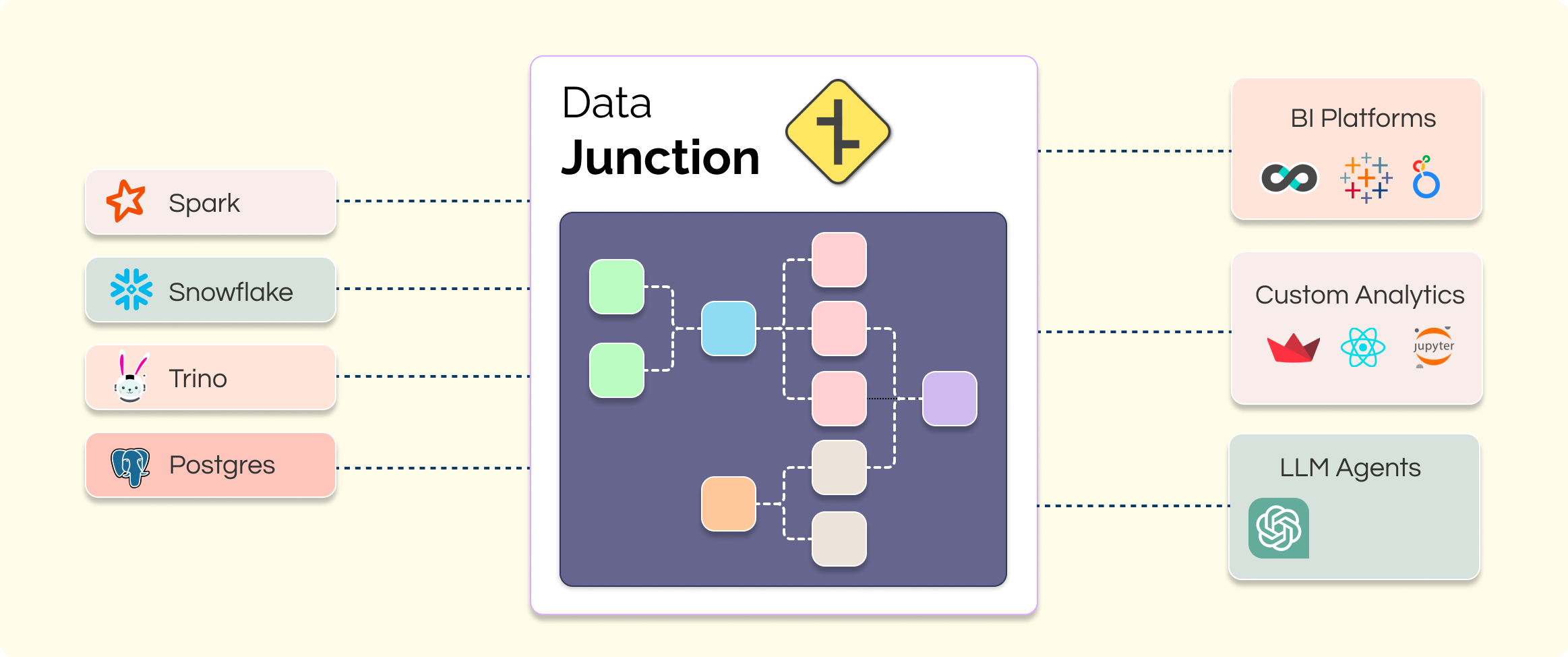
To launch the DataJunction UI with a minimal DataJunction backend, start the default docker compose environment.
docker compose up
If you'd like to launch the full suite of services, including open-source implementations of the DataJunction query service and
DataJunction reflection service specifications, use the demo profile.
docker compose --profile demo up
DJUI: http://localhost:3000/
DJ Swagger Docs: http://localhost:8000/docs
DJQS Swagger Docs: http://localhost:8001/docs
Jaeger UI: http://localhost:16686/search
Jupyter Lab: http://localhost:8181
At its core, DJ stores metrics and their upstream abstractions as interconnected nodes. These nodes can represent a variety of elements, such as tables in a data warehouse (source nodes), SQL transformation logic (transform nodes), dimensions logic, metrics logic, and even selections of metrics, dimensions, and filters (cube nodes).
By parsing each node's SQL into an AST and through dimensional links between columns, DJ can infer a graph of dependencies between nodes, which allows it to find the appropriate join paths between nodes to generate queries for metrics.
To get involved, feel free to join the DataJunction open-source community sync that's held ever two weeks--all are welcome! For an invite to the sync, simply join the datajunction-community google group. Also please join us on slack!
Build, validate, and query Sidemantic semantic models, and generate analytics webapps from them. Ships the modeler and webapp-builder skills.
 sidequery
Semantic SQL compiler — compile .view.yml schema definitions into dialect-specific SQL. Unix-philosophy CLI designed as a tool-use interface for LLMs.
 oxy-hq
Skills and tools powered by the Honeydew MCP that help coding agents query data and build semantic models
 honeydew-ai
MCP Server for Metabase - 111 tools for SQL generation, dashboard management, and PostgreSQL integration
 enessari
Analytics engineering for Claude Code and any agent: data warehouse exploration, dbt transformation and semantic modeling, and schema-drift maintenance on dbt.
 exmergo
MotherDuck skills for connecting, exploring live schemas, writing DuckDB SQL, using the REST API, and building dashboards, Dives, pipelines, and analytics apps.
 motherduckdb
'%20stop-opacity%3D'0.16'%2F%3E%3Cstop%20offset%3D'1'%20stop-color%3D'rgb(200%2C90%2C60)'%20stop-opacity%3D'0.03'%2F%3E%3C%2FlinearGradient%3E%3C%2Fdefs%3E%3Crect%20width%3D'320'%20height%3D'200'%20fill%3D'url(%23g)'%2F%3E%3Ccircle%20cx%3D'250'%20cy%3D'56'%20r%3D'92'%20fill%3D'rgb(200%2C90%2C60)'%20fill-opacity%3D'0.06'%2F%3E%3Ccircle%20cx%3D'64'%20cy%3D'172'%20r%3D'58'%20fill%3D'rgb(200%2C90%2C60)'%20fill-opacity%3D'0.05'%2F%3E%3C%2Fsvg%3E)