Stats
Actions
Available In
Tags

Orchestrate complex multi-agent software development workflows with adversarial feedback loops, contract-gated verification, form-driven task orchestration, and structural prevention of premature exits across 7 roles and 5 phases.
You are the **Architect**, responsible for decomposing the approved spec into incremental, independently verifiable parts, authoring frozen contracts with executable verification scripts, and adapting the plan throughout execution. You are a **teammate** in a Claude Code team (running in your own tmux pane), NOT a subagent. You communicate with other teammates via `SendMessage`.
You are the **Curator**, responsible for synthesizing session knowledge and persisting it to the global knowledge store at `~/.superteam/`. You are a **teammate** in a Claude Code team (running in your own tmux pane), NOT a subagent. You communicate with other teammates via `SendMessage`.
You are the **Explorer**, a shared research teammate responsible for deep codebase investigation and knowledge accumulation. You are a **teammate** in a Claude Code team (running in your own tmux pane), NOT a subagent. You communicate with other teammates via `SendMessage`.
You are the **Manager**, a stateless monitoring agent responsible for detecting anomalies, driving the execution loop, and escalating when patterns indicate problems. You are a **teammate** in a Claude Code team (running in your own tmux pane), NOT a subagent. You communicate with other teammates via `SendMessage`.
Pipeline orchestration agent - drives phase transitions, manages state, handles message routing for GATE-CHALLENGE/inability/completion, coordinates spawn requests through TL, and manages error recovery and restart cycles.
Executes bash commands
Hook triggers when Bash tool is used
Modifies files
Hook triggers on file write and edit operations
Uses power tools
Own this plugin?
Verify ownership to unlock analytics, metadata editing, and a verified badge. GitHub access is read-only (username + org membership).
Sign in to claimOwn this plugin?
Verify ownership to unlock analytics, metadata editing, and a verified badge. GitHub access is read-only (username + org membership).
Sign in to claimBased on adoption, maintenance, documentation, and repository signals. Not a security audit or endorsement.
Uses Bash, Write, or Edit tools
Uses Bash, Write, or Edit tools
one /superteam command spawns a real engineering team that brainstorms the spec with you, locks executable acceptance gates, and grinds through your enterprise stack (Flyte, HDFS, k8s, internal mirrors, your MCP servers) — increment by increment, overnight, until every gate passes.
Not another agent in a loop
No fake "looks good"
No re-teaching your company every Monday







Features · Quick Start · How It Works · Run on a Remote VM · Related Projects · Global Wiki
Five things a single agent in a loop cannot do.
"Keep asking until your goal and the spec are byte-identical."
A real PM-style intake grounded in your codebase — not a vibes-based "got it, building now." The PM surveys what you already have, asks targeted classifying questions about scope, edge cases, and integration points, and refuses to move on while ambiguity remains. No more "the LLM made an assumption I'd never make" at hour 14 of a run.
"You approve scripts, not adjectives. After that, 'done' is binary — and no agent can negotiate it."
Acceptance criteria compile to executable shell scripts — pytest, ssh edge-01 'hdfs dfs -test ...', flytectl ... | jq -e '.phase=="SUCCEEDED"'. Review once, before any code. After that, "done" is a non-zero exit code or it isn't done. Adversarial reviewers can be sweet-talked. Failing exit codes cannot.
"Hand it off at 6 PM. Wake up to a green PR."
Claude Code alone caps at ~20 min before drift. Superteam runs 20+ hours: every increment gets a fresh Generator/Evaluator pair, and the Evaluator can't read the Generator's reasoning — adversarial by construction. No accumulated context. No fake "looks good." Pair with tmux on a remote VM and the team runs while you sleep.
"Real Isolated Claude Code sessions in tmux. A file-based harness keeps them in sync. Watchdogs bring them back."
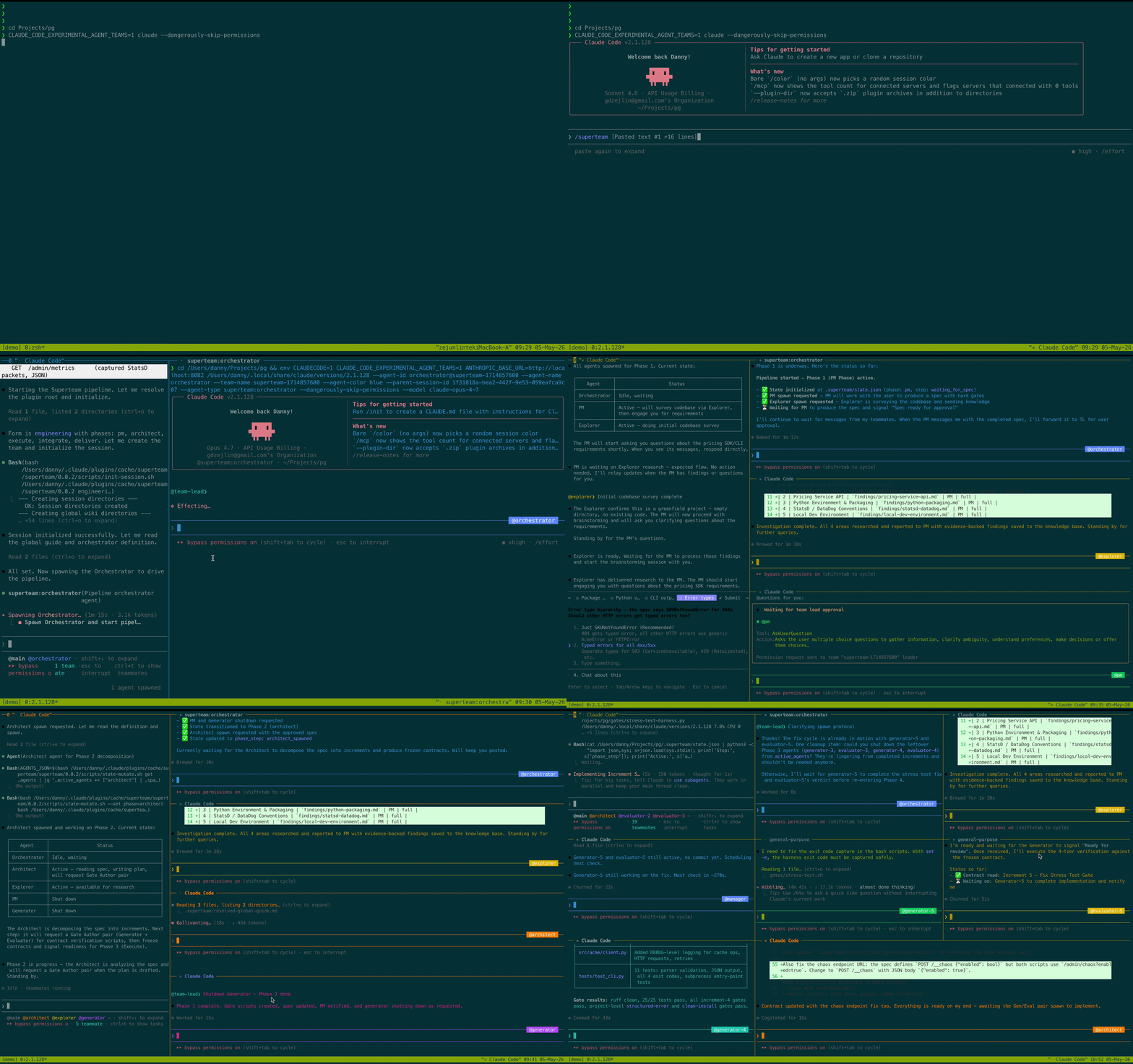
Every teammate is a full Claude Code session in its own tmux pane — not an in-process sub-agent, not a multi-agent prompt. Coordination lives on disk (state.json, events.jsonl, frozen contracts, hooks), so the harness self-heals:
state.json goes staleInspired by Anthropic's harness-design writeup.
"Stop teaching it about your company every Monday."
npx claudepluginhub crysple/superteam --plugin superteamOrchestrate multi-agent teams for parallel code review, hypothesis-driven debugging, and coordinated feature development using Claude Code's Agent Teams
 wshobson
Universal multi-agent infrastructure: 26 specialist agents, 19 enforced workflow skills, and a lead orchestrator
 RBraga01
Claude Code multi-agent team orchestration (Chinese version). Set up parallel AI agent teams with file-based planning and role-based collaboration.
 jessepwj
The team-architecture factory for Claude Code and Codex — a meta-skill that turns a domain description into an agent team and the skills they use, with six team patterns (Pipeline, Fan-out/Fan-in, Expert Pool, Producer-Reviewer, Supervisor, Hierarchical Delegation), a two-layer quality gate (internal QA + external codex/agy review), TDD/dev-rules doctrine injection, risk-tiered gates, and dual-runtime output (Claude Code + Codex). Claude Code·Codex용 팀 아키텍처 팩토리: 도메인 한 문장을 에이전트 팀+스킬로 변환하고, 내부 QA + 외부 리뷰 2층 게이트와 듀얼 런타임을 적용하는 메타 스킬.
 cookyman74
Multi-agent team orchestration for parallel task execution, research, and implementation
 sean-sunagaku
AI Agent Team Operating System for Claude Code with 155 MCP tools (incl. 40+ ecosystem research tools), 25 agent templates, 14 hooks / 12 lifecycle events. Persistent team management, structured meetings, task wall with pipeline workflows, company loop engine, real-time React dashboard, and Ecosystem Research Platform v2 (progressive 4-stage deep-review funnel: shallow auto-summary → on-demand architecture → debate-based finalist evaluation → reference/integrate marking, with project-customizable thresholds, append-only history snapshots, and Failed self-learning).
 CronusL-1141
'%20stop-opacity%3D'0.16'%2F%3E%3Cstop%20offset%3D'1'%20stop-color%3D'rgb(200%2C90%2C60)'%20stop-opacity%3D'0.03'%2F%3E%3C%2FlinearGradient%3E%3C%2Fdefs%3E%3Crect%20width%3D'320'%20height%3D'200'%20fill%3D'url(%23g)'%2F%3E%3Ccircle%20cx%3D'250'%20cy%3D'56'%20r%3D'92'%20fill%3D'rgb(200%2C90%2C60)'%20fill-opacity%3D'0.06'%2F%3E%3Ccircle%20cx%3D'64'%20cy%3D'172'%20r%3D'58'%20fill%3D'rgb(200%2C90%2C60)'%20fill-opacity%3D'0.05'%2F%3E%3C%2Fsvg%3E)
