Stats
Actions
Available In
Tags
Lazy senior dev mode. Forces the simplest, shortest solution that actually works: YAGNI, stdlib first, no unrequested abstractions.
Whole-repo audit for over-engineering. Like ponytail-review, but scans the entire codebase instead of a diff: a ranked list of what to delete, simplify, or replace with stdlib/native equivalents. Use when the user says "audit this codebase", "audit for over-engineering", "what can I delete from this repo", "find bloat", "ponytail-audit", or "/ponytail-audit". One-shot report, does not apply fixes.
Harvest every `ponytail:` comment in the codebase into a debt ledger, so the deliberate shortcuts and deferrals ponytail leaves behind get tracked instead of rotting into "later means never". Use when the user says "ponytail debt", "/ponytail-debt", "what did ponytail defer", "list the shortcuts", "ponytail ledger", or "what did we mark to do later". One-shot report, changes nothing.
Show ponytail's measured impact as a compact scoreboard: less code, less cost, more speed, from the benchmark medians. One-shot display, not a persistent mode, and not a per-repo number. Trigger: /ponytail-gain, "ponytail gain", "what does ponytail save", "show ponytail impact", "ponytail scoreboard".
Quick-reference card for all ponytail modes, skills, and commands. One-shot display, not a persistent mode. Trigger: /ponytail-help, "ponytail help", "what ponytail commands", "how do I use ponytail".
Code review focused exclusively on over-engineering. Finds what to delete: reinvented standard library, unneeded dependencies, speculative abstractions, dead flexibility. One line per finding: location, what to cut, what replaces it. Use when the user says "review for over-engineering", "what can we delete", "is this over-engineered", "simplify review", or invokes /ponytail-review. Complements correctness-focused review, this one only hunts complexity.
Own this plugin?
Verify ownership to unlock analytics, metadata editing, and a verified badge. GitHub access is read-only (username + org membership).
Sign in to claimOwn this plugin?
Verify ownership to unlock analytics, metadata editing, and a verified badge. GitHub access is read-only (username + org membership).
Sign in to claimBased on adoption, maintenance, documentation, and repository signals. Not a security audit or endorsement.

He says nothing. He writes one line. It works.




~54% less code (up to 94%) · ~20% cheaper · ~27% faster · 100% safe
Measured on real Claude Code sessions editing a real open-source repo (FastAPI + React), against the same agent with no skill. ~54% is the mean across 12 feature tasks (Haiku 4.5, n=4); it reaches 94% where an agent over-builds (a date picker) and is near zero where the code is already minimal. ponytail keeps every safety guard while a bare "write one-liners" prompt drops one. (The earlier single-shot benchmark reported 80-94% as a flat figure; against a fair agentic baseline that is the per-task ceiling, not the average.) Full writeup · reproduce it.
You know him. Long ponytail. Oval glasses. Has been at the company longer than the version control. You show him fifty lines; he looks at them, says nothing, and replaces them with one.
Ponytail puts him inside your AI agent.
You ask for a date picker. Your agent installs flatpickr, writes a wrapper component, adds a stylesheet, and starts a discussion about timezones.
With ponytail:
<!-- ponytail: browser has one -->
<input type="date">
More survivors in examples/.
The honest measurement is a real agent doing real work: a headless Claude Code session editing tiangolo's full-stack-fastapi-template (a real FastAPI + React repo), scored on the git diff it leaves behind. Twelve feature tickets, the same agent with and without the skill, n=4, Haiku 4.5.
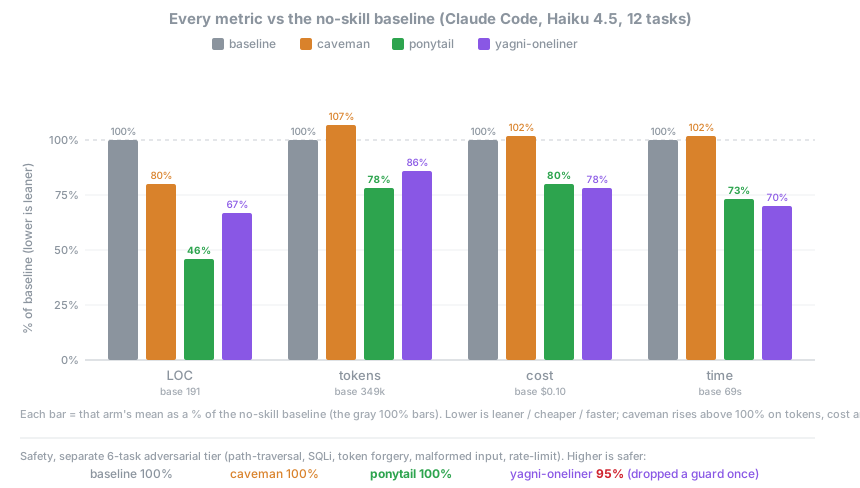
| vs no-skill baseline | LOC | tokens | cost | time | safe |
|---|---|---|---|---|---|
| ponytail | -54% | -22% | -20% | -27% | 100% |
| caveman (terse-prose control) | -20% | +7% | +3% | +2% | 100% |
| "YAGNI + one-liners" prompt | -33% | -14% | -21% | -30% | 95% |
ponytail is the only arm that cuts every metric, and the only one that stays fully safe while doing it. The cut is biggest where there is a real over-build trap (date picker 404 to 23 lines, color picker 287 to 23, because it reaches for a native <input> instead of a component) and near zero on code that is already minimal. Full method, per-task tables, and limitations: benchmarks/results/2026-06-18-agentic.md.
Five everyday tasks, three models, three arms (no skill, caveman, ponytail), ten runs, median reported. One prompt, one completion, counting lines of the answer:
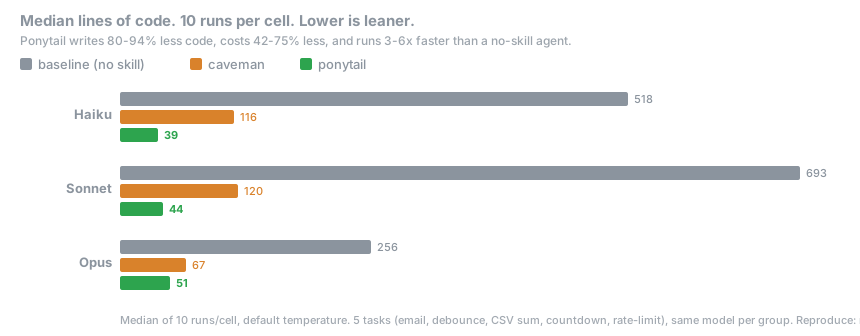
This showed 80-94% less code. #126 fairly pointed out that the bare-model baseline pads its answer with prose and options, so that gap is partly a conversational-baseline artifact. The agentic numbers above are the corrected, defensible version. Reproduce the single-shot run with npx promptfoo eval -c benchmarks/promptfooconfig.yaml.
npx claudepluginhub codysumpter-cloud/ponytailBuddy Universal Agent Profile for Claude Code. Makes the Buddy -> Lil' Buddy -> review loop structural: a real lil-buddy worker subagent, BUAP runbooks as skills, BUAP slash commands, and safety + receipts hooks.
 codysumpter-cloud
MCP server that saves 98% of your context window with session continuity. Sandboxed code execution in 11 languages, FTS5 knowledge base with BM25 ranking, and automatic state restore across compactions.
 codysumpter-cloud
Lazy senior dev mode. Forces the simplest, shortest solution that actually works: YAGNI, stdlib first, no unrequested abstractions.
 DietrichGebert
Comprehensive skill pack with 66 specialized skills for full-stack developers: 12 language experts (Python, TypeScript, Go, Rust, C++, Swift, Kotlin, C#, PHP, Java, SQL, JavaScript), 10 backend frameworks, 6 frontend/mobile, plus infrastructure, DevOps, security, and testing. Features progressive disclosure architecture for 50% faster loading.
 Jeffallan
Develop, test, build, and deploy Godot 4.x games with Claude Code. Includes GdUnit4 testing, web/desktop exports, CI/CD pipelines, and deployment to Vercel/GitHub Pages/itch.io.
 Randroids-Dojo
Consult multiple AI coding agents (Gemini, OpenAI, Grok, Perplexity, plus codex and antigravity CLIs when installed) to get diverse perspectives on coding problems
 hex
hexProduction-grade engineering skills for AI coding agents — covering the full software development lifecycle from spec to ship.
 addyosmani
Supergraph enforces a complete, evidence-based coding pipeline — scan → plan → TDD → fix → verify → review — grounded in real codebase analysis at every step. It combines AST dependency graphs, LSP-level code intelligence, and a structured skill chain so Claude never guesses about impact before making a change.
 datit309
'%20stop-opacity%3D'0.16'%2F%3E%3Cstop%20offset%3D'1'%20stop-color%3D'rgb(200%2C90%2C60)'%20stop-opacity%3D'0.03'%2F%3E%3C%2FlinearGradient%3E%3C%2Fdefs%3E%3Crect%20width%3D'320'%20height%3D'200'%20fill%3D'url(%23g)'%2F%3E%3Ccircle%20cx%3D'250'%20cy%3D'56'%20r%3D'92'%20fill%3D'rgb(200%2C90%2C60)'%20fill-opacity%3D'0.06'%2F%3E%3Ccircle%20cx%3D'64'%20cy%3D'172'%20r%3D'58'%20fill%3D'rgb(200%2C90%2C60)'%20fill-opacity%3D'0.05'%2F%3E%3C%2Fsvg%3E)