Stats
Actions
Available In
Tags

Persistent memory for Claude Code that automatically stores and retrieves project context, decisions, patterns, and bugs across sessions. Includes prospective memory triggers, knowledge graph traversal, maintenance pipelines, cross-project global memory, and MCP-based runtime integration for AI model management.
Set up automation — prospective memory triggers, neuro-symbolic rules, and CLAUDE.md sync. Use when the user says 'remind me when', 'trigger when', 'create a rule', 'auto-remember', 'sync to CLAUDE.md', 'push insights', 'set up trigger', 'when I open this file', 'when this keyword appears', or when you want to automate memory behavior based on conditions.
Run memory maintenance — decay old memories, compress stale content, consolidate episodic memories into semantic knowledge, and run sleep-like replay. Use when the user says 'clean up memories', 'consolidate', 'run maintenance', 'compress old memories', 'memory cleanup', or periodically to keep the memory system healthy. Also use after importing many memories or at the end of a long session.
Debug and fix memory system issues — validate memories, rate quality, manage protection, forget bad memories, and restore from checkpoints. Use when the user says 'fix memory', 'bad memory', 'wrong memory', 'delete this', 'protect this', 'this memory is wrong', 'memory quality', 'rate this memory', 'restore checkpoint', 'undo', or when memories are returning incorrect or stale results.
Explore the memory system's state, find gaps in knowledge, assess coverage, and get diagnostic information. Use when the user asks 'what does my memory look like', 'show me memory stats', 'what am I missing', 'how good is my knowledge', 'memory health', 'show coverage', 'find gaps', 'what topics are weak', or when you need to understand the state of stored knowledge before a task.
Import memories from other AI memory systems into Cortex. Supports claude-mem (SQLite), Claude Desktop sessions, ChatGPT web export (JSON), Gemini Takeout (JSON), Cursor conversations, and Claude Code JSONL. Use when the user says 'import from claude-mem', 'migrate memories', 'import ChatGPT history', 'import from Gemini', 'transfer memories', or when Cortex detects another memory system is installed.
Matches all tools
Hooks run on every tool call, not just specific ones
Admin access level
Server config contains admin-level keywords
Own this plugin?
Verify ownership to unlock analytics, metadata editing, and a verified badge. GitHub access is read-only (username + org membership).
Sign in to claimOwn this plugin?
Verify ownership to unlock analytics, metadata editing, and a verified badge. GitHub access is read-only (username + org membership).
Sign in to claimBased on adoption, maintenance, documentation, and repository signals. Not a security audit or endorsement.
This plugin requires configuration values that are prompted when the plugin is enabled. Sensitive values are stored in your system keychain.
database_urlLeave empty for the default zero-config SQLite store (~/.claude/methodology/memory.db). To use PostgreSQL instead, set a connection string (postgresql://[user[:pass]@]host[:port]/dbname) — a non-empty value here always wins over the SQLite default and is never silently downgraded. Your value persists across plugin updates.
${user_config.database_url}Uses power tools
Uses Bash, Write, or Edit tools
Uses power tools
Uses Bash, Write, or Edit tools
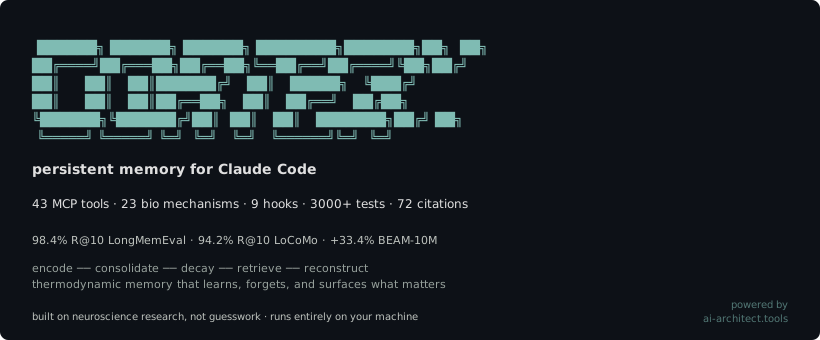





Persistent memory for Claude Code built on computational neuroscience — not just retrieval. 36 cited brain mechanisms consolidate what matters, keep it current as your project evolves, and reconstruct the right context at the right time — a living memory, not a flat RAG. Says "I don't know" when unsure, flags its own contradictions. Local-first, single-click MCP install.
Getting Started · Configuration · Examples · What's New · Science · Benchmarks · Wiki · Architecture
Companion projects:
cortex-beam-abstain (repo cortex-know-when-to-stop-training-model) — community-trained retrieval abstention model for RAG systems
zetetic-team-subagents — specialist Claude Code agents Cortex orchestrates with
automatised-pipeline — automated 11-stage pipeline (findings → PRs); Cortex ingests its codebase analysis via the optional ingest_codebase / change_impact tools
cortex-viz — read-only visualization MCP (galaxy graph, execution trace, wiki browser) over the same store
Independent project: Cortex is an independent, open-source project. It is not an Anthropic product and is not affiliated with, sponsored by, or endorsed by Anthropic.
Claude forgets you every time you close the tab. Every architecture decision you explained. Every debugging session where you traced a bug through four layers of abstraction. Every "remember, we decided to use event sourcing, not CRUD" correction. Gone. Next session, you're a stranger to your own tools.
Cortex is a persistent memory engine for Claude built on computational neuroscience. It remembers what you worked on, how you think, what you decided and why — not as a text dump shoved into context, but as a living memory system that consolidates, forgets intelligently, and reconstructs the right context at the right time.
It runs entirely on your machine — a local SQLite database by default (zero setup, no services to install), or PostgreSQL + pgvector when you want it. A 22 MB embedding model, no LLM in the retrieval loop, no data leaving localhost.
36 neuroscience mechanisms · 50 memory tools · 9 lifecycle hooks · a self-curating, continuously-groomed per-project wiki — all local, all open-source.
Cortex ships as a single-click MCP bundle (.mcpb). Download the latest hypermnesia-mcp.mcpb from Releases, then open it in Claude Desktop — Settings → Extensions installs it in one click.
It runs immediately on the built-in SQLite backend: zero configuration, no database to provision, nothing to set up. Memory persists to a local file under ~/.claude/methodology/. That's the whole install.
Claude Cowork works the same zero-setup way: the sandboxed environment is detected automatically (CLAUDE_ENVIRONMENT=cowork) and Cortex uses the local SQLite store — no PostgreSQL required.
Want PostgreSQL + pgvector instead (for very large stores or a shared team database)? It's a single configuration field — see Configuration below. SQLite is the default; PostgreSQL is opt-in.
npx claudepluginhub cdeust/cortex --plugin hypermnesia-mcpDEPRECATED — renamed to hypermnesia-mcp. Install hypermnesia-mcp from this same marketplace.
 cdeust
97 genius reasoning patterns from history's greatest minds. One epistemic standard none of them can bypass.
cdeustEnterprise PRD generator with 8 PRD types, 15 thinking strategies, multi-judge verification, codebase analysis, and 4-file export (PRD + JIRA + Tests + Verification)
 cdeust
Standalone visualization MCP for Cortex — a live neural-graph galaxy of every project, file, symbol, memory, discussion and wiki page, plus a per-session execution trace. Read-only bridge over Cortex's shared PostgreSQL and the ~/.claude artifacts.
cdeustStateless reducer that turns a feature description into a 9-file PRD. Multi-judge verification with weighted-average + Bayesian consensus, calibrated against externally-grounded oracles (schema/math/code/spec). Phase 4 closed loop: per-judge Bayesian reliability calibration, Kaplan-Meier retry budgets, Clopper-Pearson KPI gates, mechanically-sealed held-out partitions, paired-bootstrap cross-arm comparisons. Deterministic Hard Output Rules validation. 17 MCP tools, 583 tests.
cdeustDEPRECATED — renamed to hypermnesia-mcp. Install hypermnesia-mcp from this same marketplace.
cdeustBiomimetic long-term memory for Claude Code with surprisal gating, mutable reconsolidation, affective routing, and sleep consolidation.
 anthony-maio
Persistent memory for Claude Code - store decisions, patterns, and context across sessions
 verygoodplugins
Skills and hooks for rekal: memory redirect hooks, session capture (rekal-save), project bootstrap (rekal-init), and maintenance (rekal-hygiene).
 janbjorge
Persistent memory across Claude Code sessions using Cognis
 Lyzr-Cognis
Memory compression system for Claude Code - persist context across sessions
 thedotmack
'%20stop-opacity%3D'0.16'%2F%3E%3Cstop%20offset%3D'1'%20stop-color%3D'rgb(200%2C90%2C60)'%20stop-opacity%3D'0.03'%2F%3E%3C%2FlinearGradient%3E%3C%2Fdefs%3E%3Crect%20width%3D'320'%20height%3D'200'%20fill%3D'url(%23g)'%2F%3E%3Ccircle%20cx%3D'250'%20cy%3D'56'%20r%3D'92'%20fill%3D'rgb(200%2C90%2C60)'%20fill-opacity%3D'0.06'%2F%3E%3Ccircle%20cx%3D'64'%20cy%3D'172'%20r%3D'58'%20fill%3D'rgb(200%2C90%2C60)'%20fill-opacity%3D'0.05'%2F%3E%3C%2Fsvg%3E)