Stats
Actions
Available In
Tags

Enforces a structured AI-assisted development workflow where an orchestrator distributes coding tasks to headless worker agents, an independent auditor verifies results, and structural enforcement blocks downstream work on upstream failures. Includes automated code quality checks, requirements traceability, browser-based UI verification, and retrospective learning extraction.
Shortcut for /consensus-loop:guide — evidence writing guide
Shortcut for /consensus-loop:merge — squash-merge worktree branch
Shortcut for /consensus-loop:orchestrator — distribute tasks, manage agents
Shortcut for /consensus-loop:planner — design PRD, tracks, work breakdowns
Shortcut for /consensus-loop:retrospect — extract learnings, manage memories
Headless worker for quorum — receives task + context, implements code, runs tests, submits evidence to watch file, handles audit corrections. Use when the orchestrator needs to delegate a coding task to a worker agent.
Read this when implementing WB items that touch frontend code (`web/`, `src/dashboard/`, or UI components).
Read-only RTM generator — reads all track work-breakdowns, verifies each requirement against the actual codebase using deterministic tools, and produces 3 Requirements Traceability Matrices (Forward, Backward, Bidirectional). Use when the orchestrator needs to establish or update the RTM before distributing work.
Find UI issues that code-level analysis (scout, code_map, dependency_graph) cannot detect. Launches a real browser to check rendering, visual states, interactions, a11y, and runtime errors. Use after FE implementation to catch issues invisible to static analysis.
Run a consensus-loop audit manually — Codex reviews pending trigger_tag items in the watch file. Use when you want to trigger an audit without editing the watch file, re-run a failed audit, or test the audit prompt.
Extract learnings from audit history and conversation, manage memories, clean up stale entries. Use after completing a track, during retrospective (③ memory step), at end of session, or anytime the user wants memory maintenance. Triggers on 'what did we learn', 'memory cleanup', 'review learnings', 'retrospective', 'update memories', '회고', '메모리 정리'.
Guide for writing evidence packages for the consensus-loop watch file. Use when preparing code review submissions, structuring feedback evidence, or addressing audit rejections.
Run consensus-loop deterministic analysis tools via CLI — code_map, dependency_graph, audit_scan, coverage_map, rtm_parse, rtm_merge, audit_history, fvm_generate, fvm_validate. Use this skill whenever you need codebase analysis (symbol index, dependency DAG, pattern scan, coverage), RTM operations (parse, merge, query), or FVM operations (generate matrix, validate against server) — even if the MCP server is not configured. This skill replaces mcp__plugin_consensus-loop_consensus-loop__* tool calls with equivalent CLI commands.
Squash-merge a worktree branch into the target branch with a structured commit message. Use after audit consensus and retrospective completion.
Executes bash commands
Hook triggers when Bash tool is used
Modifies files
Hook triggers on file write and edit operations
Own this plugin?
Verify ownership to unlock analytics, metadata editing, and a verified badge. GitHub access is read-only (username + org membership).
Sign in to claimOwn this plugin?
Verify ownership to unlock analytics, metadata editing, and a verified badge. GitHub access is read-only (username + org membership).
Sign in to claimBased on adoption, maintenance, documentation, and repository signals. Not a security audit or endorsement.
Uses power tools
Uses Bash, Write, or Edit tools
Uses power tools
Uses Bash, Write, or Edit tools
⚠️ This project has evolved into quorum — a multi-model AI development harness with agent-to-agent communication and consensus-based delivery. New development happens there. This repo is frozen at v2.5.0.

AI writes code. A different AI reviews it. Nothing ships without consensus.
A Claude Code plugin that enforces a cross-model audit gate on every code change. Claude implements, GPT/Codex reviews, and a human-in-the-loop retrospective ensures the team learns from each cycle.
claude plugin marketplace add berrzebb/claude-plugins
claude plugin install consensus-loop@berrzebb-plugins
That's it. All hooks, skills, agents, and MCP tools are auto-registered.
AI coding tools generate code fast. They also generate bugs fast, skip tests, drift from requirements, and self-validate their own blind spots. Instruction-based corrections ("always write tests") fade across sessions. The model cannot reliably catch its own mistakes through self-review.
Structure beats instruction. consensus-loop makes it structurally impossible to ship unreviewed code:
[APPROVED] requires auditor sign-off, not self-promotionplanner → scout (RTM) → orchestrator → implementer (worktree) → verify → audit → retro → merge → loop
claude plugin marketplace add berrzebb/claude-plugins
claude plugin install consensus-loop@berrzebb-plugins
# Copy example config to your project
cp ~/.claude/plugins/cache/berrzebb-plugins/consensus-loop/*/examples/config.example.json \
   .claude/consensus-loop/config.json

# Copy prompt templates
cp -r ~/.claude/plugins/cache/berrzebb-plugins/consensus-loop/*/examples/en/templates/ \
      .claude/consensus-loop/templates/
Edit config.json — set your tags and paths:
{
  "consensus": {
    "watch_file": "docs/feedback/claude.md",
    "trigger_tag": "[REVIEW_NEEDED]",
    "agree_tag": "[APPROVED]",
    "pending_tag": "[CHANGES_REQUESTED]"
  }
}
/consensus-loop:orchestrator     # Start a work session
/consensus-loop:planner          # Design new tracks interactively
/consensus-loop:verify           # Check done-criteria before submission
/consensus-audit                 # Trigger manual audit
/consensus-status                # Show current loop state
consensus-loop was built to manage SoulFlow Orchestrator — a 32MB TypeScript codebase with 141 workflow nodes, 9 AI providers, and 188 deterministic tools.
Results from production use:
| Metric | Value |
|---|---|
| Tracks planned | 17 (+ 2 parallel support tracks) |
| Tracks RTM-scanned | 13 in 3 scout runs |
| Broken cross-track links found | 8 (automatically, in one pass) |
| Orphan tests identified | 7 |
| Parallel workers per session | Up to 3 (background, worktree-isolated) |
| Test suite | 104 tests across 21 suites |
What RTM looks like in practice:
A single scout run on 5 foundation tracks produced 3-way traceability matrices revealing:
wip (intentionally deferred to Track 15)open itemsThe scout eliminated redundant exploration — implementers received pre-verified RTM rows and skipped straight to coding.
In action — orchestrator analyzing RTM state and proposing parallel distribution:
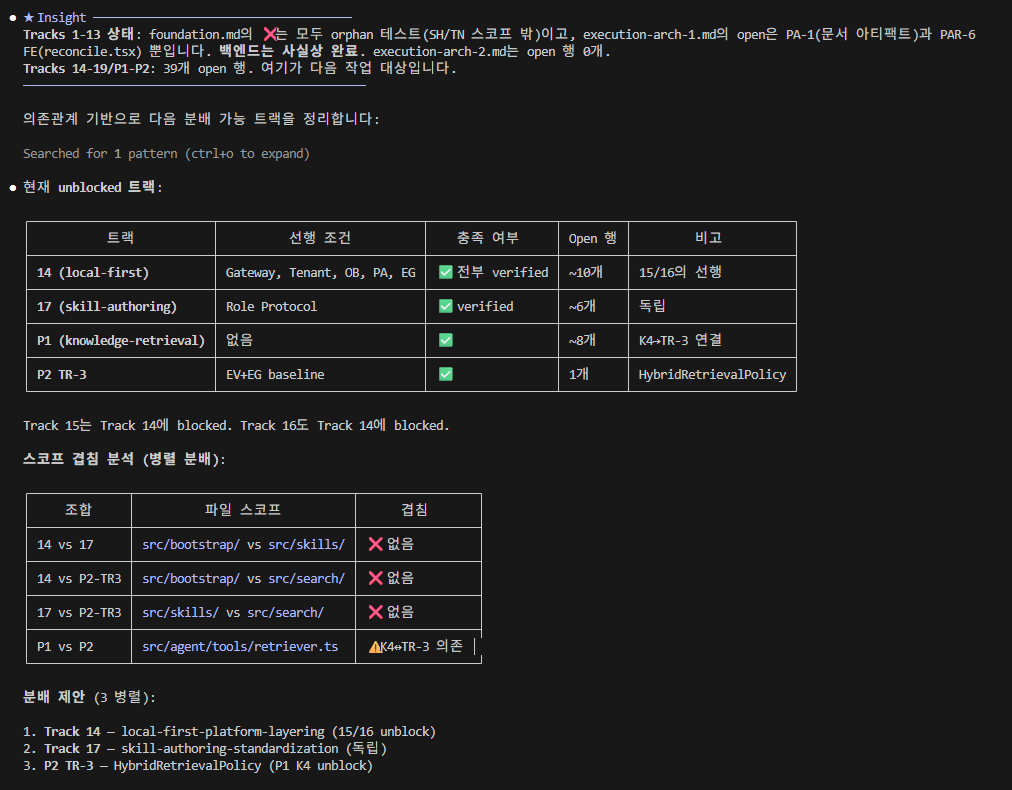
The orchestrator reads RTM state across all tracks, identifies 4 unblocked tracks (14, 17, P1, P2), checks file scope overlap between every pair (only P1 vs P2 has a dependency warning), and proposes 3 parallel agents with non-conflicting scopes.
Orchestrator distributing RTM-based work to parallel agents:
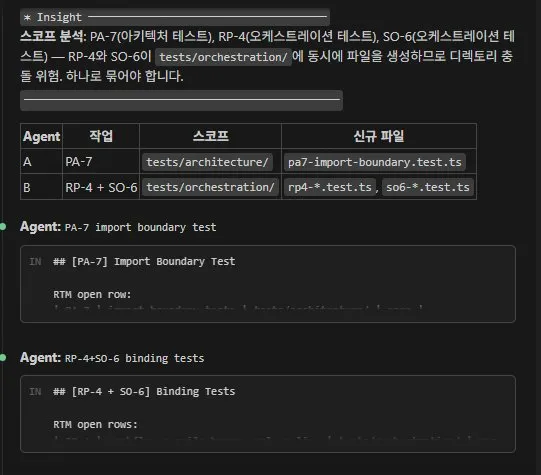
The orchestrator detects that PA-7 and RP-4+SO-6 touch different directories, assigns them to separate agents, and each agent receives only its RTM open rows.
Parallel worktree agents executing in the background:
npx claudepluginhub berrzebb/claude-plugins --plugin consensus-loopCross-model audit gate — 3-adapter (Claude Code + Gemini CLI + Codex), parliament protocol, 5 enforcement gates, 26 MCP tools, 3030 tests.
 berrzebb
Multi-agent development workflow (/crew) — planning, implementation, review, documentation, evals, and audit gates. Commands, agents, and skills are auto-discovered from the repo.
 Spiris-Innovation-Tech-Dev
Intelligent orchestration platform for AI coding tools — routes tasks to the best model, learns from outcomes, and enforces quality through multi-model consensus. 47 MCP tools for agent management, research, memory, consensus voting, codebase intelligence, and a full dev pipeline.
 nexus-substrate
Universal CLI orchestrator with multi-runner support. Autonomous spec-driven development with dependency DAG, parallel worktree execution, two-stage review gates, and modular merge hardening.
 andyzengmath
Governance-first specialist skill framework for routed, auditable AI coding workflows.
 Baelfyre
Elite AI development framework: reference-first design, agent orchestration, automated quality gates, and battle-tested engineering workflows
 NoobyGains
OSS Claude Code config: agents, skills, and hooks for professional AI-assisted development workflows
 Borda
Borda'%20stop-opacity%3D'0.16'%2F%3E%3Cstop%20offset%3D'1'%20stop-color%3D'rgb(200%2C90%2C60)'%20stop-opacity%3D'0.03'%2F%3E%3C%2FlinearGradient%3E%3C%2Fdefs%3E%3Crect%20width%3D'320'%20height%3D'200'%20fill%3D'url(%23g)'%2F%3E%3Ccircle%20cx%3D'250'%20cy%3D'56'%20r%3D'92'%20fill%3D'rgb(200%2C90%2C60)'%20fill-opacity%3D'0.06'%2F%3E%3Ccircle%20cx%3D'64'%20cy%3D'172'%20r%3D'58'%20fill%3D'rgb(200%2C90%2C60)'%20fill-opacity%3D'0.05'%2F%3E%3C%2Fsvg%3E)