Stats
Actions
Available In
Tags

Minimal-solution mode. Forces the simplest, shortest solution that actually works: YAGNI, stdlib first, no unrequested abstractions.
Whole-repo audit for over-engineering. Like whittle-review, but scans the entire codebase instead of a diff: a ranked list of what to delete, simplify, or replace with stdlib/native equivalents. Use when the user says "audit this codebase", "audit for over-engineering", "what can I delete from this repo", "find bloat", "whittle-audit", or "/whittle-audit". One-shot report, does not apply fixes.
Harvest every `whittle:` comment in the codebase into a debt ledger, so the deliberate shortcuts and deferrals whittle leaves behind get tracked instead of rotting into "later means never". Use when the user says "whittle debt", "/whittle-debt", "what did whittle defer", "list the shortcuts", "whittle ledger", or "what did we mark to do later". One-shot report, changes nothing.
Code review focused exclusively on over-engineering. Finds what to delete: reinvented standard library, unneeded dependencies, speculative abstractions, dead flexibility. One line per finding: location, what to cut, what replaces it. Use when the user says "review for over-engineering", "what can we delete", "is this over-engineered", "simplify review", or invokes /whittle-review. Complements correctness-focused review, this one only hunts complexity.
Forces the simplest solution that actually works: question whether the task needs to exist at all (YAGNI), reuse what's already here, reach for the standard library before custom code, native platform features before dependencies, one line before fifty. Use whenever the user says "whittle", "be lazy", "lazy mode", "simplest solution", "minimal solution", "yagni", "do less", or "shortest path", and whenever they complain about over-engineering, bloat, boilerplate, or unnecessary dependencies.
Own this plugin?
Verify ownership to unlock analytics, metadata editing, and a verified badge. GitHub access is read-only (username + org membership).
Sign in to claimOwn this plugin?
Verify ownership to unlock analytics, metadata editing, and a verified badge. GitHub access is read-only (username + org membership).
Sign in to claimBased on adoption, maintenance, documentation, and repository signals. Not a security audit or endorsement.

He says nothing. He writes one line. It works.




~54% less code (up to 94%) · ~20% cheaper · ~27% faster · 100% safe
Measured on real Claude Code sessions editing a real open-source repo (FastAPI + React), against the same agent with no skill. ~54% is the mean across 12 feature tasks (Haiku 4.5, n=4); it reaches 94% where an agent over-builds (a date picker) and is near zero where the code is already minimal. whittle keeps every safety guard while a bare "write one-liners" prompt drops one. (The earlier single-shot benchmark reported 80-94% as a flat figure; against a fair agentic baseline that is the per-task ceiling, not the average.) Full writeup · reproduce it.
You know him. Long whittle. Oval glasses. Has been at the company longer than the version control. You show him fifty lines; he looks at them, says nothing, and replaces them with one.
Whittle puts him inside your AI agent.
You ask for a date picker. Your agent installs flatpickr, writes a wrapper component, adds a stylesheet, and starts a discussion about timezones.
With whittle:
<!-- whittle: browser has one -->
<input type="date">
More survivors in examples/.
The honest measurement is a real agent doing real work: a headless Claude Code session editing tiangolo's full-stack-fastapi-template (a real FastAPI + React repo), scored on the git diff it leaves behind. Twelve feature tickets, the same agent with and without the skill, n=4, Haiku 4.5.
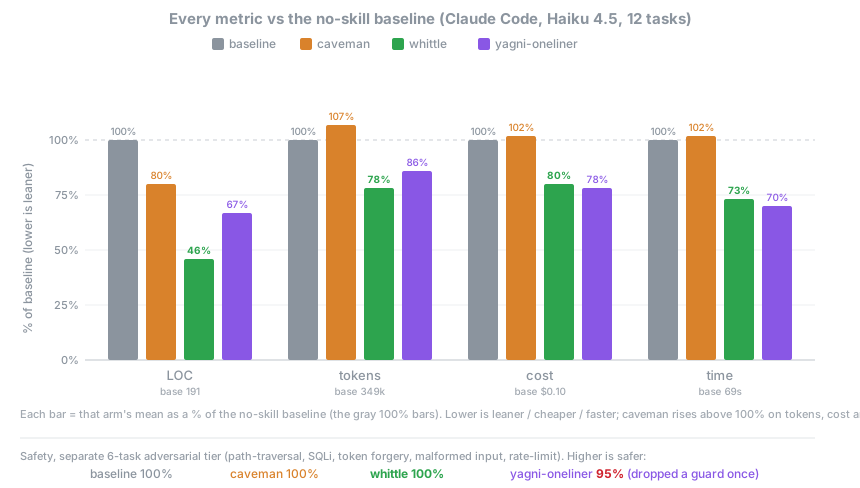
| vs no-skill baseline | LOC | tokens | cost | time | safe |
|---|---|---|---|---|---|
| whittle | -54% | -22% | -20% | -27% | 100% |
| caveman (terse-prose control) | -20% | +7% | +3% | +2% | 100% |
| "YAGNI + one-liners" prompt | -33% | -14% | -21% | -30% | 95% |
whittle is the only arm that cuts every metric, and the only one that stays fully safe while doing it. The cut is biggest where there is a real over-build trap (date picker 404 to 23 lines, color picker 287 to 23, because it reaches for a native <input> instead of a component) and near zero on code that is already minimal. Full method, per-task tables, and limitations: benchmarks/results/2026-06-18-agentic.md.
Five everyday tasks, three models, three arms (no skill, caveman, whittle), ten runs, median reported. One prompt, one completion, counting lines of the answer:
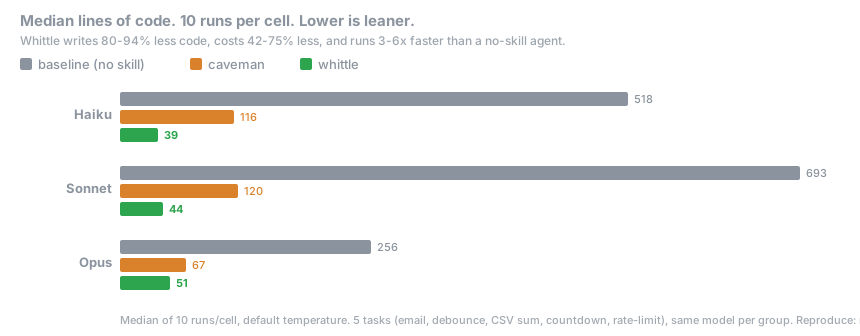
This showed 80-94% less code. #126 fairly pointed out that the bare-model baseline pads its answer with prose and options, so that gap is partly a conversational-baseline artifact. The agentic numbers above are the corrected, defensible version. Reproduce the single-shot run with npx promptfoo eval -c benchmarks/promptfooconfig.yaml.
npx claudepluginhub allmight97/whittle --plugin whittleLean Codex delegation for Claude/Fable: rescue, review, setup, transfer, adversarial review.
 Allmight97
Shared personal skills for Claude Desktop, Cowork, and Claude Code.
 Allmight97
Lazy senior dev mode. Forces the simplest, shortest solution that actually works: YAGNI, stdlib first, no unrequested abstractions.
 DietrichGebert
Evidence-gated AI coding workflow: scan → analyze → plan → TDD → execute → fix → verify → review, powered by Codebase Memory MCP >= 0.9.0 with optional Serena LSP intelligence. Includes blast-radius planning, test/cycle gates, independent review, and Windows Git Bash hook auto-resolution.
 datit309
Comprehensive SEO analysis plugin for Claude Code. 25 sub-skills (21 core + 1 orchestrator + 1 framework + 2 extension mirrors) and 18 sub-agents cover technical SEO, content quality, schema, sitemaps, Core Web Vitals, local SEO, backlinks, AI/GEO, ecommerce, hreflang, SXO, clustering, drift monitoring, and Google APIs. Includes optional MCP extensions, SPA-aware rendering, portability, and hardened SSRF/DNS-rebinding safe fetchers.
 AgriciDaniel
Complete collection of battle-tested Claude Code configs from an Anthropic hackathon winner - agents, skills, hooks, and rules evolved over 10+ months of intensive daily use
 xu-xiang
'%20stop-opacity%3D'0.16'%2F%3E%3Cstop%20offset%3D'1'%20stop-color%3D'rgb(200%2C90%2C60)'%20stop-opacity%3D'0.03'%2F%3E%3C%2FlinearGradient%3E%3C%2Fdefs%3E%3Crect%20width%3D'320'%20height%3D'200'%20fill%3D'url(%23g)'%2F%3E%3Ccircle%20cx%3D'250'%20cy%3D'56'%20r%3D'92'%20fill%3D'rgb(200%2C90%2C60)'%20fill-opacity%3D'0.06'%2F%3E%3Ccircle%20cx%3D'64'%20cy%3D'172'%20r%3D'58'%20fill%3D'rgb(200%2C90%2C60)'%20fill-opacity%3D'0.05'%2F%3E%3C%2Fsvg%3E)