Stats
Actions
Available In
Tags

Write, optimize, and publish blog content with AI-powered research, SEO analysis, multilingual translation, and AI citation readiness. Integrates Google APIs for performance data, generates schema markup, images, audio narration, and repurposes content across platforms.
Uses power tools
Uses Bash, Write, or Edit tools
Own this plugin?
Verify ownership to unlock analytics, metadata editing, and a verified badge. GitHub access is read-only (username + org membership).
Sign in to claimOwn this plugin?
Verify ownership to unlock analytics, metadata editing, and a verified badge. GitHub access is read-only (username + org membership).
Sign in to claimBased on adoption, maintenance, documentation, and repository signals. Not a security audit or endorsement.
Research specialist for blog content. Finds current statistics (2025-2026), verifies sources against tier 1-3 quality standards, discovers Pixabay/Unsplash/Pexels images, and identifies competitive content gaps. Invoked for statistic research, image discovery, and competitive analysis tasks during blog writing workflows.
Quality assessment specialist for blog posts. Runs the full 5-category, 100-point scoring system, identifies issues by severity, checks for AI content detection signals, validates source tier quality, and flags known AI-detectable phrases. Invoked for quality review tasks during blog workflows.
SEO optimization specialist for blog posts. Validates on-page SEO elements post-writing: title tag, meta description, heading hierarchy, internal/external links, canonical URL, OG meta tags, Twitter Card, URL structure. Produces a pass/fail checklist with specific fixes.
Specialized translation and localization agent for blog content. Produces native-quality translations of an entire blog post, optimized for both human readers and search engines, with format preservation (markdown, MDX, HTML, frontmatter, schema JSON-LD, SVG charts) and locale-correct number, date, currency, and quote formatting. Invoke from `blog-translate` and `blog-multilingual` orchestrators when a single source-to-target language translation is needed. One agent invocation handles one target language.
Content generation specialist for blog posts. Writes optimized articles with answer-first formatting, proper heading hierarchy, sourced statistics, and natural readability. Follows the 6 pillars of dual optimization. Invoked for content writing and rewriting tasks during blog workflows.
Audit and score blog posts on a 5-category 100-point scoring system covering content quality, SEO optimization, E-E-A-T signals, technical elements, and AI citation readiness. Includes AI content detection (burstiness, phrase flagging, vocabulary diversity). Supports export formats (markdown, JSON, table) and batch analysis with sorting. Generates prioritized recommendations (Critical/High/Medium/Low) with specific fixes. Works with any format (MDX, markdown, HTML, URL). Use when user says "analyze blog", "audit blog", "blog score", "check blog quality", "blog review", "rate this blog", "blog health check".
Generate audio narration of blog posts using Google Gemini TTS. Supports summary narration, full article read-aloud, and two-speaker podcast/dialogue mode with 30 voice options. Outputs MP3 with HTML5 audio embed code. Works standalone via /blog audio or internally from blog-write. Falls back gracefully when API key is not configured. Use when user says "blog audio", "narrate blog", "audio version", "text to speech", "tts", "podcast mode", "read aloud", "audio narration", "voice", "narration", "generate audio".
Full-site blog health assessment scanning all blog files for quality scores, orphan pages, topic cannibalization, stale content, and AI citation readiness. Spawns parallel subagents for comprehensive analysis. Produces per-post scores and a prioritized action queue. Use when user says "audit blog", "blog audit", "site audit", "blog health", "audit all posts", "check all blogs".
Establish durable brand and voice context for cross-skill consumption. Generates BRAND.md (audience, positioning, do/don't editorial rules, taboo phrases, competitor differentiation) and VOICE.md (existing persona JSON re-expressed as readable prose), both written to the project root. When present, all blog sub-skills auto-load these files before writing or reviewing. Pairs with blog-persona, which manages the structured persona JSON. Use when user says "blog brand", "create brand context", "brand voice doc", "BRAND.md", "VOICE.md", "establish editorial brand", "brand guidelines for blog".
Generate detailed content briefs for blog posts with target keywords, content outlines, competitive analysis, recommended statistics, image and chart suggestions, word count targets, internal linking architecture, template recommendations (12 types), TL;DR drafts, citation capsule planning, information gain prompts, and multi-channel distribution plans. Briefs are optimized for Google rankings and AI citations (GEO/AEO). Use when user says "content brief", "blog brief", "write brief", "outline blog", "plan blog post", "blog outline", "content outline".

claude-blog)







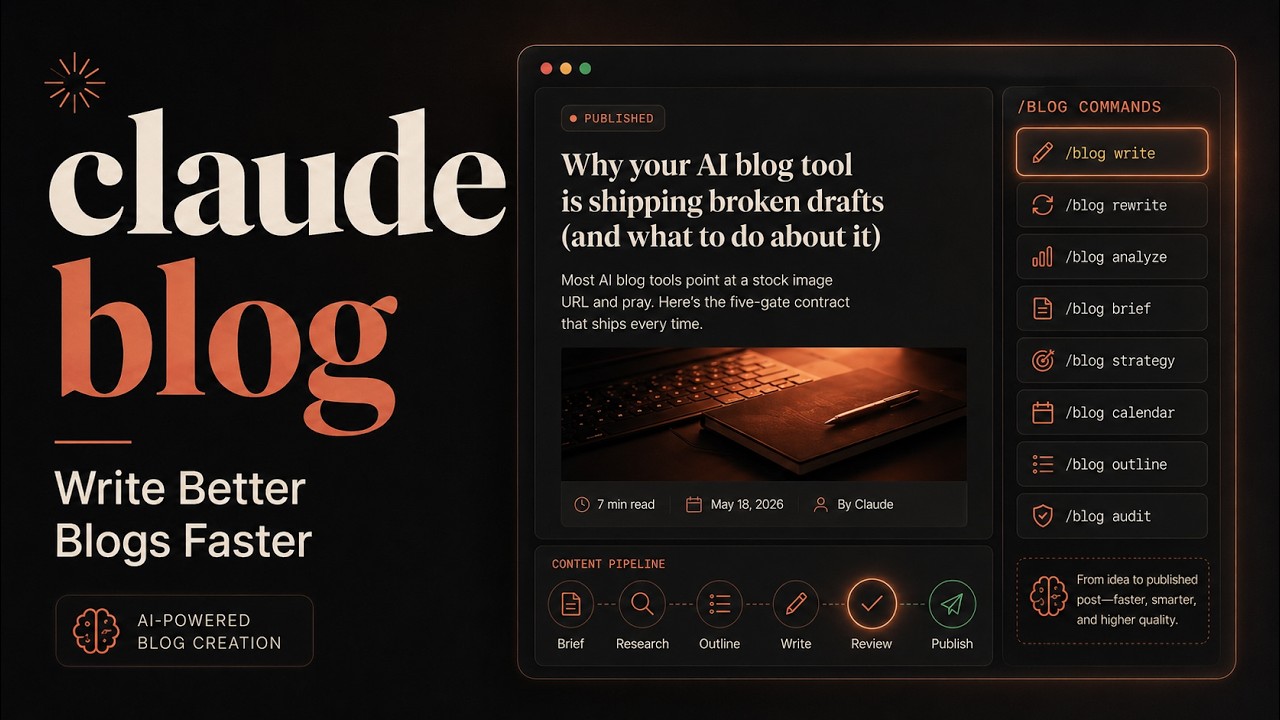
Watch the 12:48 v1.9.1 walkthrough on YouTube · See the 5-gate Blog Delivery Contract run live, including a 6-minute live demo of the Codex vs Claude sample blog being generated end-to-end.
Two versions of this skill. Choose the one that fits how you work:
- 🌐 Public open-source:
AgriciDaniel/claude-blog. MIT-licensed, public releases, open to anyone. Use this if you want the stable, downloadable, no-membership-required version.- 🔒 Community private mirror (this repo):
AI-Marketing-Hub/claude-blog. Early access to in-development work (v1.9.0+ Blog Delivery Contract, hero ladder, mutation-tested regression coverage), and direct collaboration with the AI Marketing Hub Pro community. Requires membership.The badges above track the public repo (
AgriciDaniel/claude-blog) since the private mirror is not visible to shields.io. The publishing workflow (private dev, review, public release) is documented indocs/PUBLISHING.md.
claude-blog is a Claude Code skill suite that writes, optimizes, and audits blog content at scale. Every article is dual-optimized for Google rankings (December 2025 Core Update, E-E-A-T) and AI citation platforms (ChatGPT, Perplexity, AI Overviews). A v1.9.0 5-gate Delivery Contract scores every draft against a 100-point rubric and blocks anything below 90 from reaching you.
blog-reviewer is a BLOCKING gate, not advisory.claude-blog serves three audiences with one engine:
Solo bloggers and creators who want to ship one high-quality post per week without spending three hours on the SEO checklist. The orchestrator handles research, outline, draft, schema, internal linking, and citation verification in a single /blog write invocation.
npx claudepluginhub agricidaniel/claude-blog --plugin claude-blogComprehensive SEO analysis plugin for Claude Code. 25 sub-skills (21 core + 1 orchestrator + 1 framework + 2 extension mirrors) and 18 sub-agents cover technical SEO, content quality, schema, sitemaps, Core Web Vitals, local SEO, backlinks, AI/GEO, ecommerce, hreflang, SXO, clustering, drift monitoring, and Google APIs. Includes optional MCP extensions, SPA-aware rendering, portability, and hardened SSRF/DNS-rebinding safe fetchers.
AgriciDanielClaude + Obsidian knowledge companion. Sets up a persistent, compounding wiki vault (Karpathy's LLM Wiki pattern). v1.7 "Compound Vault" + v1.8 methodology modes close 5 of 5 priority gaps from the May 2026 compass artifact. Ships: substrate alignment with kepano/obsidian-skills, default Obsidian CLI transport, hybrid retrieval (contextual prefix + BM25 + cosine rerank per Anthropic's Sept 2024 research), per-file advisory locking for multi-writer safety, pre-commit verifier agent, AND methodology modes (LYT / PARA / Zettelkasten / Generic) for first-class organizational support no other Claude+Obsidian competitor offers. v1.7.x audit closure: every BLOCKER + HIGH + MEDIUM + LOW finding from the v1.7.0 audit is CLOSED or DEFERRED-with-rationale. Optional DragonScale Memory extension (log folds, deterministic addresses, semantic tiling lint, boundary-first autoresearch).
 AgriciDaniel
Multi-host paid advertising audit & optimization skill conforming to the Agent Skills open standard. Verified on Claude Code; experimental on Codex CLI, Cursor, Windsurf, Gemini CLI, Goose. 250+ checks across Google, Meta, YouTube, LinkedIn, TikTok, Microsoft, Apple & Amazon Ads with weighted scoring, parallel agents, 12 industry templates, AI creative generation, PPC math, A/B test design, PDF reports, attribution + server-side tracking deep dives, and a 41-test pytest eval harness.
AgriciDanielAI image generation Creative Director powered by Google Gemini Nano Banana models. Claude interprets intent, selects domain expertise, constructs optimized prompts, and orchestrates Gemini for best results.
AgriciDanielAI-powered cybersecurity code review with 8 specialist agents, OWASP Top 10:2021, CWE Top 25:2024, MITRE ATT&CK v15, and framework-aware false-positive suppression
AgriciDanielSEO content creation with auditing, planning, and optimized writing
 EricGrill
Anti-hallucination blog engine with 34 sub-skills: write, analyze, rewrite, outline, schema, seo-check, geo, image, audio, repurpose, factcheck, cannibalization, persona, taxonomy, translate, localize, multilingual, locale-audit, audit, flow, notebooklm, google, monitor, strategy, cluster, brief, calendar, llmstxt, brand-mentions, drift, crawlers, customer-research, backlinks. Triple-layer anti-hallucination verification, Humanizer 29-pattern anti-AI review, 100-point quality scoring, E-E-A-T + AI citation optimization. Traditional Chinese first.
 rainday
Content Creator subagent
 ananddtyagi
Editorial "SEO Specialist" bundle for Claude Code from Antigravity Awesome Skills.
 sickn33
The Hitchhiker's Guide — content creation suite with automated pipeline, daily briefs, and blog writing
 ondrej-svec
End-to-end SEO blog generation — onboard your business, research keywords, write publish-ready articles
 maun11