Stats
Actions
Available In
Tags

Generic agent harness for Junie CLI — pipeline agents, skills, plus the engine setup (re-run per update).
Grade a passing change for how much human attention it deserves before merge. Terminal, advisory node dispatched after the reviewer roster approves. Reads the diff and the deterministic feature row, emits five facets (clear/concern/unknown) with notes, a rationale, and a clear/concern verdict. Never a merge or correctness gate.
Review code for readability and maintainability following the project's code-quality conventions. Checks naming conventions, function design, module structure, error handling patterns, and code organization.
Review documentation for coherence, structural correctness, and writing quality. Validates PRD, system-design, and ADRs against the checklist in the document-writing skill.
Implement features following Test-Driven Development (TDD) and Domain-Driven Design (DDD) practices. Reads current feature scope, creates implementation plan, writes tests first, then implements code to pass those tests.
Orchestrates the feature delivery pipeline. Use for new features or when unsure which agent to invoke.
Architecture Decision Record format, naming conventions, and when to create ADRs. Load when making or documenting architectural decisions.
Audit the agentic configuration for consistency, coherence, and conciseness. Load when modifying agent definitions, skills, or pipeline structure, or to verify cross-tool parity.
Audit the project's docs/ briefs against the high bar — each document on its own (principle form, enforceability) and in combination (cross-document coherence, contradictions, brief-vs-data agreement). Runs the doctor (deterministic structural gate) first, then the advisory judgment review, and reports both. Load when you want to check the docs hold up — at onboarding, after a harness upgrade, or on request. The judgment half is advisory: it judges form, never philosophical direction.
Grade a passing change for how much human attention it deserves before merge. Load when running the change-grader after the reviewer roster approves. Holds the full grading protocol: the five facets, worst-facet aggregation, the facets-rationale-verdict order, persistence, and scope/non-goals.
Build, test, format, and lint requirements that must pass before code review. Load when checking implementation completeness or running the quality gate.
Uses power tools
Uses Bash, Write, or Edit tools
Own this plugin?
Verify ownership to unlock analytics, metadata editing, and a verified badge. GitHub access is read-only (username + org membership).
Sign in to claimOwn this plugin?
Verify ownership to unlock analytics, metadata editing, and a verified badge. GitHub access is read-only (username + org membership).
Sign in to claimBased on adoption, maintenance, documentation, and repository signals. Not a security audit or endorsement.

Agentic coding that amplifies an engineer's judgment instead of replacing it.
Ship in days what would otherwise die in triage — and hold a high bar for years. The work worth trying but never worth weeks gets built and tested against real users instead of shelved. The bar holds because durable specs and nested feedback loops keep every agent, session, and person pointed the same way.
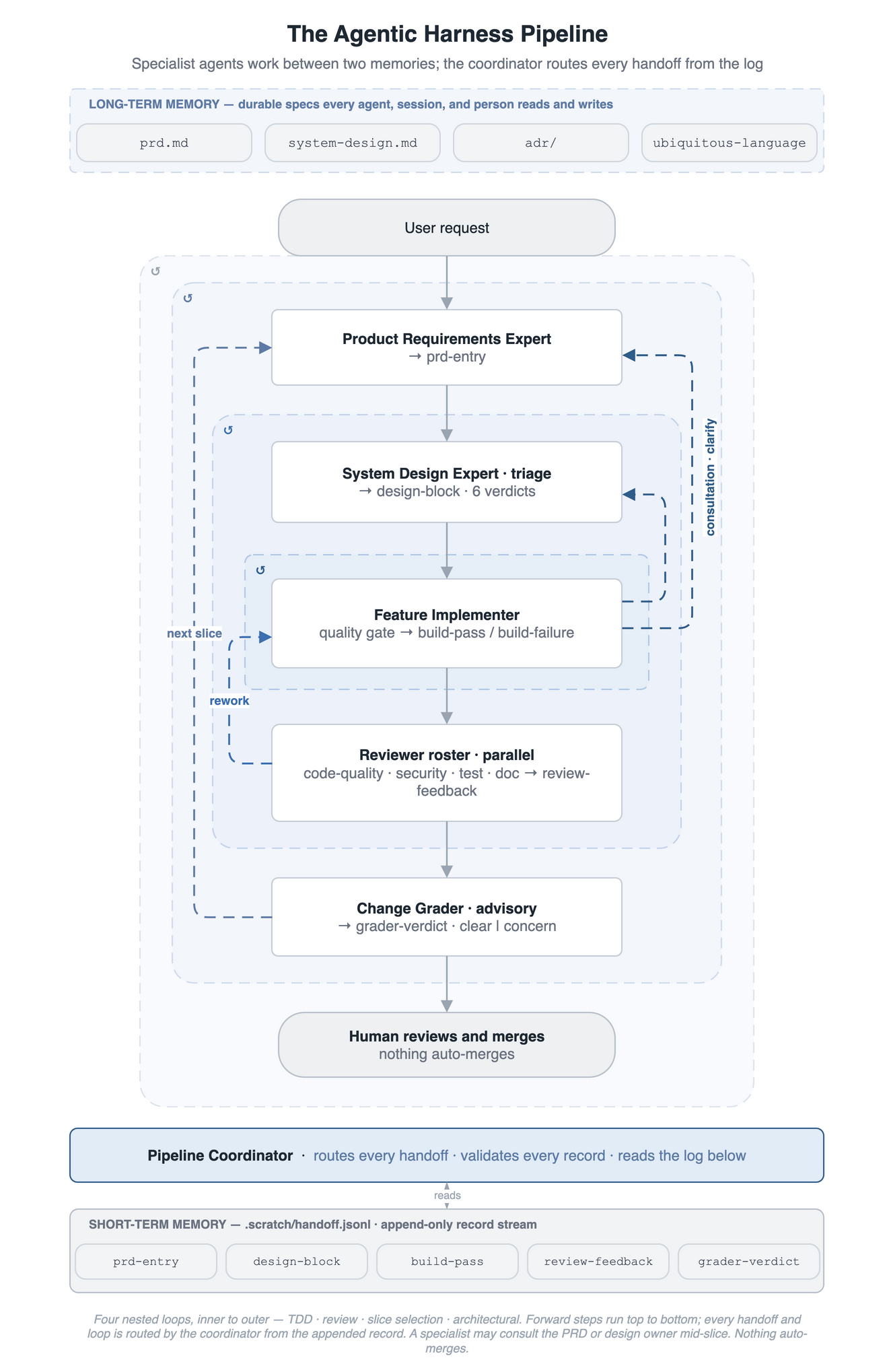
TL;DR — The interface is a conversation; the machinery behind it is deep. A file-based pipeline of ten one-job specialist agents builds one vertical slice at a time. Each appends a schema-validated record to a shared log, a deterministic router dispatches from it, and a reviewer roster gates every change; an advisory change-grader then flags where human attention pays — nothing auto-merges. The work runs through four nested feedback loops, from the inner TDD cycle out to whole-codebase review, so drift is caught before it compounds. Durable specs — PRD, system design, ADRs, ubiquitous language — are the shared memory every agent, session, and person reads and writes. One
CLAUDE.mdcarries it across four agent tools;/materializeand/harvestadopt it in your project and feed improvements back.
You don't use the agents directly. Adopt the harness, start a conversation, and describe the feature — the right specialists are selected for you, behind the scenes. It's an engineering team you collaborate with, not a toolbox you operate. The depth documented below is for building and extending the harness itself; to adopt it, the Quick Start is enough.
AI coding agents face the same two challenges human engineers always have: keeping long-term memory across sessions, and running multi-scale feedback loops that catch drift before it compounds. The difference is degree, not kind — a human forgets between Friday and Monday; an agent forgets between one message and the next. Within days, not years, an agentic project that skips the disciplines that compensate starts drifting: terms picked inconsistently session-to-session, settled decisions re-litigated, this week's architecture contradicting last week's.
The fix is to treat the disciplines human teams already built as the memory and feedback substrate — documentation standards, DDD, TDD, ADRs, ubiquitous language, and XP-style nested loops. Every agent, every session, and every person on the codebase reads and writes the same durable specs, so all stay pointed the same direction. A file-based specialist pipeline of ten one-job agents operates it, building one vertical slice at a time. A single rules file (CLAUDE.md) carries it across Claude Code, Copilot CLI, OpenCode, and Junie CLI.
Two working reference implementations (Go, Spring Boot), portable skills, and enforceable documentation standards demonstrate the pattern; a bidirectional /materialize + /harvest loop adopts it in your own project and feeds improvements back.
It is for anyone running an agentic coding workflow over more than a few sessions:
The failure modes are the same; only the speed differs.
The architecture, principles docs, and reference implementations are stable and in active use. The specialist pipeline machinery (JSONL contract, reviewer-roster fan-out, capability progression) is operational, though its cost-effectiveness is still being measured (with Harness Stats) and will be revised as evidence accumulates. Treat the disciplines as the validated core and the pipeline machinery as one reference implementation of the shape the harness can take.
npx claudepluginhub woditschka/agentic-coding-reference --plugin generic-junieGo agent harness for Claude Code — pipeline agents, skills, continuation hook, plus the engine setup (re-run per update).
 woditschka
Java Spring Boot agent harness for Claude Code — pipeline agents, skills, continuation hook, plus the engine setup (re-run per update).
woditschkaJava Spring Boot agent harness for Junie CLI — pipeline agents, skills, plus the engine setup (re-run per update).
woditschkaGo agent harness for Copilot CLI — pipeline agents, skills, plus the engine setup (re-run per update).
woditschkaGo agent harness for Junie CLI — pipeline agents, skills, plus the engine setup (re-run per update).
woditschkaGo agent harness for Junie CLI — pipeline agents, skills, plus the engine setup (re-run per update).
woditschkaHelloAGENTS — The orchestration kernel that makes any AI CLI smarter. Adds intelligent routing, unified QA gates, safety guards, and notifications.
 hellowind777
Production-grade engineering skills for AI coding agents — covering the full software development lifecycle from spec to ship.
 az9713
Per-feature development lifecycle: design, launch, build, wrap.
 memorysaver
Multi-agent development workflow (/crew) — planning, implementation, review, documentation, evals, and audit gates. Commands, agents, and skills are auto-discovered from the repo.
 Spiris-Innovation-Tech-Dev
Persistent memory, shared standards, and structured workflows for AI coding agents. Detects project setup and injects agent context automatically.
 ahmadulhoq
'%20stop-opacity%3D'0.16'%2F%3E%3Cstop%20offset%3D'1'%20stop-color%3D'rgb(200%2C90%2C60)'%20stop-opacity%3D'0.03'%2F%3E%3C%2FlinearGradient%3E%3C%2Fdefs%3E%3Crect%20width%3D'320'%20height%3D'200'%20fill%3D'url(%23g)'%2F%3E%3Ccircle%20cx%3D'250'%20cy%3D'56'%20r%3D'92'%20fill%3D'rgb(200%2C90%2C60)'%20fill-opacity%3D'0.06'%2F%3E%3Ccircle%20cx%3D'64'%20cy%3D'172'%20r%3D'58'%20fill%3D'rgb(200%2C90%2C60)'%20fill-opacity%3D'0.05'%2F%3E%3C%2Fsvg%3E)