Stats
Actions
Available In
Tags

Token-lean sessions at the harness level, measured on real multi-turn coding sessions — a terse output style, output-shrinking hooks, and log compression cut output tokens and narration.
Builds a personal output style on hush's frame — the user's voice on the surface, hush's silence-and-structure mechanics copied verbatim underneath. Manages its own creations: lists them alongside stock Hush and edits them. A mechanical verifier confirms every invariant survived. Activation is hush:pick-style's job — it owns the swap that makes a style bind. Only the stock Hush style is benchmarked — crafted styles are unmeasured.
Compresses a memory file (CLAUDE.md, project notes, preferences) into hush's own dev-shorthand voice to cut input tokens every session it's loaded. Never touches the original file — writes a sibling file for the user to review and swap in manually. A mechanical verifier checks that headings, code blocks, URLs, paths, and inline code all survived.
Reports how much hush's compression hook actually saved this session — a per-decision byte rollup from the HUSH_DEBUG manifest plus a per-model token breakdown from the transcript. Requires HUSH_DEBUG=1 to have been set during the work being measured; without it there is nothing to report.
Lists every output style available to this plugin — the presets hush ships, stock Hush, and anything craft-style has built — and switches the active one. Activation swaps the chosen style into the plugin's own slot so it binds like stock, and hands back to stock on request. This skill owns the swap procedure; craft-style calls into it. Only the stock Hush style is benchmarked — every preset is unmeasured.
Matches all tools
Hooks run on every tool call, not just specific ones
Executes bash commands
Hook triggers when Bash tool is used
Own this plugin?
Verify ownership to unlock analytics, metadata editing, and a verified badge. GitHub access is read-only (username + org membership).
Sign in to claimOwn this plugin?
Verify ownership to unlock analytics, metadata editing, and a verified badge. GitHub access is read-only (username + org membership).
Sign in to claimBased on adoption, maintenance, documentation, and repository signals. Not a security audit or endorsement.

Shuts Claude up so your session stops costing money to read.
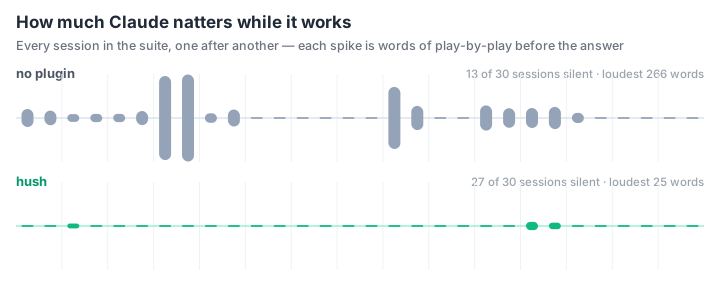
This is what a session sounds like.



TL;DR — Claude bills you for every word it reads and writes, and most of those words are logs, build output, and play-by-play. hush trims them at the source, automatically. Install it, change nothing, pay less: $0.174 an average session against $0.211 without it.
You've seen it: "Let me start by looking at the codebase." "Now I'll check the config." Four hundred lines of build output you didn't ask for, and — eventually — the one sentence you actually needed. Every word of that is billed.
hush doesn't ask Claude to "be more concise" and hope for the best. It trims the actual bulk — logs, command output, narration — at the source, before any of it hits your bill. It earns its keep in real engineering sessions, the kind that read logs and run builds, because that's where the noise lives.
Five small habits, picked up the moment it's installed:
| Moment | What happens |
|---|---|
| Progress narration | Swapped for one clean summary at the end |
| Command output & log files | Trimmed as they come in — a short tail from a clean run, the whole thing from a failing one |
| Mid-turn rambling | Caught by a running word count and cut off the moment it starts |
| Really large output (a huge log, a giant lockfile) | Parked in a local file behind a short summary, so it isn't re-sent in full every turn |
| Re-reading a file that changed on its own | Shown as just the changed lines, not the whole file again |
That's the whole list. No workflow to learn, no dial to find first — it's just how Claude behaves now.
Inside Claude Code, run:
/plugin marketplace add V-Songbird/foundry
/plugin install hush@foundry
Takes effect at your next session — nothing to configure. hush works in the background.
Running razor too? Good instinct — the pair is measured in Better together below.
hush runs itself; these commands are extras:
| You want to… | Command |
|---|---|
Shrink a CLAUDE.md or notes file so every session that loads it costs less | /hush:hush-compress <path> |
| See exactly what hush trimmed this session | /hush:stats |
| Try one of the six output styles hush ships, or hand back to stock | /hush:pick-style |
| Build an output style in your own voice on hush's silent frame | /hush:craft-style |
[!IMPORTANT]
hush-compressnever touches your original — it writes a copy alongside it (CLAUDE.md→CLAUDE.hush.md) for you to review and swap in yourself.
/hush:stats needs HUSH_DEBUG=1 set before the work you want measured. Without it there's nothing to report — and it says so.
/hush:pick-style is the shelf. Six styles ship with hush, same silent machinery underneath, and they differ only in what that one last message is for:
npx claudepluginhub v-songbird/hushGovernor: always-on compact professional output, telemetry, context slimming, tool-output filtering, prompt guidance, and drift guardrails for Claude Code Max users.
 0xhimanshu
Maximum-efficiency dev mode. Zero-fluff prose combined with YAGNI/ladder-first code decisions. One persona: the senior dev who deletes code for fun and bills by the syllable.
 JayPokale
Opus 4.8-aware context optimization: cache-aware real costs & cache-break detection, session baseline audit (/cco-overhead), auto .contextignore, self-calibrating estimates, delegation advisor, ru/en prompt coach
 egorfedorov
Session intelligence for Claude Code — find why your sessions fail and fix them
 jakeefr
Honey (I Shrunk the AI) — three reflexive levers that cut agent token cost: less code (YAGNI/stdlib-first), less prose, and denser agent-to-agent handoffs (ESON/compact-JSON). Plus on-demand satellites (review, eco, gain, compress) and a hive of read-only subagents that return compressed handoffs. Auto-intensity lite/full/ultra; correctness and safety-critical paths stay exact.
 Green-PT
Always-on efficiency discipline for Claude Code — triage token spend to task size, write minimal correct code, take fewer round-trips, keep context lean. Ships three skills plus guard/state/status hooks.
 broisnischal
'%20stop-opacity%3D'0.16'%2F%3E%3Cstop%20offset%3D'1'%20stop-color%3D'rgb(200%2C90%2C60)'%20stop-opacity%3D'0.03'%2F%3E%3C%2FlinearGradient%3E%3C%2Fdefs%3E%3Crect%20width%3D'320'%20height%3D'200'%20fill%3D'url(%23g)'%2F%3E%3Ccircle%20cx%3D'250'%20cy%3D'56'%20r%3D'92'%20fill%3D'rgb(200%2C90%2C60)'%20fill-opacity%3D'0.06'%2F%3E%3Ccircle%20cx%3D'64'%20cy%3D'172'%20r%3D'58'%20fill%3D'rgb(200%2C90%2C60)'%20fill-opacity%3D'0.05'%2F%3E%3C%2Fsvg%3E)