Stats
Actions
Available In
Tags

Run a complete PDCA (Plan-Do-Check-Act) knowledge work OS inside Claude Code: decompose tasks into parallel worktrees, research blocked URLs via adaptive fetch chains, review drafts with multi-perspective agents, and evolve prompts through benchmark-driven optimization loops.
Do/Produce phase -- apply strategic frameworks such as SWOT, RICE, OKR, and Lean Canvas
Batch parallel execution -- decompose large tasks into independent units and run concurrently
Plan/Gather phase -- collect knowledge into PARA-classified storage
Run a Socratic requirements interview that turns vague ideas into approval-gated specs
Plan/Gather phase -- find and install new skills beyond the core 8
Find specific shared concepts between new items and existing knowledge
Adversarial review that attacks the weakest points. Use when you want stress-testing before publishing or presenting. Examples: "Attack this proposal", "What would a skeptic say about this?", "Find the holes in this argument".
Data analysis and pattern recognition. Use after research collection to synthesize findings into structured insights. Examples: "Analyze these research findings", "Find patterns in this data", "Identify contradictions across these sources".
Execute pipeline steps sequentially with state persistence
Score skill candidates using weighted criteria
Use when applying strategic frameworks such as SWOT, RICE, OKR, or GTM
Use when decomposing large tasks into independent parallel units
Use when collecting URLs, notes, files, or excerpts into structured PARA knowledge
Use when a vague idea needs Socratic requirements discovery, topology confirmation, ambiguity scoring, and an approval-gated spec before execution
Use when the current skills cannot handle a task and new skills are needed
Admin access level
Server config contains admin-level keywords
Own this plugin?
Verify ownership to unlock analytics, metadata editing, and a verified badge. GitHub access is read-only (username + org membership).
Sign in to claimOwn this plugin?
Verify ownership to unlock analytics, metadata editing, and a verified badge. GitHub access is read-only (username + org membership).
Sign in to claimBased on adoption, maintenance, documentation, and repository signals. Not a security audit or endorsement.
Uses power tools
Uses power tools
Uses Bash, Write, or Edit tools
Uses Bash, Write, or Edit tools
Runs pre-commands
Contains inline bash commands via ! syntax
Runs pre-commands
Contains inline bash commands via ! syntax
Bash prerequisite issue
Uses bash pre-commands but Bash not in allowed tools
Bash prerequisite issue
Uses bash pre-commands but Bash not in allowed tools

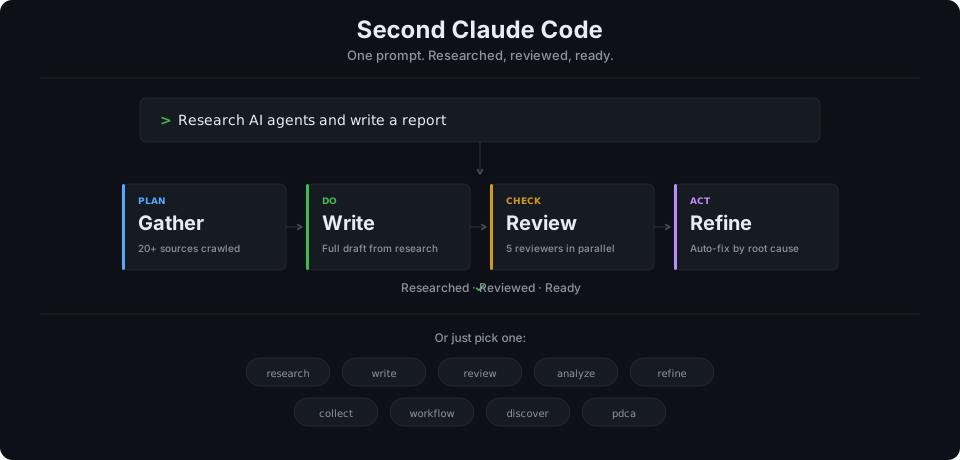
You type one prompt. Researchers crawl 20+ sources. An analyst finds patterns. A writer drafts 3,000 words — and before you even see it, five reviewers are already tearing the draft apart. One checks the logic. Another attacks the weak points. A third fact-checks every number.
One prompt. Full cycle. No duct tape between plugins.
This isn't a coding assistant. It's a work OS — it runs the full knowledge-work cycle autonomously: Plan → Do → Check → Act. Research, analysis, writing, and quality assurance in a single automated loop.
 Image created with SceneSteller
Docs · 한국어 문서 · User Manual · 사용 매뉴얼 · Skill Guides · GitHub Issues · 한국어 README
flowchart TB
    U[One user prompt] --> R[Prompt router]
    R --> O{External plugin wins?}
    O -->|yes| E[Installed plugin capability]
    O -->|no| P[Second Claude PDCA]
    E --> P
    P --> PLAN[Plan: research and analyze]
    PLAN --> DO[Do: write or build]
    DO --> CHECK[Check: review and verify]
    CHECK --> ACT[Act: refine, commit, or route back]
    ACT --> OUT[Finished artifact plus cycle memory]
Second Claude Code is the control loop. The v1.4.0 orchestrator sits in front of that loop and gives installed plugins the first shot when they are a stronger fit.
Deep Interview + Code Engineering Lane — clearer requirements before safer execution. v1.5.2 adds the 18th public command, /second-claude-code:deep-interview, and tightens domain=code PDCA work with stricter planning, validation, cleanup, and handoff contracts.
See docs/RELEASE-v1.5.2.md for the release notes and validation.
Previously in v1.5.0...
unblock skill — zero-key adaptive fetch chain. The 16th skill closes the gap where blocked URLs (4xx, captcha, WAF, JS-heavy SPAs) silently degraded research output. Eevee researcher and the auto-router now invoke a 9-phase escalation pipeline before giving up.
Phase 0a → 0b → 0c → 0d → 1 → 2 → 3 → 4 → 5 → 6
public APIs → Jina → yt-dlp → keyword → curl variants →
TLS rotation → LightPanda → Playwright → free archives → optional paid
schema_version + idempotency_key envelope; stagnation detection short-circuits to archive after 3 same-reason failuresSee docs/RELEASE-v1.5.0.md for full release notes and verification.
Previously in v1.4.0...
Cross-Plugin Orchestrator — Second Claude Code now discovers and commands all your installed Claude Code plugins automatically.
npx claudepluginhub unclejobs-ai/second-claude-code --plugin second-claude-codeLichAmnesia's open-source Claude Code skills — skills-map router (picks which skill to use) plus flagship spec-driven-dev workflow, debug-hypothesis, wiki-aggregate, build-until-pass (self-correcting build loop), Tavily search, Nano Banana image generation, frontend-design, and subagent-brief (pre-flight token discipline for multi-agent fan-out).
 LichAmnesia
Structured deep research methodology for Claude Code — query decomposition, parallel web research with source verification, hallucination prevention, and synthesis into well-sourced documents
 oborchers
Framework for AI-powered multi-step workflows with quality gates
 Unsupervisedcom
Verification-first engineering toolkit for Claude Code. 15 skills across a 5-phase spine (Investigate → Design → Implement → Verify → Ship), 8 specialist agents, an interactive setup wizard. Every skill has rationalizations + evidence requirements. Built for senior ICs and tech leads.
 duthaho
18 universal AI skills for Claude Code — skill creation, deep research, strategic planning, content processing, solution architecture, and orchestration workflows
 ericgandrade
Claude Code skill pack for FireCrawl (30 skills)
 jeremylongshore
'%20stop-opacity%3D'0.16'%2F%3E%3Cstop%20offset%3D'1'%20stop-color%3D'rgb(200%2C90%2C60)'%20stop-opacity%3D'0.03'%2F%3E%3C%2FlinearGradient%3E%3C%2Fdefs%3E%3Crect%20width%3D'320'%20height%3D'200'%20fill%3D'url(%23g)'%2F%3E%3Ccircle%20cx%3D'250'%20cy%3D'56'%20r%3D'92'%20fill%3D'rgb(200%2C90%2C60)'%20fill-opacity%3D'0.06'%2F%3E%3Ccircle%20cx%3D'64'%20cy%3D'172'%20r%3D'58'%20fill%3D'rgb(200%2C90%2C60)'%20fill-opacity%3D'0.05'%2F%3E%3C%2Fsvg%3E)
