Stats
Actions
Available In
Tags

Full AI context layer over MCP — tree-sitter code-map, document RAG (PDF/Office/HTML/email + OCR + reranker), shared agent memory, on-demand web crawl, git history + blame + per-symbol diff. 300+ languages, 10+ coding-agent harnesses, content-addressed Fjall + LanceDB.
Diagnose and recover basemind when it isn't working (MCP tools missing/erroring, "no index", dead server) — runs CLI checks and gives the client-specific way to reconnect the server.
Build or refresh the basemind index by running `basemind scan` via the CLI — works without the MCP server (use it when basemind reports "no index" / "no indexed files").
basemind dashboard — resource footprint (disk + RAM) and activity (tool calls, per-tool histogram, estimated tokens saved). Works with or without the MCP server.
Enable the basemind status line in your Claude Code user settings (one-time setup).
Ask basemind anything about the current codebase — outlines, refs, callers, git history, blame, diffs, docs, memory.
Navigate codebases and manage caches via the basemind CLI — outlines, symbol search, reference/caller lookups, git history, blame, and diffs. For headless scripting, CI, or when driving the CLI more efficiently than interactive MCP calls. Shares the same index as the MCP server.
Find where code is defined and used without reading files — symbol search, file outlines, references, callers, call graphs, implementations, dependents, and indexed regex over content. Reach for it whenever the user asks "where is X defined", "what calls Y", "what implements Z", "what's the shape of this file", or whenever you're about to grep or open files to learn structure.
Coordinate with other agents working the same repo via basemind's broker — scoped rooms, a per-agent inbox, and two-tier messages. Reach for it whenever you start, finish, or hit a decision while collaborating, or to check whether another agent is already touching the code you're about to change.
Diagnose and recover basemind when it isn't working — MCP tools missing or erroring, "no index" / "no indexed files", empty results that shouldn't be empty, or the MCP server seems dead. Runs CLI checks (no MCP server required) and gives the client-specific way to reconnect the server.
Semantic + full-text search over documents and the web via basemind's RAG store — PDFs, Office, HTML, email, images (OCR), plus scraped/crawled web pages, with cross-encoder reranking, keyword and named-entity (NER) filters, and per-document summaries. Reach for it whenever the user asks to "search the docs / PDFs", "find where a topic is discussed", "pull this URL into context", or "what does the documentation say about X".
Admin access level
Server config contains admin-level keywords
Executes bash commands
Hook triggers when Bash tool is used
Own this plugin?
Verify ownership to unlock analytics, metadata editing, and a verified badge. GitHub access is read-only (username + org membership).
Sign in to claimOwn this plugin?
Verify ownership to unlock analytics, metadata editing, and a verified badge. GitHub access is read-only (username + org membership).
Sign in to claimBased on adoption, maintenance, documentation, and repository signals. Not a security audit or endorsement.

The context and communication layer for coding agents.
basemind turns any repo into an always-current map of its code, documents, history, and memory —
so agents answer from structure and search instead of burning their context window on grep and
file reads — and gives a team of agents a shared channel to coordinate while they work. One
server does both.
Code map across 300+ languages · documents in 90+ formats · semantic + full-text search · git history & blame · shared memory · web crawl · agent-to-agent comms




Docs · Install · Features · How it works · Performance · CLI
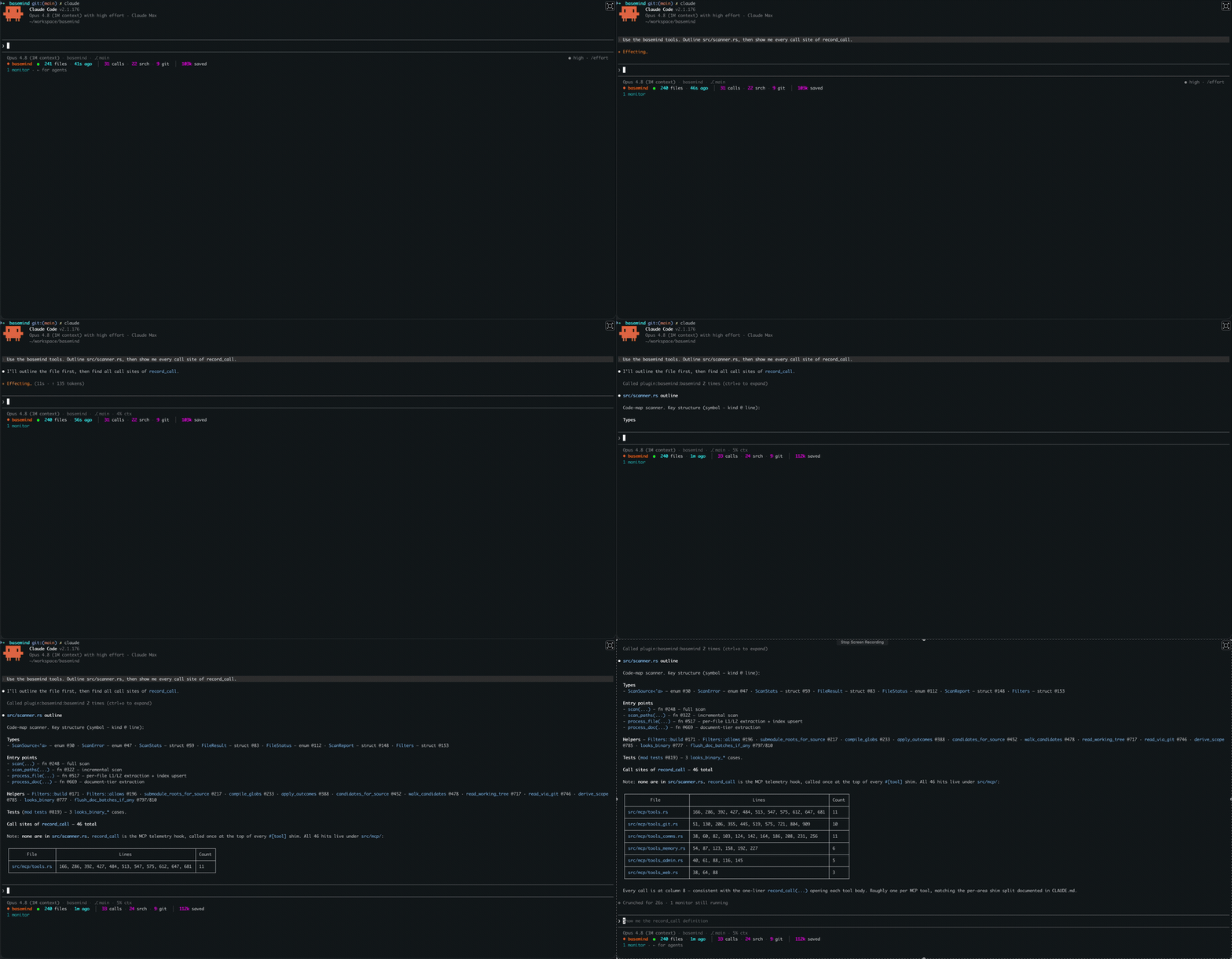
An agent reasoning from structure — outline + find_references in a live session, statusline tracking tokens saved.
basemind answers with file paths, line numbers, and signatures — not whole files — so a question about your code costs a small fraction of the tokens it takes to read the source.
| Capability | What it does | Key tools |
|---|---|---|
| Code intelligence | Find where things are defined, what calls what, who implements what, how calls chain, and the overall architecture (hub modules + dependency cycles) — across 300+ languages. | outline · search_symbols · find_references · find_callers · goto_definition · call_graph · architecture_map · find_implementations · workspace_grep |
| Git intelligence | Ask what changed recently, who last touched a function, where the churn is, how a file's structure differs across commits, and full-text search commit authors + messages. | blame_symbol · symbol_history · recent_changes · hot_files · diff_outline · commits_touching · search_git_history |
| Document search | Search PDFs, Office files, HTML, email, and images by meaning — with built-in text extraction and OCR, no extra setup. | search_documents |
| Code search | Find source code by meaning, term, or symbol — mode picks the strategy: hybrid (default, RRF fusion of vector + BM25 + exact-symbol lanes), semantic (vector KNN), or keyword (native BM25); optional rerank cross-encoder pass. Returns pointers, fetch bodies with get_chunk. Needs --features code-search. | search_code · get_chunk |
| Shared memory | A per-repo memory agents can write to and search; clones of the same repo share it, unrelated repos stay separate. | memory_put · memory_search · memory_audit |
| Suggestions | Spots files that change together and suggests notes worth saving — you approve before anything is kept. | proposals_mine · proposal_accept |
| Web crawl | Fetch a page or follow links from a starting URL; results join the document search above. | web_scrape · web_crawl · web_map |
| Agent comms | A shared chat for agents on the same repo: per-repo rooms they auto-join, direct messages, and a recency-filtered inbox. One orchestrator can drive many named subagents (as_agent). | room_post · dm_send · inbox_read · agent_list |
| Agent shells | Let agents open, type into, and watch terminal sessions in the background. | shell_spawn · shell_send · shell_capture · shell_list |
| Token saving | Hand an agent a file's outline instead of its full text, pull back only the one function it needs, diff a re-read instead of resending it whole, checkpoint a session, and flag wasteful tool use. | compress · expand · delta · checkpoint · detect_waste |
| Admin | Refresh the index, see what's been queried, and check or clean up the on-disk cache. | rescan · telemetry_summary · cache_stats |
npx claudepluginhub tunings-lab/basemindIntelligent draw.io diagramming plugin with AI-powered diagram generation, multi-platform embedding (GitHub, Confluence, Azure DevOps, Notion, Teams, Harness), conditional formatting, live data binding, and MCP server integration for programmatic diagram creation and management.
 markus41
Comprehensive skill pack with 66 specialized skills for full-stack developers: 12 language experts (Python, TypeScript, Go, Rust, C++, Swift, Kotlin, C#, PHP, Java, SQL, JavaScript), 10 backend frameworks, 6 frontend/mobile, plus infrastructure, DevOps, security, and testing. Features progressive disclosure architecture for 50% faster loading.
 Jeffallan
Persistent file-based planning for AI coding agents. Crash-proof markdown plans (task_plan.md, findings.md, progress.md) that survive context loss and /clear, with an opt-in completion gate and multi-agent shared state. Manus-style. Works with Claude Code, Codex CLI, Cursor, Kiro, OpenCode and 60+ agents via the SKILL.md standard. Includes Arabic, German, Spanish, and Chinese (Simplified and Traditional).
 OthmanAdi
Access thousands of AI prompts and skills directly in your AI coding assistant. Search prompts, discover skills, save your own, and improve prompts with AI.
 f
fConsult multiple AI coding agents (Gemini, OpenAI, Grok, Perplexity, plus codex, antigravity, and grok CLIs when installed) to get diverse perspectives on coding problems
 hex
hexProduction-grade engineering skills for AI coding agents — covering the full software development lifecycle from spec to ship.
 addyosmani
'%20stop-opacity%3D'0.16'%2F%3E%3Cstop%20offset%3D'1'%20stop-color%3D'rgb(200%2C90%2C60)'%20stop-opacity%3D'0.03'%2F%3E%3C%2FlinearGradient%3E%3C%2Fdefs%3E%3Crect%20width%3D'320'%20height%3D'200'%20fill%3D'url(%23g)'%2F%3E%3Ccircle%20cx%3D'250'%20cy%3D'56'%20r%3D'92'%20fill%3D'rgb(200%2C90%2C60)'%20fill-opacity%3D'0.06'%2F%3E%3Ccircle%20cx%3D'64'%20cy%3D'172'%20r%3D'58'%20fill%3D'rgb(200%2C90%2C60)'%20fill-opacity%3D'0.05'%2F%3E%3C%2Fsvg%3E)
