Stats
Actions
Available In
Tags

Full lifecycle SDLC orchestrator with specialized agents, memory, and auto-reflection
Stage 6 agent. Implements code from the technical spec and task plan. Use when running /forge:build or when the user starts implementation. Works one task at a time from the DAG. Reads Stage 1–5 artifacts and writes production code.
Stage 8 agent. Plans and executes deployment of the evaluated build. Use when running /forge:deploy or when the user wants to ship to an environment. Produces deployment plan, runbook, and rollback procedure. Reads Stage 1–7 artifacts.
Nightly lesson consolidation agent. Applies confidence decay to low-confidence lessons, detects duplicate and contradicting lesson pairs (flag only — never auto-merges or auto-resolves), and produces a daily digest. Optionally generates a cheap-model consolidation summary when background agents are available. Triggered by /forge:dreamer-run.
Stage 7 agent. Evaluates the implementation against requirements and gate criteria. Use when running /forge:eval or when the user wants a quality assessment. Produces an eval report with pass/fail status per REQ-ID. Reads Stage 1–6 artifacts.
Cross-stage agent. Evaluates whether the current stage's gate criteria are met, reasoning about ambiguous or partial results that the mechanical check-gate.py script cannot resolve. Invoked when check-gate.py returns inconclusive results or when the user explicitly requests a gate assessment.
Onboard an EXISTING codebase into Forge (brownfield adoption). Use when the user runs /forge:adopt, wants to start using Forge on a project that already has code, says "adopt this repo", "set up Forge on my existing project", "reverse-engineer the requirements/architecture", or asks to bring a legacy/brownfield codebase into the pipeline. Pass --dry-run to preview without writing. Distinct from /forge:init, which scaffolds a greenfield pipeline.
Run Stage 3 of the Forge pipeline — system architecture. Use when the user says /forge:architecture or /forge:arch, wants a C4 diagram, data model, API design, or tech stack decisions. Requires Stage 1–2 to exist. Invokes system-architect.
Stop a running Forge autopilot. Use when the user runs /forge:autopilot-stop, says "stop autopilot", "cancel the autopilot", "halt the pipeline run", or "stop running the pipeline". Sets a stop flag the autopilot loop checks between stages, so it halts cleanly at the next stage boundary (the in-progress stage finishes; nothing is forced).
Drive the Forge pipeline hands-off — run stages back-to-back, checking each stage's gate and advancing only when it passes, stopping at the first blocker. Use when the user runs /forge:autopilot, says "autopilot", "run the pipeline for me", "take it from here", "build through to stage N", "run the next few stages automatically", or "drive the rest of the pipeline". Bounded and safe by default (stop-on-gate, never force). Stop anytime with /forge:autopilot-stop.
Run Stage 6 of the Forge pipeline — implementation. Use when the user says /forge:build, wants to start coding, implement a feature, or work the task DAG. Requires Stage 1–5. Invokes the builder persona. Works one task at a time.
Executes bash commands
Hook triggers when Bash tool is used
Modifies files
Hook triggers on file write and edit operations
Uses power tools
Own this plugin?
Verify ownership to unlock analytics, metadata editing, and a verified badge. GitHub access is read-only (username + org membership).
Sign in to claimOwn this plugin?
Verify ownership to unlock analytics, metadata editing, and a verified badge. GitHub access is read-only (username + org membership).
Sign in to claimBased on adoption, maintenance, documentation, and repository signals. Not a security audit or endorsement.
Uses Bash, Write, or Edit tools
Uses Bash, Write, or Edit tools
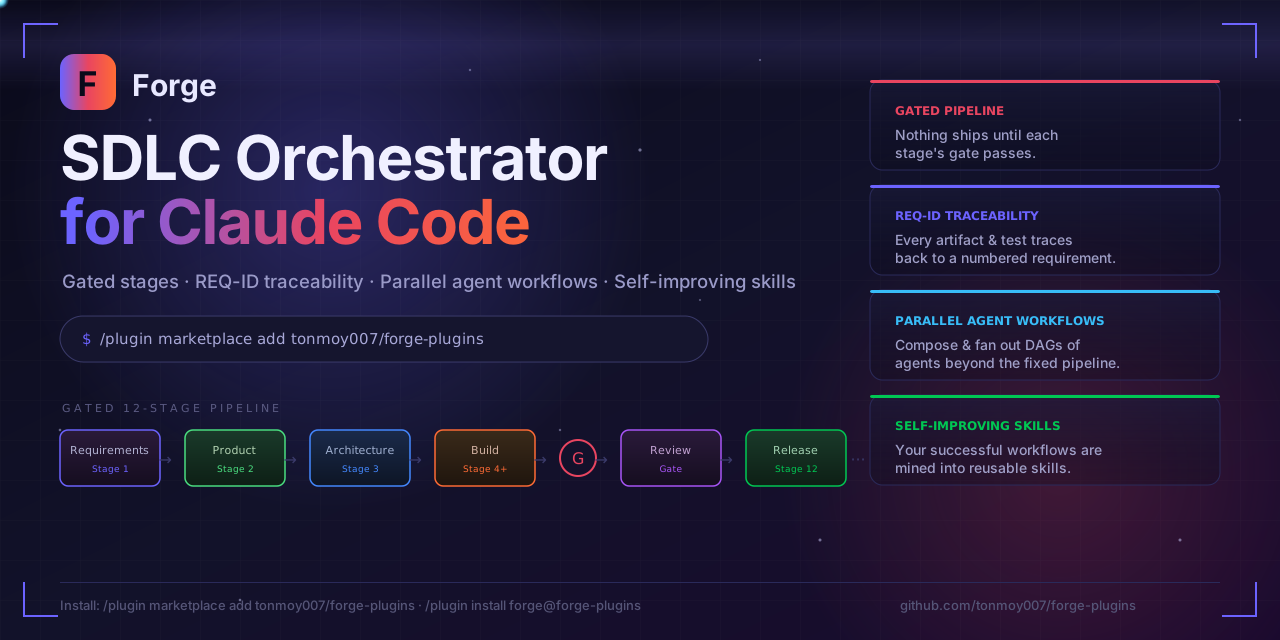
Forge turns Claude Code from a smart coding assistant into a disciplined engineering partner. Claude already remembers — what it doesn't enforce is process. Forge does: gated stages, requirement traceability, and learning that compounds across projects.



A Claude Code plugin that adds the one thing a coding assistant lacks — enforced sequencing. Forge gives you:
REQ-NNN → gate → code → test.Nothing advances silently and nothing is untraceable. When you do need to skip a gate,
/forge:force-advance records why — the override is explicit and audited.
flowchart LR
    subgraph DEFINE["📐 Define — what & how"]
        direction LR
        S1[1 · Requirements] --> S2[2 · Product / UX] --> S3[3 · Architecture] --> S4[4 · Spec] --> S5[5 · Plan]
    end
    subgraph BUILD["🔨 Build"]
        direction LR
        S6[6 · Implement] --> S7[7 · Evaluate]
    end
    subgraph SHIP["🚀 Ship & iterate"]
        direction LR
        S8[8 · Deploy] --> S9[9 · Monitor] --> S10[10 · Feedback] --> S11[11 · Resolve] --> S12[12 · Release]
    end
    S5 --> S6
    S7 --> S8
    S12 -. retrospective · next cycle .-> S1
Every arrow is a gate — work advances only when the previous stage's exit criteria pass.
| Stage | Command | Output |
|---|---|---|
| 1 — Requirements | /forge:srs | SRS with REQ-IDs |
| 2 — Product & UX | /forge:product | PRD, design system, user flows |
| 3 — Architecture | /forge:arch | Architecture doc, ADRs, data model |
| 4 — Technical Spec | /forge:spec | Tech spec, interface contracts, test strategy |
| 5 — Planning | /forge:plan | Task DAG, milestones, risk register |
| 6 — Implementation | /forge:build | Code, decisions log, progress tracker |
| 7 — Evaluation | /forge:eval | Test results, security review, eval report |
| 8 — Deployment | /forge:deploy | Deploy plan, runbook, deploy log |
| 9 — Monitoring | /forge:monitor | Observability config, incident log |
| 10 — Feedback | /forge:feedback | Feedback log, triage |
| 11 — Resolution | /forge:resolve | Hotfixes, regression tests, backlog |
| 12 — Release | /forge:release | Changelog, release notes, checklist |
In Claude Code:
/plugin marketplace add tonmoy007/forge-plugins
/plugin install forge@forge-plugins
Prerequisites: Claude Code ≥ 2.1.0 · Python ≥ 3.11 on PATH · pip install pyyaml.
/forge:init      # detect project type, scaffold pipeline/, write state.md
/forge:srs       # Claude interviews you → requirements with REQ-IDs
/forge:status    # "where am I?" — Forge tells you at every session start
Then run each /forge:<stage> in turn. You never track where you are — Forge injects the
current stage, task, and blockers into every session and always names the next step.
Forge runs as silent lifecycle hooks around your normal Claude Code session. They inject state at the start, enforce gates as you work, and quietly learn from what succeeds:
flowchart TD
    B["SessionStart hook injects state<br/>stage · task · blockers · lessons · rules"]
    C["You + Claude work the current stage"]
    D{"Gate passes?"}
    E["Advance · REQ-ID traceability recorded"]
    F["Hooks capture tool-use traces"]
    G["Lessons + skills mined<br/>semantic · success-gated · cross-project"]
    B --> C --> D
    D -- "no · blocker" --> C
    D -- "yes" --> E
    C --> F --> G
    G -. feeds the next session .-> B
    E -. next stage .-> B
Three tiers of memory feed that loop:
SessionStart (≤ 2 000 tokens).pipeline/ accumulates decisions, reflections, and stage history.~/.forge/global-lessons.yaml promotes high-frequency
patterns across all your repos.When a successful workflow recurs in your own traces, Forge mines it and proposes a
reusable skill for you to approve, modify, or reject. See
references/skill-mining.md.
npx claudepluginhub tonmoy007/forge-pluginsConsult multiple AI coding agents (Gemini, OpenAI, Grok, Perplexity, plus codex, antigravity, and grok CLIs when installed) to get diverse perspectives on coding problems
 hex
hexv9.52.0 - Reliability wave: tangle contextual review correction loop with hard round ceiling, progress-supervised review rounds (per-agent stall watch, descendant-tree kills), council diversity and agy pin fixes, marketplace generator source-of-truth fix, provider troubleshooting runbook and cost-expectations docs. Run /octo:setup.
 nyldn
nyldnComplete creative writing suite with 10 specialized agents covering the full writing process: research gathering, character development, story architecture, world-building, dialogue coaching, editing/review, outlining, content strategy, believability auditing, and prose style/voice analysis. Includes genre-specific guides, templates, and quality checklists.
 greyhaven-ai
Upstash Context7 MCP server for up-to-date documentation lookup. Pull version-specific documentation and code examples directly from source repositories into your LLM context.
 upstash
Comprehensive startup business analysis with market sizing (TAM/SAM/SOM), financial modeling, team planning, and strategic research
 wshobson
Permanent coding companion for Claude Code — survives any update. MCP-based terminal pet with ASCII art, stats, reactions, and personality.
 1270011
'%20stop-opacity%3D'0.16'%2F%3E%3Cstop%20offset%3D'1'%20stop-color%3D'rgb(200%2C90%2C60)'%20stop-opacity%3D'0.03'%2F%3E%3C%2FlinearGradient%3E%3C%2Fdefs%3E%3Crect%20width%3D'320'%20height%3D'200'%20fill%3D'url(%23g)'%2F%3E%3Ccircle%20cx%3D'250'%20cy%3D'56'%20r%3D'92'%20fill%3D'rgb(200%2C90%2C60)'%20fill-opacity%3D'0.06'%2F%3E%3Ccircle%20cx%3D'64'%20cy%3D'172'%20r%3D'58'%20fill%3D'rgb(200%2C90%2C60)'%20fill-opacity%3D'0.05'%2F%3E%3C%2Fsvg%3E)
