Agency



Agency is an AI agent orchestrator running purely in the command line.
Getting Started
- Install Agency with your preferred method (macOS and Linux supported)
- NPM:
npm install -g agency-cli
- Homebrew :
brew install tobias-walle/tap/agency
- Build from source:
cargo install --git https://github.com/tobias-walle/agency
- Set up your preferences:
agency setup
- Set up Agency in your project:
agency init
- Start the TUI:
agency
TUI or CLI: your choice
The easiest option is to use the TUI; run agency tui or just agency.
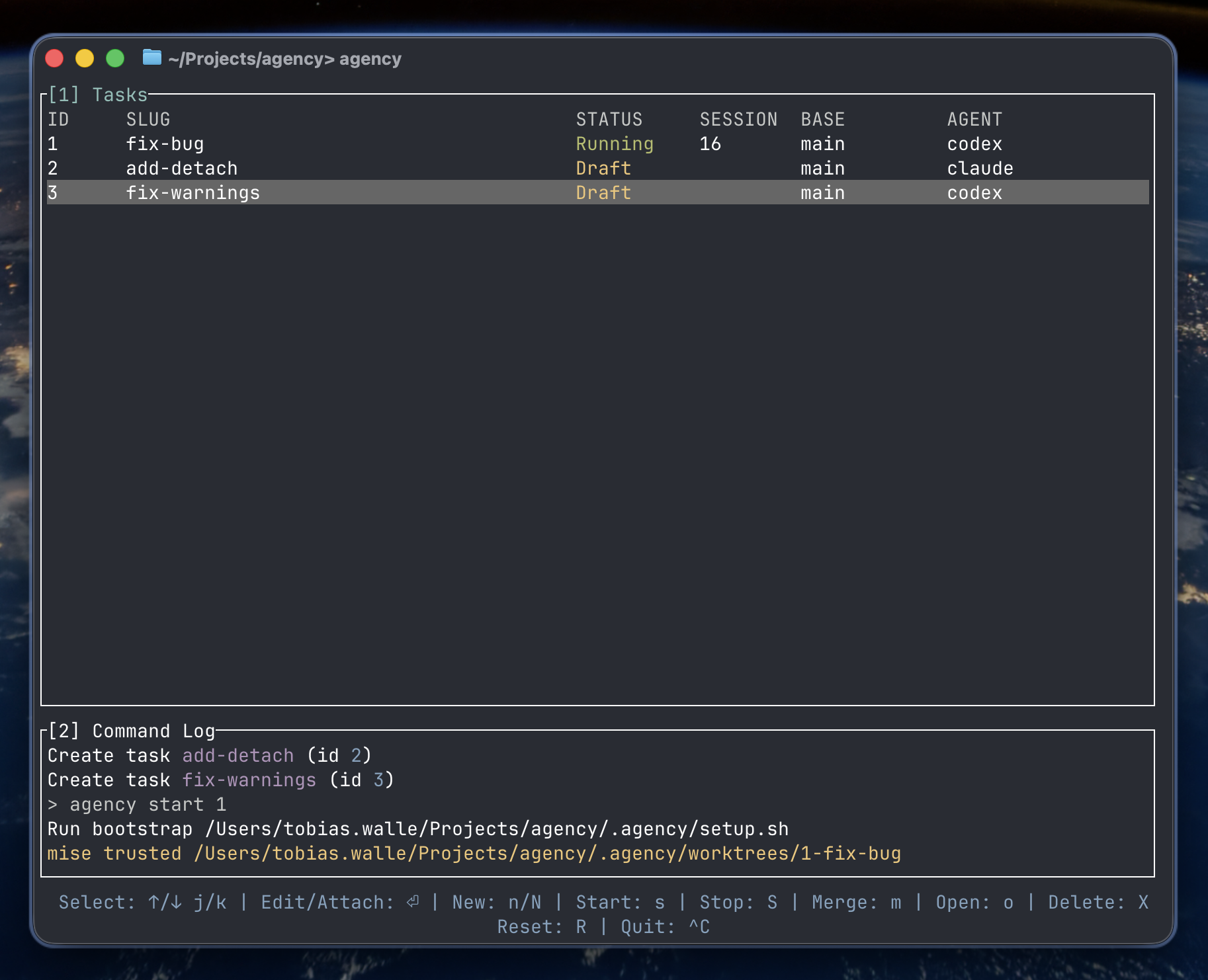
Everything available in the TUI is also available via the CLI:
agency --help - See all available commandsagency new my-task - Create a new task with slug my-task, start a session for it, and attach immediately (no editor by default).agency new --draft my-task - Create a new task as a draft (doesn't start or attach; in interactive TTY mode without a description, this opens your editor to write the initial instructions).agency edit my-task - Edit a draft task.agency start my-task - Start a task that is a draft or stopped.agency attach my-task or agency attach 1 - Open the agent TUI by slug or ID.agency attach --follow - Attach to the focused task in a running Agency TUI.agency stop my-task - Stop a running task (keep its worktree and branch).agency merge my-task - Merge the task back into the base branch.agency path my-task - Get the worktree path for a task.agency shell my-task - Open a shell in the task's worktree.agency tasks - List all tasks and their status.agency config - Open the global Agency config in your editor.agency daemon start|stop|restart - Manage the background daemon that tracks sessions and notifies clients.- ... and many more (see
agency --help).
Skills
Teach your AI coding agent how to use Agency by installing the Agency skill. Once installed, your agent will know how to parallelize tasks using Agency when you ask it to.
Claude Code
/plugin marketplace add tobias-walle/agency
/plugin install agency@agency
# Alternative: install via Agency CLI
agency skill install
# When prompted, select: "Claude (~/.claude/skills)"
Codex CLI and Others
agency skill install
# When prompted, select: "Codex (~/.codex/skills)" or a custom path
Configuration
Configuration is layered in three tiers:
- Defaults (see crates/agency/defaults/agency.toml or
agency defaults)
- Global file
~/.config/agency/agency.toml (created by agency setup)
- Project overrides at
./.agency/agency.toml
Tmux
Agency uses Tmux to manage the background agents.
If you attach to an agent you are basically opening Tmux.
Config precedence when starting sessions:
- User defaults (best-effort):
~/.tmux.conf, then ~/.config/tmux/tmux.conf
- Agency defaults (baseline UI/options applied programmatically)
- Agency global overrides:
~/.config/agency/tmux.conf
- Project overrides:
./.agency/tmux.conf
Defining a custom agent
You can define custom agents using any CLI command.
[agents.my-agent]
cmd = ["my-agent", "-p", "$AGENCY_TASK"]
The following environment variables are injected into the command:
$AGENCY_TASK - The full prompt for the current task.$AGENCY_ROOT - The path to the folder of the main repo (not the worktree).$AGENCY_TASK_ID - The numeric ID of the task.
You can also use the <root> placeholder for relative paths (works in any config in which you define a path).
[agents.my-local-agent]
cmd = ["<root>./my-local-agent", "-p", "$AGENCY_TASK"]
Check out the default config for a few examples.
Editor
Control which editor Agency uses when opening files (e.g. task descriptions, worktrees, and config):
# Preferred editor argv. If unset, Agency falls back to $EDITOR, then to `vi`.
editor = ["nvim"]

# Examples:
# editor = ["code", "-w"]
# editor = ["zed", "--wait"]
You can also run agency config to open (and create if missing) the global config file directly in your editor.

 prassanna-ravishankar
 JsonLee12138
 Jamie-BitFlight
 first-fluke
 guanyang
 joelhooks
'%20stop-opacity%3D'0.16'%2F%3E%3Cstop%20offset%3D'1'%20stop-color%3D'rgb(200%2C90%2C60)'%20stop-opacity%3D'0.03'%2F%3E%3C%2FlinearGradient%3E%3C%2Fdefs%3E%3Crect%20width%3D'320'%20height%3D'200'%20fill%3D'url(%23g)'%2F%3E%3Ccircle%20cx%3D'250'%20cy%3D'56'%20r%3D'92'%20fill%3D'rgb(200%2C90%2C60)'%20fill-opacity%3D'0.06'%2F%3E%3Ccircle%20cx%3D'64'%20cy%3D'172'%20r%3D'58'%20fill%3D'rgb(200%2C90%2C60)'%20fill-opacity%3D'0.05'%2F%3E%3C%2Fsvg%3E)