Stats
Actions
Available In
Tags

Turn a rough idea or GitHub issue into a fully implemented, reviewed, tested, and documented pull request with auto-generated release notes and a self-improving retrospective loop that files issues for recurring problems.
Merges multiple batches of checklist items from checklist-generator into a single deduped checklist. Preserves traceability by recording which original IDs were merged. Does NOT judge correctness or re-tag items.
Use when an orchestrator needs to enumerate every verifiable claim in a code diff (dependency interactions, test-mock alignment, data format assumptions, API contracts) and return a JSON checklist for independent verification. Does NOT judge correctness.
Verifies a single claim from the verification checklist against the actual source code. Reports PASS, FAIL, or INCONCLUSIVE with file:line evidence. Used for `verification_mode: "agent"` items; lite-mode items are resolved by the orchestrator directly via grep.
Designs feature architectures by analyzing existing codebase patterns and conventions, then providing comprehensive implementation blueprints with specific files to create/modify, component designs, data flows, and build sequences
Deeply analyzes existing codebase features by tracing execution paths, mapping architecture layers, understanding patterns and abstractions, and documenting dependencies to inform new development
Use when generating or updating a PR description for the current branch. Takes an optional issue number as argument.
Use when you have a rough user story, bug report, or feature idea that needs to become a well-structured GitHub issue.
Use when setting up external documentation for the first time, performing a comprehensive documentation refresh, or when large portions of internal docs need corresponding external docs created.
Use when setting up internal documentation for the first time, when the docs directory is empty or poorly organized, or when a codebase has no structured developer documentation yet.
Use when a PR has customer-visible changes (new features, bug fixes, UI changes) that need a release note entry, or when finalizing a branch before merge.
Uses power tools
Uses Bash, Write, or Edit tools
Based on adoption, maintenance, documentation, and repository signals. Not a security audit or endorsement.
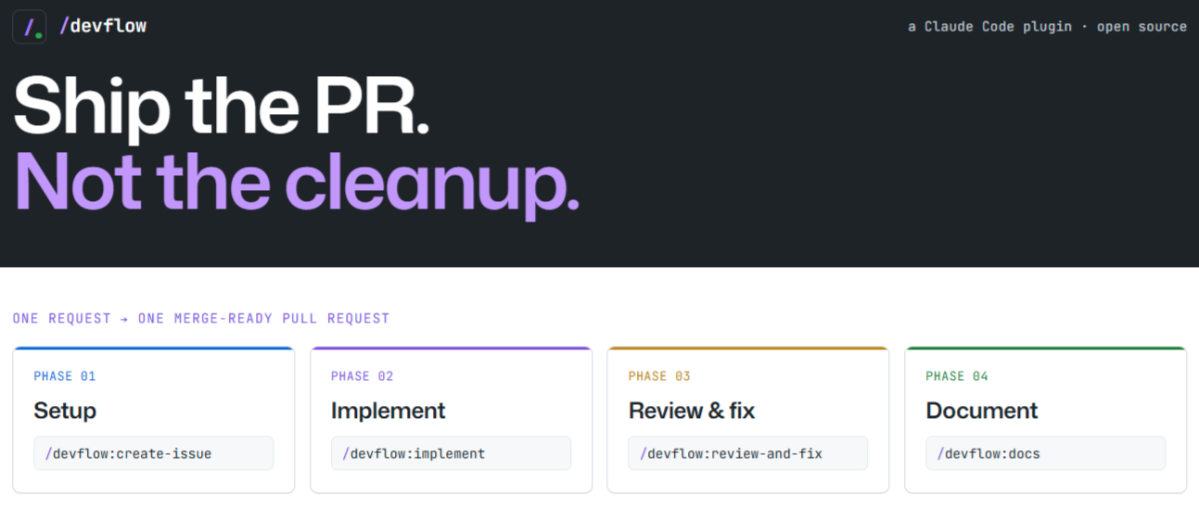



AI coding agents dazzle on a demo repo, then stall on a real ticket in a large production codebase. DevFlow is the Claude Code plugin that closes that gap — it carries one feature request all the way to a complete, tested, reviewed, documented pull request, so you do the final review and merge, not the cleanup.
[!TIP] Just ask your agent. Paste this into Claude Code and it handles steps 1 and 2 for you — the install, the setup, and the PATH dependencies
/plugin installdoesn't cover. Then ship your first PR with step 3.Read https://github.com/The01Geek/devflow-autopilot#quick-start and install DevFlow and its dependencies.
1. Install (two commands — run in order; works in any shell):
claude plugin marketplace add The01Geek/devflow-autopilot
claude plugin install devflow@devflow-marketplace
2. Set up — launch Claude Code and scaffold your config:
claude /devflow:init # launches Claude Code and scaffolds your config
3. Ship a PR — turn a feature request into a reviewed, documented pull request:
/devflow:create-issue <user_story>
/devflow:implement <issue_number>
The local tier runs with zero configuration — every value already has a built-in default. /devflow:init is recommended: it keeps the plugin auto-updated and writes a .devflow/config.json you can tweak. See Installing & updating for the full options (the zero-dependency install, PyYAML, the cloud tier) and Requirements for the handful of tools it expects on your PATH.
The thesis isn't code generation — it's disciplined, auditable AI software delivery at production scale. A single LLM pass is variable; DevFlow's architecture is built around not trusting any single pass.
npx claudepluginhub the01geek/devflow-autopilot --plugin devflowComplete task implementation workflow - accepts plan documents, issues, or task descriptions
 dean0x
Use Claude Code As Is - native plugin leveraging built-in architecture
 Joncik91
Development workflow automation including feature development, code quality, and PR management
 rp1-run
Opinionated 5-phase development lifecycle for Claude Code — language-agnostic, repo-local bin/* delegation
 benkruger
Opinionated GitHub-native development workflow with 51 skills for autonomous, issue-driven software development. Enforces TDD, strict typing, IPv6-first networking, comprehensive code review, local service testing, and continuous issue tracking. Features GitHub-based state management (no local state files), documentation enforcement gates, autonomous orchestration with parallel workers, and PostgreSQL 18/PostGIS/TimescaleDB database skills.
 troykelly
Git and PR workflows with code review, onboarding, and PR enhancement
 EricGrill
'%20stop-opacity%3D'0.16'%2F%3E%3Cstop%20offset%3D'1'%20stop-color%3D'rgb(200%2C90%2C60)'%20stop-opacity%3D'0.03'%2F%3E%3C%2FlinearGradient%3E%3C%2Fdefs%3E%3Crect%20width%3D'320'%20height%3D'200'%20fill%3D'url(%23g)'%2F%3E%3Ccircle%20cx%3D'250'%20cy%3D'56'%20r%3D'92'%20fill%3D'rgb(200%2C90%2C60)'%20fill-opacity%3D'0.06'%2F%3E%3Ccircle%20cx%3D'64'%20cy%3D'172'%20r%3D'58'%20fill%3D'rgb(200%2C90%2C60)'%20fill-opacity%3D'0.05'%2F%3E%3C%2Fsvg%3E)