Stats
Actions
Available In
Tags
Enforce a structured, gate-based software methodology where AI agents build production code slice by slice, with invariant checks, design prototyping, decomposition, fidelity ledgers, and formal exit reports — all governed by human decisions at each gate.
Use after the repo is seeded to run the D-000 five-lens decomposition, record persistent schema decisions, define slice one, and start the deltas file. Also use when a stays-ahead decision (decomposition, schema) must be revisited. Do not use for per-slice implementation decisions; those are D-0xx record-gaps raised during implement.
Use when an existing project that was not built with X2 must be migrated to run under it, with documentation sprawl to dissolve, stories to harvest at epic altitude, an as-built design to baseline, and existing enforcement to map and arm. Runs the migration on a dedicated branch with three human gates. Do not use for a new project (that is seed), and do not use it to redesign the product or refactor code beyond what arming the enforcement requires.
Use only after the lock (gate 2b) is on record for the slice portion, to derive the fidelity ledger and acceptance scenarios from the locked prototype. Triggers when a portion is newly locked or re-locked. Never use before the lock, and never use it to hand-author prototype-fidelity test cases from prose.
Use when D-000 exists and the whole-product prototype does not, to run Claude Design in its own context and produce the prototype and design system. Also use when a later slice exposes a design gap that needs a spine revision. Requests gate 2a (prototype approved at Claude Design). Never run in the builder's context, and never used to author tests, acceptance criteria, or application code.
Use when an X2 project completes (or reaches a major milestone) to run the extraction loop, the quality feedback that folds the project's evidence back into the method. Reads the turn ledger and decision records, computes the metric and the per-decision churn table, distils sanitized candidates, confirmations, and negative-space nominations, and holds everything for a rulings pass. Do not use mid-slice (that is the normal intake flow), and never let raw project material cross into the public method.
Based on adoption, maintenance, documentation, and repository signals. Not a security audit or endorsement.
Something strange happened to software in the last few years, and almost nobody outside the industry noticed.
For half a century, the most valuable thing a software company owned was its code, the written instructions its programs run on. Code was slow and expensive to produce. Companies guarded it like gold, because rewriting it could take years and cost millions.
Then AI learned to write it.
Today, an AI assistant can write, and rewrite, working code in minutes. An entire section of a program can be regenerated faster than a person could read it. Overnight, code went from the most expensive thing a company owns to the cheapest. And anything that can be remade on demand is no longer a treasure.
So what is the treasure now?
The decisions. The things no AI can invent for you:
A banking app can be rebuilt in an afternoon. The decision that no customer's balance may ever silently change cannot be rebuilt by anyone but the people responsible for it.
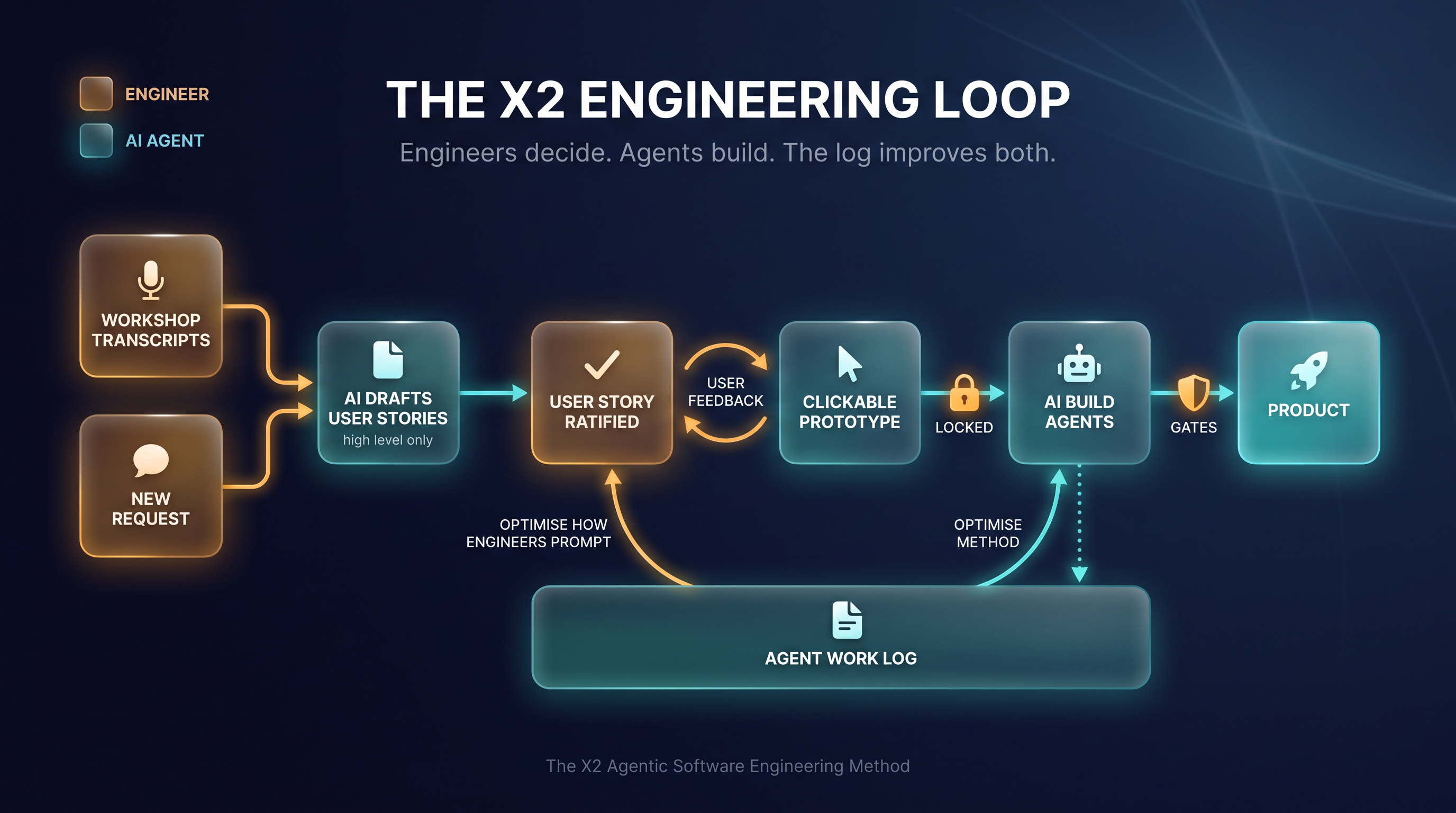
X2 is a method for building software that takes this reversal seriously. It was created for teams who let AI do the building, and it answers one uncomfortable question: how do you stay in control of a builder that works faster than you can watch?
Imagine hiring a builder who works a hundred times faster than anyone alive, but who forgets everything between jobs and has no personal stake in whether the work is any good.
You could hand that builder your rules on paper. It would read them, then forget or ignore them on the very next task. This is not a hypothetical; it is how AI coding assistants actually behave. A rule that nobody actively checks is only a suggestion.
X2 sorts everything into three piles and puts each one where it cannot go wrong.
The unbreakable rules go into the machinery. Instead of living on paper, they are built into the automated checks that every piece of work must pass before it ships. Break a rule and the work simply fails, no matter what the AI claims. A machine enforces them, so they cannot be forgotten.
The decisions stay with people. They live in a handful of short documents that humans own and humans change. This is the treasure, and it is kept deliberately small.
The code becomes disposable. It is regenerated from the decisions whenever needed, like printing a fresh copy from a master document. Nobody mourns it.
The result: nothing important depends on the AI remembering anything.
In the method's own vocabulary the three piles are the invariants, the decisions and the
consequences. X2.md walks through all three, and the reasoning behind them.
The AI does the building, but a person decides at three checkpoints:
Between checkpoints, the AI must stop and ask whenever it hits a question no document answers.
And "finished" is never taken on the builder's word. Work counts as done only when a report, verified by someone who did not build it, shows it was genuinely tested and genuinely works. Nobody grades their own homework. The failure this guards against even has a name inside the method: green-but-wrong, a build where every light is green while the product is quietly not what was decided.
For decades, software teams have run on trust in people: their memory, their habits, their honesty. That worked because people were doing the building.
The builders are no longer people. X2's wager is that the trust which must never slip should move into machinery that cannot forget and cannot fudge, while everything requiring real judgment stays with humans.
If AI ends up building most of the world's software, and it is heading that way, then the interesting question is no longer who writes the code. It is who makes the decisions, and how those decisions are protected from a workforce that never remembers yesterday. X2 is one answer.
learn.reqwiseconsulting.com is a free seven-lesson prompt
course with an AI trainer that marks your work. X2 built it in 2 days, six slices, idea to
production. Every moment a person had to step in was logged as it happened and published in
record/metrics.md, which is the part most methods cannot show you.
npx claudepluginhub teklabsdigital/x2-method --plugin x2Elite AI development framework: reference-first design, agent orchestration, automated quality gates, and battle-tested engineering workflows
 NoobyGains
The only Claude Code plugin that verifies AI-generated code against its own design specs.
 popup-studio-ai
Agent Driven Development (ADD) — Coordinated AI agent teams that ship verified software. Spec-driven TDD, trust-but-verify orchestration, human-AI collaboration protocols, environment-aware deployment, and cross-project learning.
 MountainUnicorn
Auto-dev platform for agent-majority software teams. Five skills (auto-dev, auto-env, auto-req, auto-test, auto-triage), four roles (dev-agent, req-agent, user-agent, triage-agent), and cross-skill contracts. Humans supply requirements and intervene at key decision points; agents handle everything else.
 A7um
A7umUse Claude Code As Is - native plugin leveraging built-in architecture
 Joncik91
Reference implementation of the Ironclad standard — multi-agent dev harness for Claude Code.
 qwerfunch
'%20stop-opacity%3D'0.16'%2F%3E%3Cstop%20offset%3D'1'%20stop-color%3D'rgb(200%2C90%2C60)'%20stop-opacity%3D'0.03'%2F%3E%3C%2FlinearGradient%3E%3C%2Fdefs%3E%3Crect%20width%3D'320'%20height%3D'200'%20fill%3D'url(%23g)'%2F%3E%3Ccircle%20cx%3D'250'%20cy%3D'56'%20r%3D'92'%20fill%3D'rgb(200%2C90%2C60)'%20fill-opacity%3D'0.06'%2F%3E%3Ccircle%20cx%3D'64'%20cy%3D'172'%20r%3D'58'%20fill%3D'rgb(200%2C90%2C60)'%20fill-opacity%3D'0.05'%2F%3E%3C%2Fsvg%3E)