Stats
Actions
Available In
Tags

Onboard an existing brownfield repository into the Shipwright SDLC by analyzing the codebase, generating documentation, configs, compliance artifacts, and an E2E test baseline via Playwright crawl.
Modifies files
Hook triggers on file write and edit operations
Based on adoption, maintenance, documentation, and repository signals. Not a security audit or endorsement.
Ship right, not just fast.

AI can build your software now. The hard part is keeping it true to what you already decided, on every change, not just the first.
Shipwright is the harness your AI follows. On every change it checks the work back against your baseline (requirements, architecture, past decisions) and won't let through a change that silently drops a requirement or reverses a call you already made. That is enforced in code, not left to the model to remember; the traceability and audit trail just fall out of it.
/shipwright-iterate "Add a dark mode toggle"
What comes with it: a failing test written first, the change, your specs and traceability updated to match, and a clean Conventional-Commit PR, security-scanned and gated on green checks. Nothing you'd already settled gets quietly undone.
Not a stack framework, not autonomous codegen, just the discipline layer that makes whatever generates your code something you can stand behind. Use it from the Claude Code VSCode Extension or CLI terminal, or for multi-project work through the Shipwright Command Center web UI. Built for daily iteration, not one-shot generation. It scales from a one-line change to a whole new app:
/shipwright-run "A SaaS time tracking app with Supabase and Next.js"
Beta: Shipwright is in active beta. It builds itself daily, but you're an early user, so expect the occasional rough edge. Report issues and feedback are very welcome.
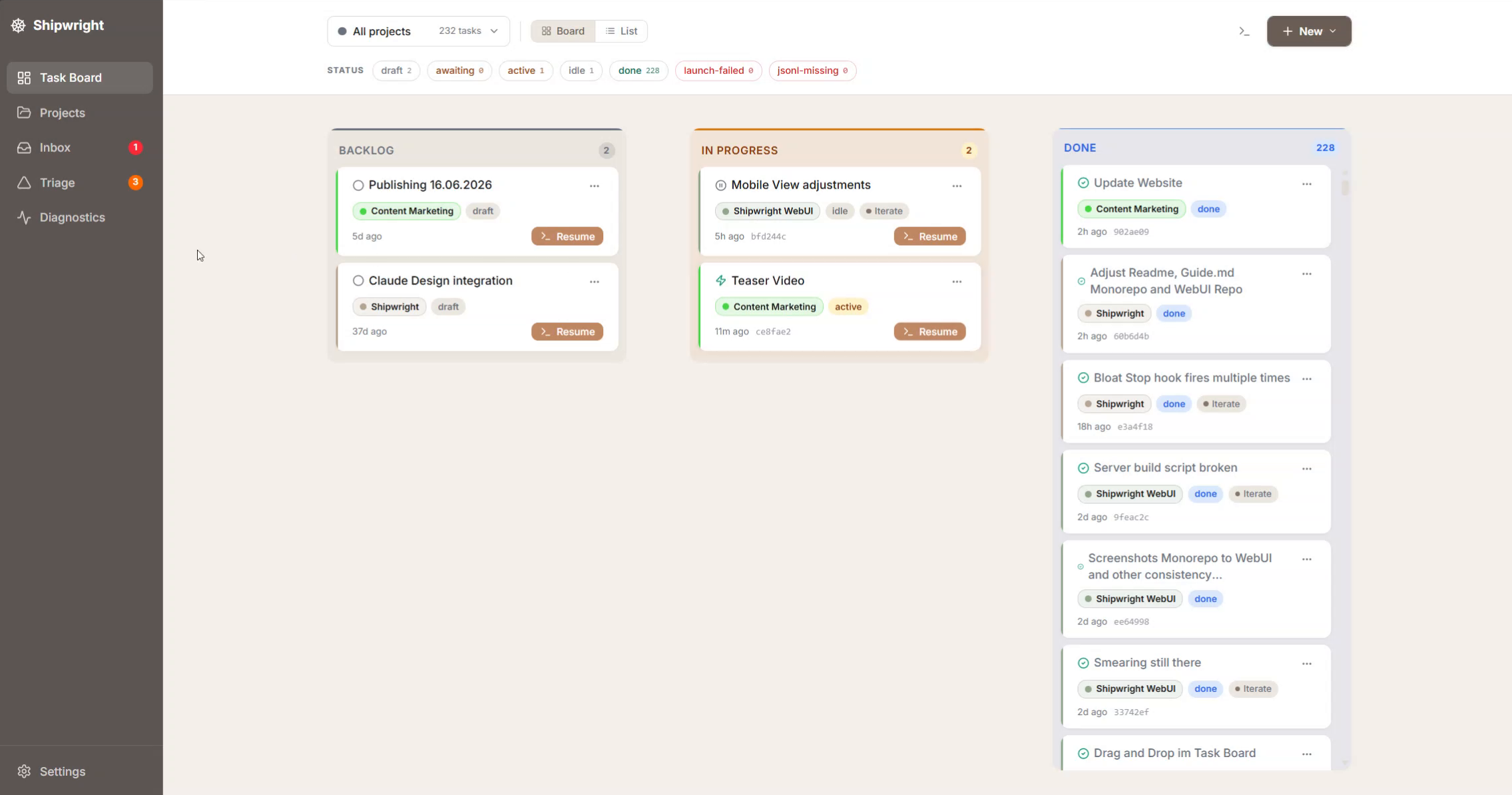 | 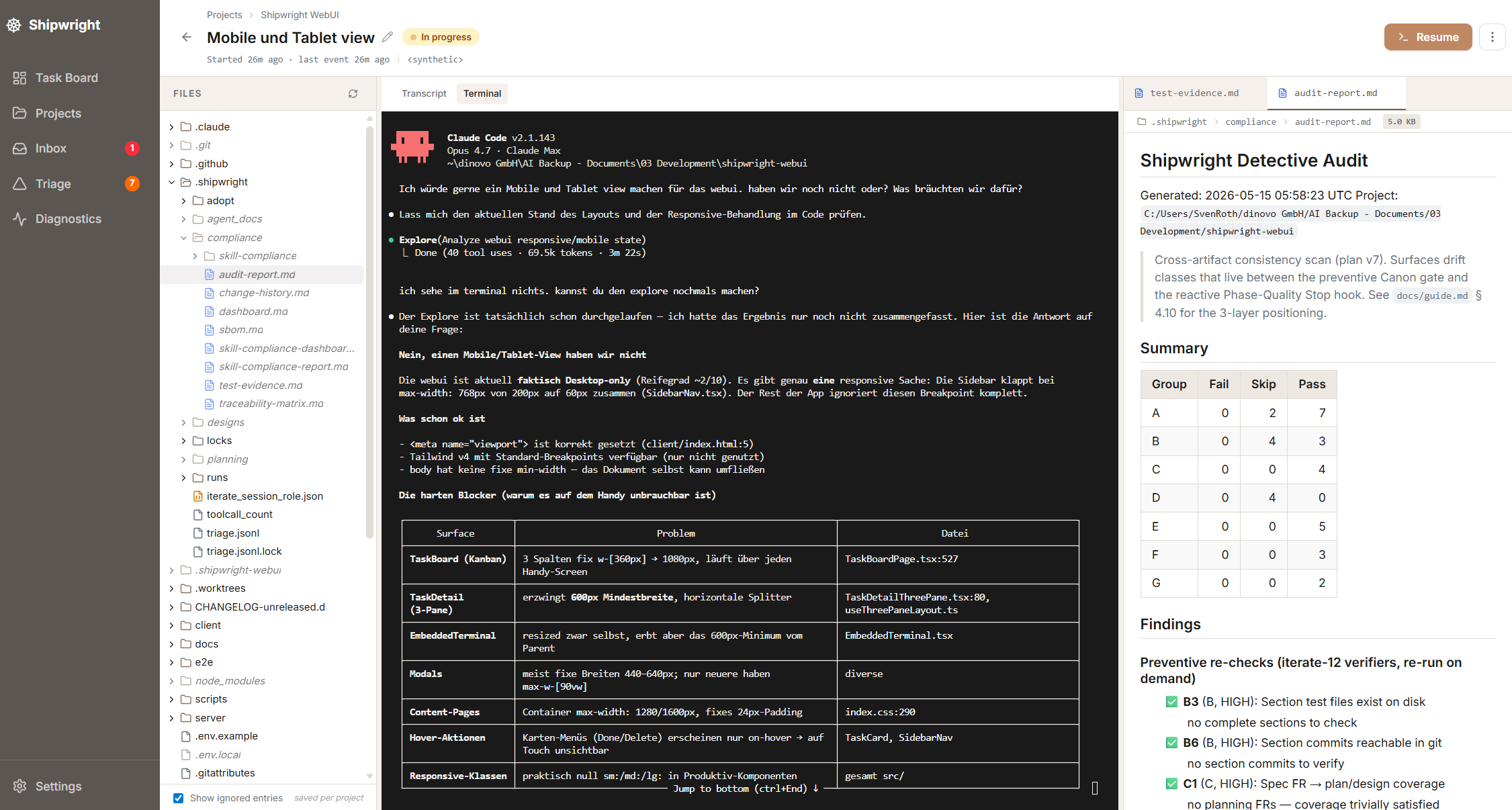 |
| Kanban board across every Shipwright project: Backlog, In Progress, In Review, Done. One place to see where everything stands. | Task detail: embedded terminal, Project File Viewer, Markdown Editor. |
The Command Center is the browser surface for the same skills you run in the terminal or VS Code Extension. Instead of keeping 4 terminal windows or VS Code sessions open for 4 projects, you get one kanban board, one inbox for agent questions, and one place to launch a new pipeline or iterate. When you launch, the claude command runs in an embedded terminal on the task page, and the Command Center follows the session live. It lives in its own repo. See Start the Command Center.
/shipwright-run, iterate daily with /shipwright-iterate, or invoke any single skill on its own.main runs through the same pipeline, scanner chain, and compliance gates it ships to you.npx claudepluginhub svenroth-ai/shipwright --plugin shipwright-adoptImplement code from /shipwright-plan sections with TDD, code review, Conventional Commits, and git workflow
 svenroth-ai
AI-assisted deep planning with research, interview, external LLM review, and TDD approach
svenroth-aiComplexity-adaptive SDLC for ongoing changes. Auto-detects intent + complexity, scales from quick fix to structured feature with specs, plans, reviews, and testing.
svenroth-aiGrade any git repository against the Control Grade rubric — a read-only, deterministic cold-repo grader that reuses the same scoring engine as the compliance dashboard and certification. Underivable dimensions render honest n/a.
svenroth-aiLocal browser preview for Shipwright projects — starts dev server and shows URL
svenroth-aiv9.54.1 — Reliability wave: tangle contextual review correction loop with hard round ceiling, progress-supervised review rounds (per-agent stall watch, descendant-tree kills), council diversity and agy pin fixes, marketplace generator source-of-truth fix, provider troubleshooting runbook and cost-expectations docs. Run /octo:setup.
 nyldn
nyldnClaude + Obsidian knowledge companion. Sets up a persistent, compounding wiki vault (Karpathy's LLM Wiki pattern). v1.7 "Compound Vault" + v1.8 methodology modes close 5 of 5 priority gaps from the May 2026 compass artifact. Ships: substrate alignment with kepano/obsidian-skills, default Obsidian CLI transport, hybrid retrieval (contextual prefix + BM25 + cosine rerank per Anthropic's Sept 2024 research), per-file advisory locking for multi-writer safety, pre-commit verifier agent, AND methodology modes (LYT / PARA / Zettelkasten / Generic) for first-class organizational support no other Claude+Obsidian competitor offers. v1.7.x audit closure: every BLOCKER + HIGH + MEDIUM + LOW finding from the v1.7.0 audit is CLOSED or DEFERRED-with-rationale. Optional DragonScale Memory extension (log folds, deterministic addresses, semantic tiling lint, boundary-first autoresearch).
 AgriciDaniel
Complete AI coding workflow system. Self-correcting memory + persistent FTS5-indexed research wikis + auto-research loop + multi-LLM council on a single SQLite store. 41 skills, 8 agents, 23 commands, 37 hook scripts across 24 events. Cross-agent via skills add.
 rohitg00
Access official Microsoft documentation, API references, and code samples for Azure, .NET, Windows, and more.
 MicrosoftDocs
Full API lifecycle management for Claude Code. Sync collections, generate client code, discover APIs, run tests, create mocks, publish docs, and audit security. Powered by the Postman MCP Server.
 Postman-Devrel
Comprehensive C4 architecture documentation workflow with bottom-up code analysis, component synthesis, container mapping, and context diagram generation
 wshobson
'%20stop-opacity%3D'0.16'%2F%3E%3Cstop%20offset%3D'1'%20stop-color%3D'rgb(200%2C90%2C60)'%20stop-opacity%3D'0.03'%2F%3E%3C%2FlinearGradient%3E%3C%2Fdefs%3E%3Crect%20width%3D'320'%20height%3D'200'%20fill%3D'url(%23g)'%2F%3E%3Ccircle%20cx%3D'250'%20cy%3D'56'%20r%3D'92'%20fill%3D'rgb(200%2C90%2C60)'%20fill-opacity%3D'0.06'%2F%3E%3Ccircle%20cx%3D'64'%20cy%3D'172'%20r%3D'58'%20fill%3D'rgb(200%2C90%2C60)'%20fill-opacity%3D'0.05'%2F%3E%3C%2Fsvg%3E)
