Stats
Actions
Available In
Tags

Enforce a specification-first development workflow with structural gates, multi-agent verification, and pair programming modes. Automatically generate seed specs from interviews, decompose into atomic tasks, run continuous validation, and evolve specs after failures. Includes Socratic ambiguity reduction, rollback, and deadlock-breaking perspectives.
Break seed AC into atomic layer-aware tasks BEFORE /run. USE WHENEVER implementation spans multiple files or layers. Prevents mega-prompts; each unit is independently implementable and testable.
Run 3-stage verification (Mechanical gates → Semantic AC compliance → Judgment quality) after /run. ALWAYS run before committing. Blocks at Stage 1 failures — no Stage 2 until gates pass.
Evolve the system when /evaluate fails. Runs Wonder → Reflect → Re-seed cycle with fan-out multi-perspective analysis (Contrarian + Simplifier + Researcher). Stops at convergence (ontology similarity ≥ 0.95).
Interactive installation wizard for AI Harness Template. Guides through version, track, permissions, gates, and more via step-by-step questions.
START HERE for ANY new feature or unclear requirement. Socratic interview that surfaces hidden assumptions before a single line of code is written. Measures 4D ambiguity score — blocks progress until score ≤ 0.2.
USE THIS WHEN symptoms keep recurring, layer boundaries blur, or changes ripple unexpectedly. ALWAYS invoke for structural diagnosis during /unstuck or major refactors. Finds root causes in design, not symptoms. Names tradeoffs explicitly.
USE THIS WHEN the team reaches quick consensus, before committing to a major design decision, or during /evolve and /unstuck. Challenges assumptions with "what if we're wrong?" scenarios. Always proposes at least one alternative.
USE THIS WHEN verifying implementation against a seed spec, running gates, or assessing AC compliance. ALWAYS invoke during /evaluate. Never fixes — only judges Pass/Fail with file:line evidence. Runs 3-stage verification (Mechanical → Semantic → Judgment).
USE THIS WHEN the official path is blocked, a deadline looms, or a temporary workaround is acceptable. ALWAYS invoke during /unstuck when standard approaches fail. Finds safe bypasses (monkey-patch, polyfill, shim) with explicit expiry dates.
USE PROACTIVELY whenever the user describes a new feature, vague requirement, or unclear goal. ALWAYS run BEFORE writing code or creating a seed spec. Asks Socratic questions to surface hidden assumptions. Never writes code or gives answers — only questions.
Uses power tools
Uses Bash, Write, or Edit tools
Own this plugin?
Verify ownership to unlock analytics, metadata editing, and a verified badge. GitHub access is read-only (username + org membership).
Sign in to claimOwn this plugin?
Verify ownership to unlock analytics, metadata editing, and a verified badge. GitHub access is read-only (username + org membership).
Sign in to claimBased on adoption, maintenance, documentation, and repository signals. Not a security audit or endorsement.
한국어 · English
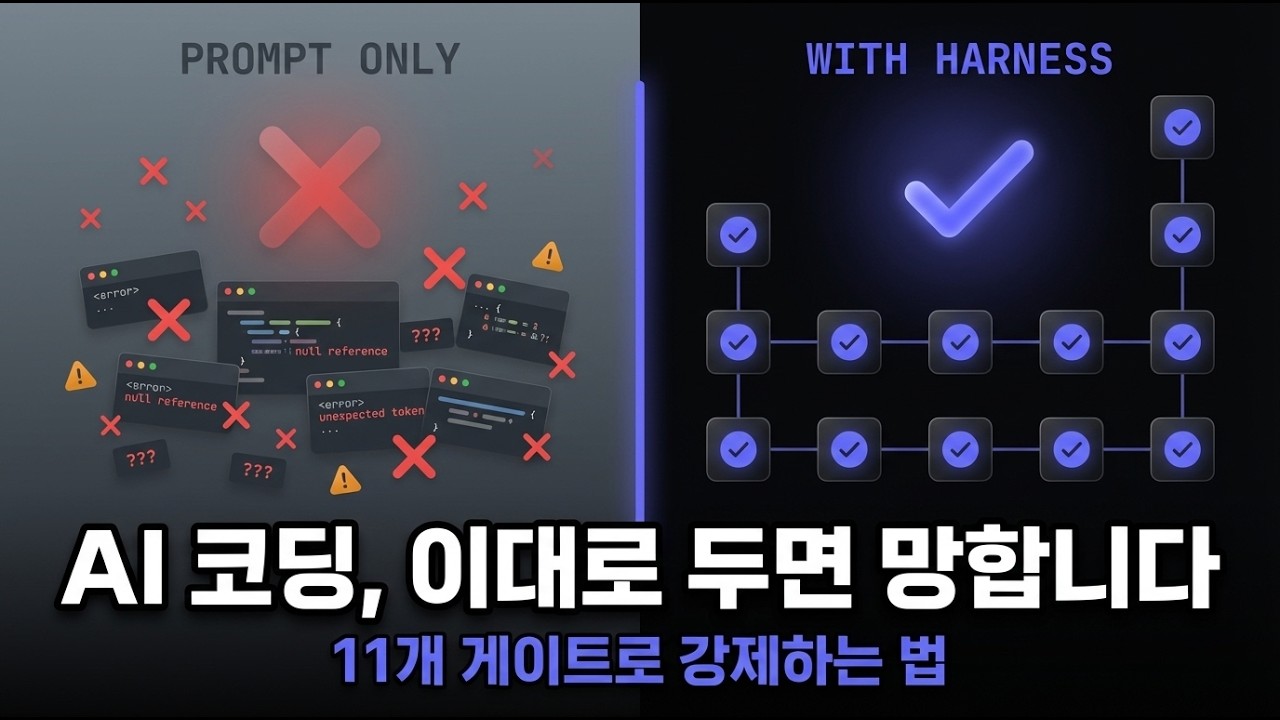
AI 에이전트가 자율적으로 일하되, 안전하게 통제할 수 있는 환경을 만드는 템플릿. Harness(구조적 가드레일) + Ouroboros(명세 기반 개발) + 3-Tier Layered Architecture를 통합.
"프롬프트는 부탁이고, 하네스는 강제다." "프롬프팅을 멈추고, 명세부터 시작하라."
권장 설치:
v2.6.0(최신 안정). 모든 릴리즈가stable상태이며, 메서드 번들은/methodology커맨드로 선택 활성화합니다.
| 버전 | 날짜 | 상태 | 주요 변경 |
|---|---|---|---|
| v2.6.0 | 2026-05-15 | stable ⭐ 권장 | Isolated AI Security Gate — 코딩 에이전트와 완전히 분리된 보안 전용 에이전트. 확증 편향 없이 취약점 탐지. claude CLI(Pro/Max) 우선, ANTHROPIC_API_KEY 폴백. critical/high 발견 시 커밋 차단. (NON-BREAKING) |
| v2.5.3 | 2026-05-06 | stable | Workflow Gate Fix — AI가 /seed 후 /trd·/decompose를 건너뛰고 /run으로 직행하던 구조적 버그 수정. CLAUDE.md 워크플로우 다이어그램, seed 완료 메시지, /run Prerequisites 3곳 동시 수정. (NON-BREAKING) |
| v2.5.2 | 2026-05-04 | stable | AI Behavioral Baseline — Karpathy 4원칙을 CLAUDE.md에 통합. 메서드 선택과 무관하게 항상 적용. check-surgical-changes opt-in 게이트 추가. (NON-BREAKING) |
| v2.5.0 | 2026-05-01 | stable | 메서드 16종 완성 — ddd-lite·bdd·shape-up 포함 총 16종 번들 확정. /install 마법사에서 Lean/Dev/Domain/Full 선택 설치 지원. (NON-BREAKING) |
| v2.2.0 | 2026-04-29 | stable | Methodology Plugin System — 하네스 코어 고정, 개발 방법론 플러그인 분리. /methodology compose <a> <b> 다중 활성화. (NON-BREAKING) |
| v2.1.0 | 2026-04-19 | stable | Pair Mode — AC complexity 기반 선택적 활성화, Navigator를 persistent background agent로 전환 (SendMessage 양방향 통신), Test Designer worktree 격리, Mixed Mode (direct+pair 혼합), 자동 /review 체크포인트. PairCoder(ASE 2024) + AgentCoder 논문 기반. |
| v2.0.0 | 2026-04-12 | stable | Unified layout — .ouroboros/를 .harness/ouroboros/로 통합. opt-in 게이트 4종 분리. (BREAKING) |
| v1.0.0 | 2026-04-12 | stable | 최초 릴리즈 — 11 게이트, 10 커맨드, 9 에이전트, 3-Tier 아키텍처 강제. |
메서드 번들 도입 가이드:
stable. /methodology list로 확인, /methodology use <name>으로 활성화.Lean(ouroboros) 또는 Dev(ouroboros + bdd + tdd-strict + exploration) 번들 권장.1분 요약
https://github.com/user-attachments/assets/87a778e3-1fee-451e-9e18-f0cda740e7da
풀버전 (5분) —
┌───────────────────────────────────────────────────────────────────┐
│  OUROBOROS (명세 기반 개발 루프)                                    │
│  /interview → /seed → /trd → /decompose → /run → /evaluate       │
│       ↑                                                │          │
│       └──────── /evolve (수렴까지 반복) ────────────────┘          │
└───────────────────────────────────────────────────────────────────┘
                          ↕ (강제됨)
┌───────────────────────────────────────────────────────────────────┐
│  HARNESS GATES (12개 구조적 가드레일)                               │
│  boundaries | layers | secrets | security | structure | spec       │
│  | complexity | deps | mutation | performance | ai-antipatterns    │
│  | security-ai                                                      │
└───────────────────────────────────────────────────────────────────┘
                          ↕ (학습됨)
┌───────────────────────────────────────────────────────────────────┐
│  FEEDBACK LOOP (자기 강화)                                         │
│  위반 감지 → 분류 → 규칙 추가 → 게이트 반영 → 시스템 강건화          │
└───────────────────────────────────────────────────────────────────┘
npx claudepluginhub studiokjm/ai-harness-templateA suite of expert AI agents and skills implementing Harness Engineering — autonomous TDD/DDD orchestration, phase-isolated agents, adversarial QA, critical code review, and persistent project memory for disciplined, high-quality software engineering workflows.
 romabeckman
Session harness plugin for Claude Code workflow automation
 modakbul-gongbang
Harness Engineering framework - skills, agents, and commands for safe, reviewable, incremental agent-driven development. Includes RPEQ workflow (Research, Plan, Execute, QA), ast-grep setup, and codebase analysis tools.
 alchemiststudiosDOTai
HarnessFlow — a three-layer skill suite for stable AI coding: main-chain discipline (SDD + TDD) along frame -> plan -> build -> verify -> ship, mechanical gates (hf_gate.py evidence logs + stage adjudication), and pluggable ext-* domain extensions.
 hujianbest
Elite AI development framework: reference-first design, agent orchestration, automated quality gates, and battle-tested engineering workflows
 NoobyGains
Makes a repo agent-ready: AGENTS.md, boundary tests, CI pipeline, GC scripts — based on OpenAI's harness engineering methodology
 Gizele1
'%20stop-opacity%3D'0.16'%2F%3E%3Cstop%20offset%3D'1'%20stop-color%3D'rgb(200%2C90%2C60)'%20stop-opacity%3D'0.03'%2F%3E%3C%2FlinearGradient%3E%3C%2Fdefs%3E%3Crect%20width%3D'320'%20height%3D'200'%20fill%3D'url(%23g)'%2F%3E%3Ccircle%20cx%3D'250'%20cy%3D'56'%20r%3D'92'%20fill%3D'rgb(200%2C90%2C60)'%20fill-opacity%3D'0.06'%2F%3E%3Ccircle%20cx%3D'64'%20cy%3D'172'%20r%3D'58'%20fill%3D'rgb(200%2C90%2C60)'%20fill-opacity%3D'0.05'%2F%3E%3C%2Fsvg%3E)
