Stats
Actions
Available In
Tags

Build and maintain a portable knowledge base using Open Knowledge Format (OKF) bundles. Ingest notes, transcripts, emails, PDFs, images, and web pages, extracting entities and cross-links so knowledge compounds over time. Includes scaffolding, querying, health-checking with contradiction detection, and interactive graph visualization.
Render a knowledge bundle as an interactive graph — native UI where the host supports it, otherwise a self-contained HTML artifact.
Portable OKF knowledge bundle for coding-agent memory and LLM wikis. Use when the user wants to start a wiki, ingest a source, query project knowledge with citations, lint for drift, or visualize connections; whenever a repo has a knowledge/ bundle that should inform the task; and when another kb-* skill needs the shared spec, glossary, templates, or trust model.
Ingest a source into the knowledge bundle. Use when the user wants to capture, ingest, file, process, or "add this" — a note, transcript, email, PDF, image, web page, or any raw source — into a knowledge/ bundle, or drops content for processing. Reads the source once, extracts its signal, and integrates it across the bundle under the trust model so knowledge compounds instead of being re-derived per query.
Scaffold a new OKF knowledge bundle in this project — run when starting a wiki or adding a bundle under knowledge/.
Health-check a knowledge bundle for conformance and drift; optionally auto-fix safe issues.
Own this plugin?
Verify ownership to unlock analytics, metadata editing, and a verified badge. GitHub access is read-only (username + org membership).
Sign in to claimOwn this plugin?
Verify ownership to unlock analytics, metadata editing, and a verified badge. GitHub access is read-only (username + org membership).
Sign in to claimBased on adoption, maintenance, documentation, and repository signals. Not a security audit or endorsement.
Give your coding agent a knowledge base that gets better over time.
agent-knowledge turns project documents, decisions, notes, and conversations into a portable
Markdown wiki that your agent maintains for you. Ask a question and get a cited answer. Add a source
and the agent integrates it with what the project already knows. Run a health check and it finds
stale claims, contradictions, and orphaned pages before the wiki quietly rots.
Everything stays in your repository as plain Markdown + Git: readable without special tooling, diffable in code review, and portable across agents.
Via skills.sh for Claude Code, Cursor, Codex, and 20+ other agents:
npx skills@latest add stjbrown/agent-knowledge
Or install it as a Claude Code plugin:
/plugin marketplace add stjbrown/agent-knowledge
/plugin install agent-knowledge
Start a knowledge base in any project:
/kb-init
Then use ordinary prompts:
Ingest this architecture decision: we chose Postgres because...

What do we know about authentication, and which sources support it?

What conflicts with our current deployment strategy?
The agent extracts durable knowledge, connects it to existing concepts, answers with citations, and files valuable new conclusions back into the bundle. Two explicit commands handle maintenance:
/kb-lint       # find broken links, stale claims, contradictions, and gaps
/kb-visualize  # explore the bundle as an interactive graph
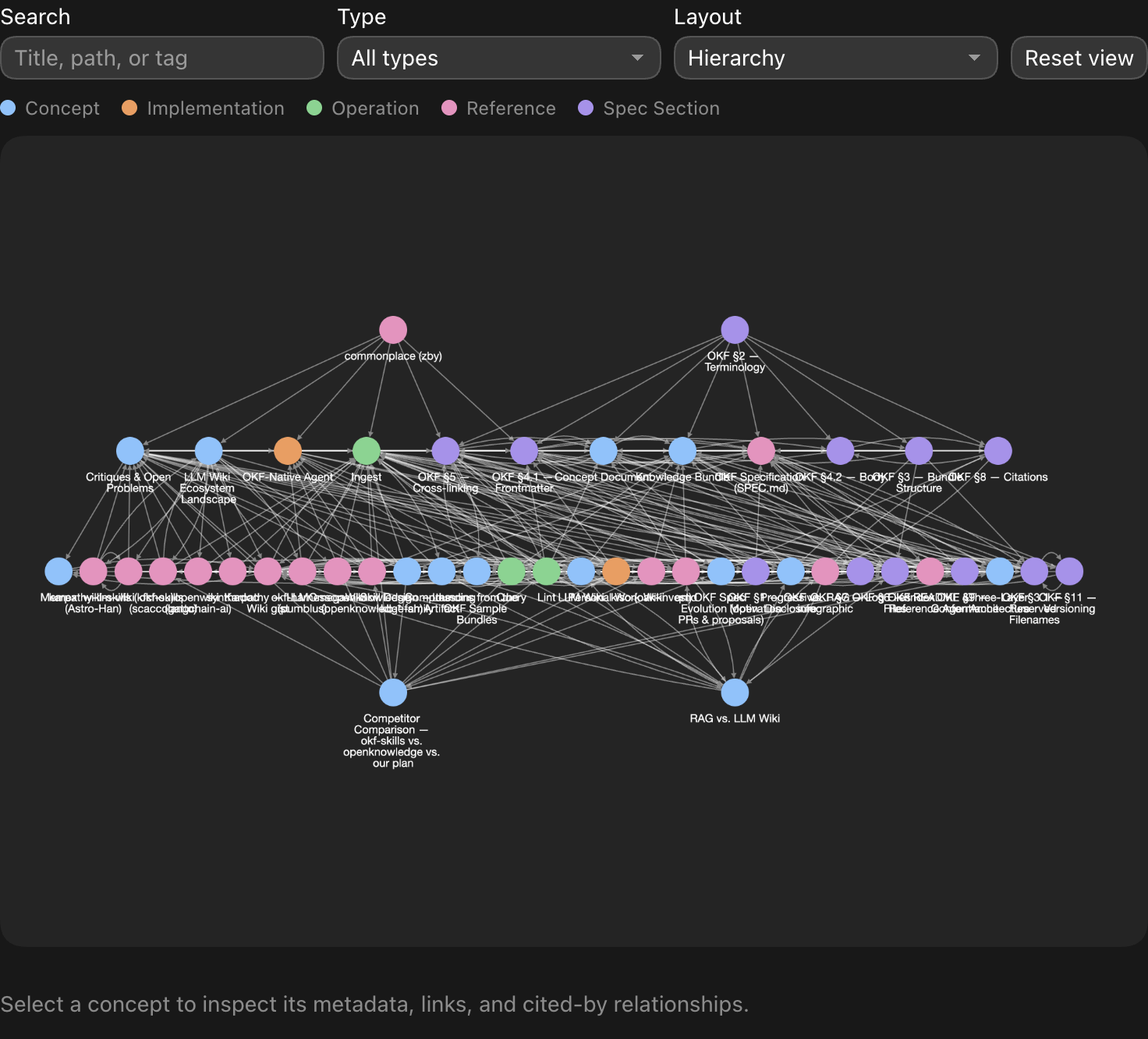
The knowledge/ directory is a complete working example. It documents this project
using the same format and skills the project provides.
Most agent "memory" is either retrieval over raw documents or a pile of notes that nobody maintains. The first repeatedly re-derives answers; the second gradually becomes untrustworthy. Neither makes knowledge stewardship an explicit job.
The hard part of a useful knowledge base is the bookkeeping: integrating new information, updating cross-references, preserving provenance, flagging contradictions, and keeping summaries current. That is exactly the work an agent can perform consistently.
agent-knowledge makes the agent a disciplined wiki maintainer:
Two design choices keep the result portable and trustworthy:
The workflow is based on Andrej Karpathy's LLM Wiki pattern, made conformant to OKF and packaged as skills you can drop into any project.
The family splits on who invokes them. Model-invoked skills the agent can reach for on its own when the task fits; user-invoked skills you trigger deliberately by name.
Model-invoked
kb — the hub. Explains the format, holds the shared spec / glossary / trust model /
templates, and routes to the right skill. Other kb-* skills read its reference as their single
source of truth.kb-ingest — read a raw source once, extract its signal, and integrate it across the bundle
under the trust model. The heart of the system.kb-query — answer a question from the bundle (or surface relevant context for another task)
by progressive disclosure, cite the concepts used, and file valuable answers back so the base
compounds.User-invoked
kb-init — scaffold a new bundle (default knowledge/, custom path, multi-bundle aware) and
write its per-project schema layer (concept types + conventions) so the generic skills fit your
domain.kb-lint — health-check the bundle: a deterministic OKF conformance pass plus a drift audit
(contradictions, stale claims, orphans, coverage gaps), with an optional safe fix mode.kb-visualize — render the bundle as an interactive graph — native UI where the host supports
it, otherwise a self-contained HTML file.npx claudepluginhub stjbrown/agent-knowledgeAI-powered knowledge base management - Capture conversation learnings, maintain topic-specific KB files, Obsidian-compatible knowledge graph, structured dynamic context loading, and institutional knowledge in CLAUDE.md
 charlesjones-dev
Indexed knowledge bases with command-line tools for agents.
 plasma-ai
Build and maintain an LLM-curated personal knowledge base in your project — Andrej Karpathy's LLM Wiki pattern, designed to scale to thousands of pages without becoming a context bottleneck. Now with an optional compiled graph layer for typed, provenance-backed relationships.
 praneybehl
Navigate an OpenKB-compiled wiki: discover documents and concepts via openkb CLI commands, read concept and summary pages directly, and follow wikilinks across the knowledge graph.
 VectifyAI
Karpathy-style local-first LLM Wiki / Knowledge Compiler for Claude Code. Ingest sources, build a structured markdown knowledge base, and maintain it with AI-powered workflows.
 bradduy
A persistent LLM-maintained wiki for your knowledge base. Ingest sources, query your knowledge, and lint for consistency.
 cooperacode
'%20stop-opacity%3D'0.16'%2F%3E%3Cstop%20offset%3D'1'%20stop-color%3D'rgb(200%2C90%2C60)'%20stop-opacity%3D'0.03'%2F%3E%3C%2FlinearGradient%3E%3C%2Fdefs%3E%3Crect%20width%3D'320'%20height%3D'200'%20fill%3D'url(%23g)'%2F%3E%3Ccircle%20cx%3D'250'%20cy%3D'56'%20r%3D'92'%20fill%3D'rgb(200%2C90%2C60)'%20fill-opacity%3D'0.06'%2F%3E%3Ccircle%20cx%3D'64'%20cy%3D'172'%20r%3D'58'%20fill%3D'rgb(200%2C90%2C60)'%20fill-opacity%3D'0.05'%2F%3E%3C%2Fsvg%3E)